

Painting History – One Stroke at a Time
When landscapes and street markets disappear, visual artist Yip Yew Chong preserves them in their fading glory, recreating paintings informed by maps, memory and archival photos.
By Ruth Wee
10 December 2025
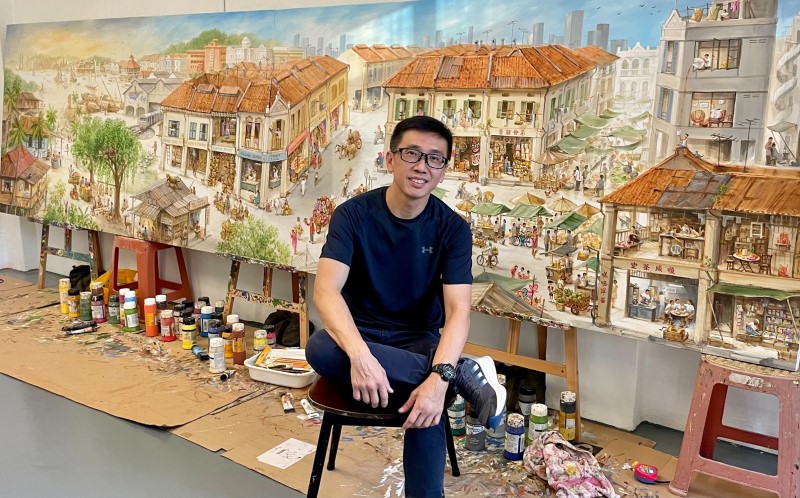 Yip Yew Chong with a section of his 60-metre-long painting, “I Paint my Singapore” (2023). Courtesy of Yip Yew Chong.
In a city where continuous progress is often at conflict with preservation, old buildings tend to make way for gleaming new structures. Landmarks that once stood on solid ground now reside solely in memory, their physical presence replaced by modernisation.
To remember old landscapes, visual artist Yip Yew Chong relies on his paintbrush. His journey began in 2015 when he convinced a homeowner to let him paint a mural of a barbershop on a wall for free. This eventually resulted in a plethora of murals scattered around Singapore today. These murals typically reflect scenes of everyday life in a bygone Singapore.1 Yip has since expanded his artistic repertoire to include canvas paintings, digital artworks and even painting on household items, skilfully documenting his impressions of the Singapore he grew up in.2
Beyond Mere Nostalgia
Many of Yip’s works are scenes based on Singapore’s past. These works rely on a combination of memory, research and imagination. “Trengganu Street Market” (2020) captures a wet market scene from the 1970s. This work in his Stories from Yesteryear series (2017–21) features itinerant hawkers selling their wares at makeshift stalls along Sago Street, Smith Street, Temple Street and Pagoda Street, sheltered from the elements by scant canvas material stretched across poles.3
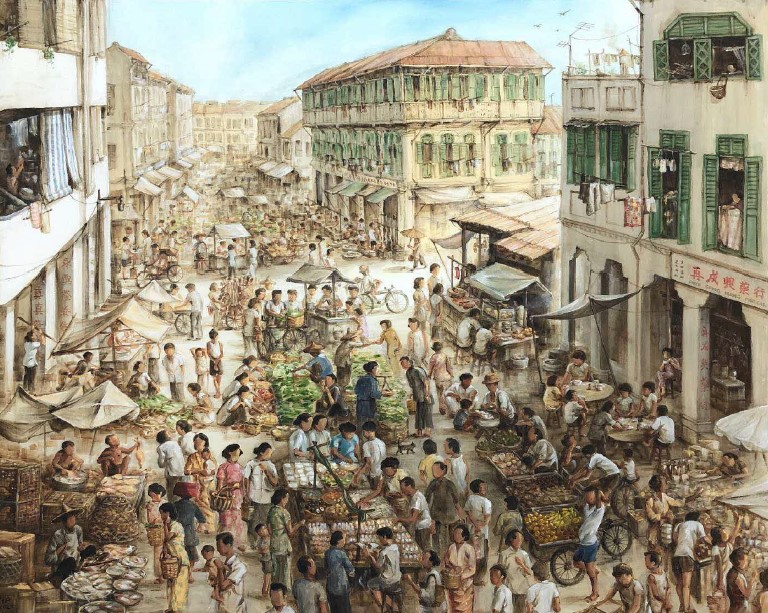 “Trengganu Street Market” (2020). Yip Yew Chong’s rendition of a busy market scene in Chinatown in the 1970s. Courtesy of Yip Yew Chong.
In 1983, most of these street hawkers were resettled into Chinatown Complex (originally known as Kreta Ayer Complex), emptying the streets of Chinatown of its bustling market life.4 For Yip, painting this lively scene in Chinatown evoked vivid memories and allowed him to relive his childhood – something he hopes his paintings do for other Singaporeans too. “I am conscious of how my work affects people,” he said in a book about his work, Art of Joy. “As much as my art is drawn from my imagination, it also lives through the imagination of the people who see it.”5
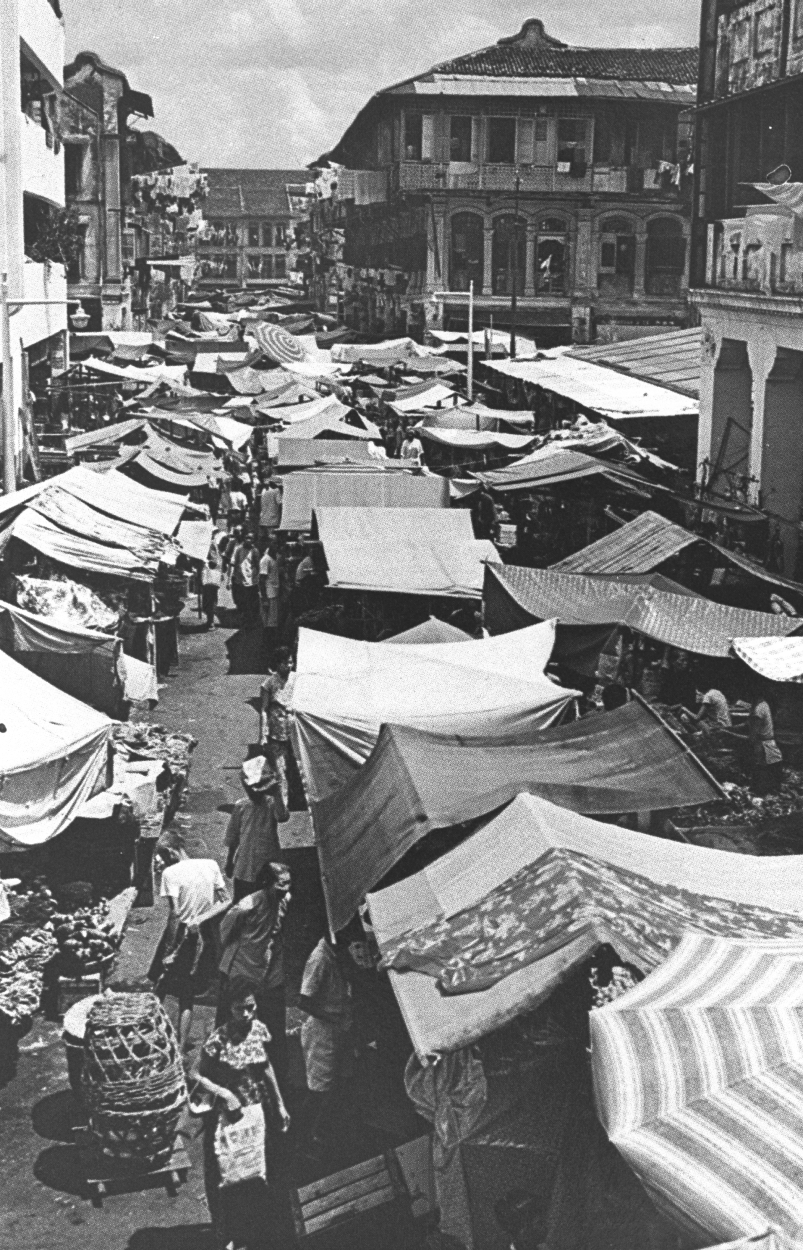 A wet market on Trengganu Street, Chinatown, c. 1960. In the background is the former Lai Chun Yuen Opera House. Courtesy of National Archives Singapore (Media - Image no. 19980005922 - 0089).
In works like “Trengganu Street Market”, Yip was drew from his own memories growing up in Chinatown. However, in other works, archival research and old photographs play a bigger role. In “Preparing for the Haj” (2020), the canvas captures a cross-section of Bussorah Street bustling with activities surrounding the Haj preparations, with the grand Masjid Sultan (Sultan Mosque) in the background.6
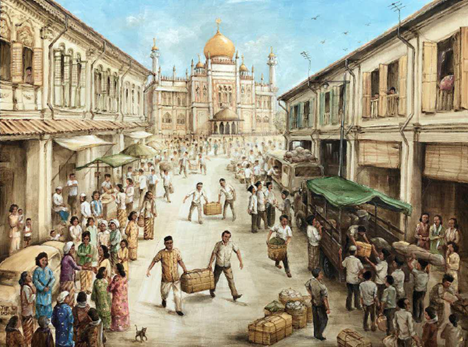 “Preparing for the Haj” (2020) captures the Haj preparations on Bussorah Street, with Sultan Mosque in the backgrounds. Courtesy of Yip Yew Chong.
The work shows, among other things, two men walking down Bussorah Street, jointly carrying a trunk, while several others load luggage onto trucks as women gather nearby, waiting to bid farewell to departing pilgrims. These two elements in the painting were inspired by photograps that can be found in the National Archives of Singapore.
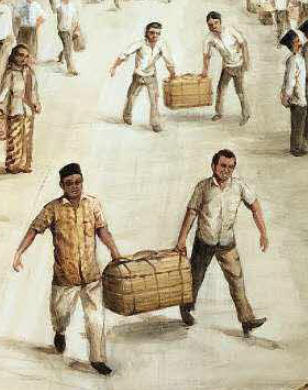 A close-up view of men walking down Bussorah Street in “Preparing for the Haj”. Courtesy of Yip Yew Chong.
“I imagined these viewpoints based on a mixture of old street level photos, present day aerial views (Google Maps), and old maps. Most scenes show condensed versions of real places, selectively showcasing the more iconic or representative infrastructures and leaving out the more repetitive buildings around them. It is like a composite drawing but painted in a more realistic than illustrative style.”7
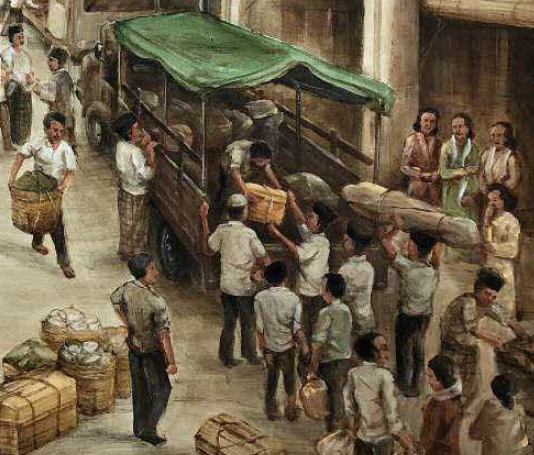 Men loading the luggage onto the truck in “Preparing for the Haj”. Courtesy of Yip Yew Chong.
A Personal Connection
Some of his paintings also weave in tiny personal stories. His 2019 painting, “New Year’s Eve”, depicts an older woman waiting alone in her room while Yip’s family enjoys a reunion gathering in the adjoining room – a deliberate and sharp contrast highlighting isolation amid celebration.
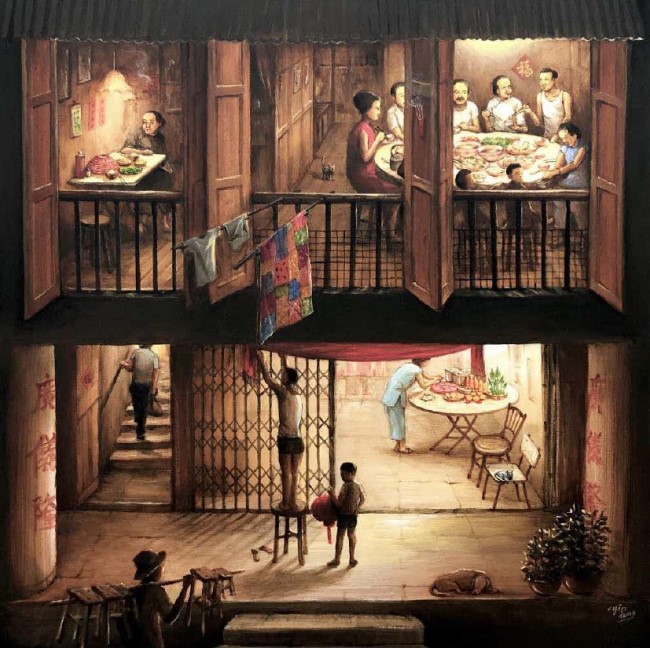 In “New Year’s Eve” (2019), Dai Soh sits alone in her room while Yip Yew Chong’s family celebrates next door. Courtesy of Yip Yew Chong.
The woman is Dai Soh, an elderly woman who was a co-tenant in Yip’s old Chinatown home on Sago Lane and had two sons. One suffered from a compulsive condition and “couldn’t control himself and would throw his mother’s things in the house”. The other was “well-educated and married to a rich girl, [but] was ashamed of his poor background”. This son never returned to visit his mother, only sending her some money monthly.8
A character in Dai Soh’s likeness has appeared in several other paintings. “I created her because I want to remember Dai Soh,” he said. “I insert[ed] a poor old lady, begging, picking up crumbs on tables. Although my artworks depict positive and happy energy, I also want to be realistic [in showing] that amongst us there are always those less fortunate that we need to be mindful of. If the observer looks hard enough, he will see this figure, not prominent, but she is there in my paintings.”9
For Yip, preserving Singapore’s past means capturing not just its iconic landmarks but also stories of quiet, ordinary characters that would otherwise be forgotten.
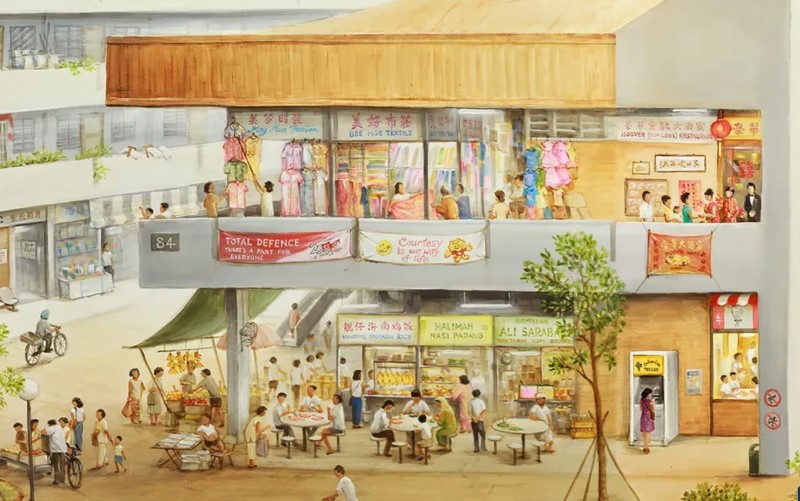 A figure resembling Dai Soh begs in the foreground of Yip Yew Chong’s “I Paint my Singapore” (2023). Courtesy of Yip Yew Chong.
From History to the Future
These days in Singapore, Yip spends most of his time on canvases, creating digital artworks and working on installations. The well-received “I Paint my Singapore” exhibited in the foyer of the Raffles City Convention Centre from late 2023 to early 2024 is a case in point. The 60-metre-long work captures Singapore in the 1970s and 1980s, and was done with acrylic on canvas.
He has not given up on murals though. However, rather than painting them in Singapore, many of his recent murals have been outside Singapore, in cities like Perth, Australia, and Wuhan, China. At exit B of Wuhan’s Garden Expo metro station, his “Old Hankou Quay” mural (“老汉口码头” 壁画) recreates scenes of daily life at the quays along the Yangtze and Han rivers in the 1920s. For this project, he referenced old photographs online to capture scenes from a century ago while consulting heritage experts to ensure accurate representation.
Yip’s works, especially his murals, are unique. The works combine research, memory, artistic talent and accessibility to help make history come to life. In Wuhan, he wrote on his Instagram feed that he had observed older folks being inspired by his work to talk about their childhood. In a similar way, during his exhibition of “I Paint my Singapore”, those who came would gaze at different scenes and share their experiences with their peers. The ability of his work to get authentic engagement is a tribute to his skill as an artist and to the very human desire to connect with the past.
“I am not lamenting their loss,” Yip said about the vanishing landscapes he recreates. “I also love the modern efficiency and high living standard of today. My goal in presenting these scenes is to remind ourselves how far Singapore has progressed – educating the younger generations of how life used to be, while allowing the older generations to cherish fond memories of the days when life was much simpler and slower.”10
 Ruth Wee is an intern with the publishing department at the National Library Singapore. Ruth has a Bachelor of Arts (Honours) in English Language and Linguistics (Distinction) from the National University of Singapore.
Notes
-
Amanda Oon, “The Mural Artist Making Singapore’s Heritage Accessible,” Southeast Asia Globe, 16 December 2021, https://southeastasiaglobe.com/mural-artist-singapore-heritage-accessible-yip-yew-chong/. ↩
-
Karen Tee, “Singapore Street Artist Yip Yew Chong’s First Series of Nostalgic Paintings Sells out in a Flash,” CNA, 25 January 2021, https://www.channelnewsasia.com/people/singapore-street-artist-yip-yew-chong-paintings-1883626. ↩
-
Yip Yew Chong, “‘Stories from Yesteryear’ 2017–2021 Series,” Yip Yew Chong blog, accessed 30 October 2025, https://yipyc.com/blog/2023/06/10/stories-from-yesteryear-2017-2021-series/. An exhibition catalogue was published in conjunction with an exhibition of the same title, organised by and presented at The Substation, 17–22 February 2021, and Sofitel Singapore City Centre, 26 February–31 March 2021. ↩
-
Joanna Tan Hwang Soo, “Chinatown Complex,” Singapore Infopedia. Article published October 2020. ↩
-
Woon Tai Ho, Art of Joy: The Journey of Yip Yew Chong (Singapore: World Scientific, 2024), 3. (From National Library Singapore, call no. RSING 759.95957 WOO) ↩
-
Yip, “‘Stories from Yesteryear’ 2017–2021 Series.” ↩
-
Woon, Art of Joy, 206. ↩
-
Woon, Art of Joy, 18. ↩
-
Woon, Art of Joy, 110. ↩
-
“‘My Goal in Presenting These Scenes Is to Remind Ourselves How Far Singapore Has Progressed’: Yip Yew Chong,” On Art and Aesthetics, 14 January 2018, https://onartandaesthetics.com/2018/01/14/my-goal-in-presenting-these-scenes-is-to-remind-ourselves-how-far-singapore-has-progressed-yip-yew-chong/. ↩