

P Ramlee: The Singapore Years
The formative years of the legendary singer, actor and filmmaker P. Ramlee unfolded in Singapore, a city he not only helped to enliven through his presence and artistry but also captured with enduring vividness in his songs and films.
By Raphaël Millet
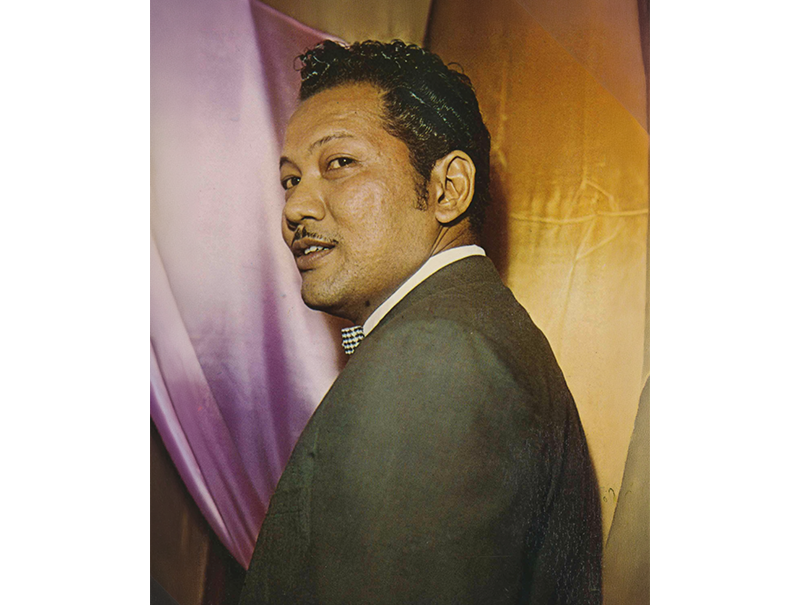
Memorials to the legendary singer, actor, filmmaker and musician P. Ramlee can be found around Malaysia. Jalan Parry in Kuala Lumpur was renamed Jalan P. Ramlee in 1982, and Caunter Hall Road (the house that he was born in was located on this street) in Georgetown, Penang, became Jalan P. Ramlee in 1983. His birthplace has since been restored and turned into a museum called Rumah P. Ramlee, while the P. Ramlee Memorial Library opened in 1986 in his former home in Setapak, Kuala Lumpur.1
Ramlee’s presence in Singapore, on the other hand, is much less visible. There are no roads named after him nor are there any museums dedicated to him. This is despite his years in Singapore, a little more than 15 in total, forming one of the most fertile chapters of his artistic life. Some of his more iconic films were actually made during his time in Singapore.
Beginnings at Jalan Ampas Studio
Ramlee was born Teuku Zakaria Teuku Nyak Puteh in Penang on 22 March 1929 into a household shaped by the island’s cosmopolitan rhythms and by his father’s Acehnese seafaring roots. Music drew him early, more deeply than formal schooling ever did, and during the disruptions of the Japanese Occupation, Ramlee found refuge in village ensembles, learning harmony by ear and later mastering musical notation. By the late 1940s, he was winning radio competitions and refining his stage identity – the name P. Ramlee – with its simple initial acknowledging his father, Teuku Nyak Puteh, and offering a clear, memorable signature.2
Ramlee’s path changed on 1 June 1948 when B.S. Rajhans, an Indian-born director working for Shaw Brothers, heard him singing keroncong (a traditional Indonesian musical style with Portuguese origins) in Penang.3 Rajhans invited him to join Malay Film Productions, the Shaw Brothers’s Malay-language studio on Jalan Ampas in Singapore, where he would record songs for soundtracks. He accepted, and a few weeks later, travelled south on 9 August carrying a violin.4
Ramlee’s audition at Shaw studio included “Azizah”, which he had composed after a youthful heartbreak. He was immediately taken on as a musician and playback singer in Chinta (Love, 1948) where he sang five songs composed by Zubir Said, who later wrote Singapore’s national anthem, “Majulah Singapura”. (A playback singer is a vocalist who records songs for films that actors then lip-sync on screen.) He also made his film debut in Chinta and was given a small part to play alongside actress Siput Sarawak, although the leading man was S. Roomai Noor for whom Ramlee provided the playback vocals.5
The Actor
After Chinta, other films – Noor Asmara (Light of Love), Nasib (Fate) and Nilam (Sapphire) (all three in 1949) – immediately beckoned in quick succession and each widened his range. In Bakti (Faithfulness, 1950), where he acted opposite Kasma Booty under L. Krishnan’s direction, Ramlee emerged as a true leading man, singing in his own voice and showing that he could inhabit character and melody with equal force.6 Takdir Ilahi (Will of God, 1950), also directed by Krishnan, cemented the impression.
In Krishnan’s Penghidupan (Life, 1951), Ramlee played a morally ambiguous drifter who preyed on women. It was his only collaboration with the star Maria Menado, and it drew criticism from the Malay Welfare Association for its perceived affront to Malay values. Yet it showed Ramlee’s readiness to inhabit darker, more complex roles. In Patah Hati (Broken Heart,1952) and Miskin (The Poor, 1952), both directed by K.M. Basker, Ramlee refined his dramatic sensibility by borrowing melodramatic elements from bangsawan (Malay opera) theatre and Indian cinema.7
B.N. Rao then cast him in some of his most compelling early performances, notably in Hujan Panas (Hot Rain, 1953) where he portrayed Amir, a musician lured by fame and undone by desire. This was followed by Malay Film Productions lavish Eastmancolor project, Hang Tuah (1956), where he took on the titular role as the 15th-century Melakan warrior.8
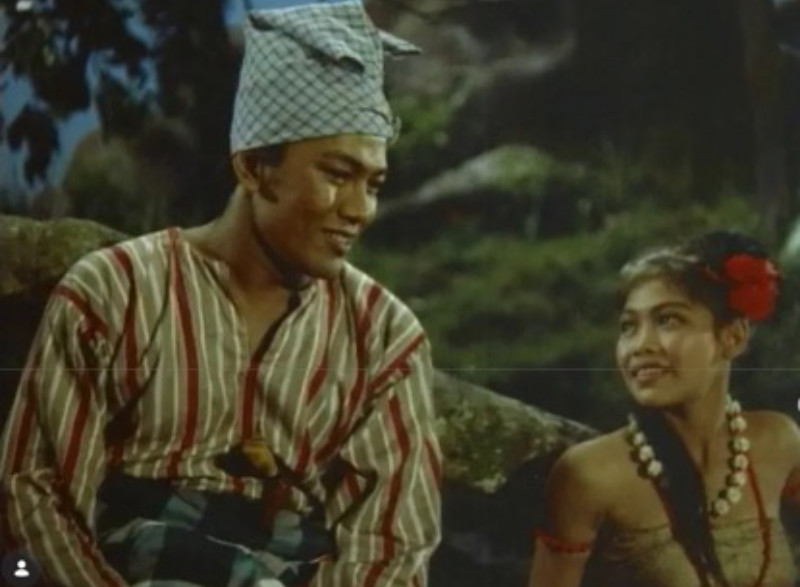
Ramlee’s versatility was on display in the neo-realist (a style of filmmaking focusing on ordinary people and everyday life) drama Anakku Sazali (My Son Sazali, 1956) where he played both father and son. He also demonstrated his flair for comedy with the Bujang Lapok series of five films, beginning with Bujang Lapok (Old Bachelor, 1957) where, alongside Aziz Sattar and S. Shamsuddin, he was one of three bachelors whose missteps through modernity reveal humour and vulnerability.9
The Singer
Not long after Ramlee came to Singapore to work as a background vocalist, he earned the reputation of a “golden voice”. By 1951, he was composing and performing the songs for the three films in which he appeared while also providing music for five others. Over the years, he wrote more than 500 songs and recorded about 350 of them himself.10
Ramlee’s musical language grew from the cosmopolitan soundscape of early 20th-century Singapore.11 The theatrical flair of bangsawan and the social rhythms of ronggeng (a traditional Javanese dance form) shaped his sensibility, while keroncong added its slow, swaying pulse. He wove these threads with Malay melodic lines, Anglo-American jazz harmonies, Latin inflections as well as influences from Javanese, Middle Eastern and Indian traditions. Its durability is clear in the enduring lives of songs like “Azizah”, “Getaran Jiwa”, “Engkau Laksana Bulan”, “Dendang Perantau”, “Joget Pahang”, “Tudung Periok”, “Malam Bulan Di Pagar Bintang”, “Dimanakan Ku Cari Ganti” and “Pukul Tiga Pagi”.12
The Filmmaker
Ramlee’s development as a filmmaker grew from years of close observation. He absorbed the working methods of the Indian directors who shaped early Malay cinema and learned precise camera craft from Chow Cheng Kok, the cinematographer for Bakti. In 1955, at just 26 years old (the same age Orson Welles was when he made Citizen Kane in 1941), Ramlee was given his first movie to direct. The decision marked an important shift in an industry long dependent on Indian filmmakers and signalled confidence in a Malay creative voice at the centre of a cosmopolitan studio system.
His debut effort, Penarek Becha (Trishaw Puller, 1955), set out his social and aesthetic compass.13 The use of real streets, incidental sound and unposed movement created an immediacy that critics later linked to neo-realist cinema.14 His shift from actor to director demonstrated that local Malay talent could helm major productions.
Across his early features, Ramlee sought breadth of form and theme. Semerah Padi (1956) drew on customs and moral choice.15 Antara Dua Darjat (Between Two Classes, 1960) explored class conflict with clarity and bite.16 Ibu Mertuaku (My Mother-in-Law, 1962) offered one of his finest performances as the blind musician Kassim Selamat moves through a vividly realised Singapore.17
His comedies, including Labu dan Labi (Labu and Labi, 1962), Madu Tiga (Three Wives, 1964) and Tiga Abdul (The Three Abduls, 1964), folded satire into everyday concerns of money, status and desire while retaining the allure of popular entertainment.18
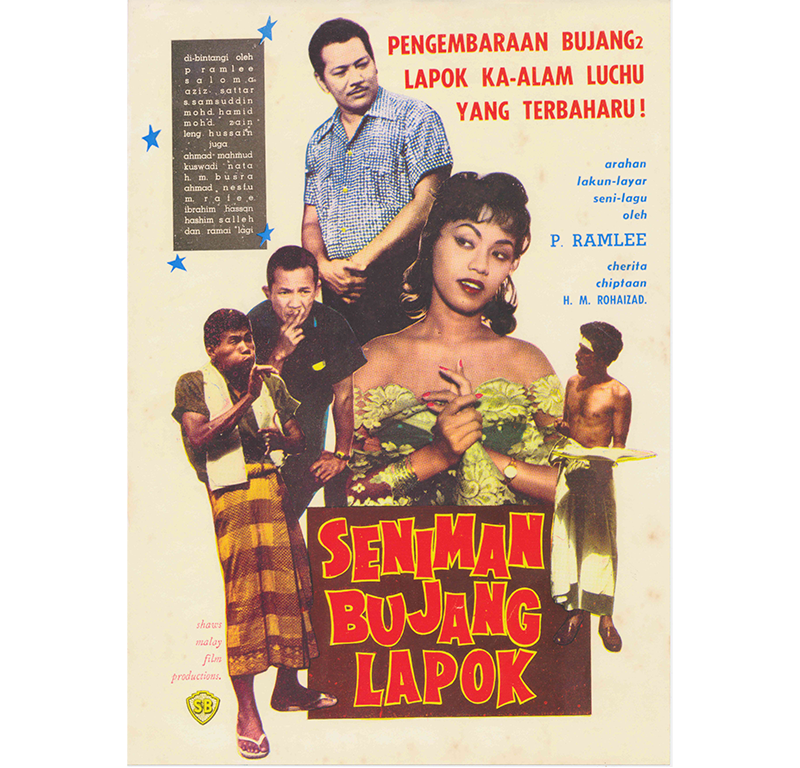
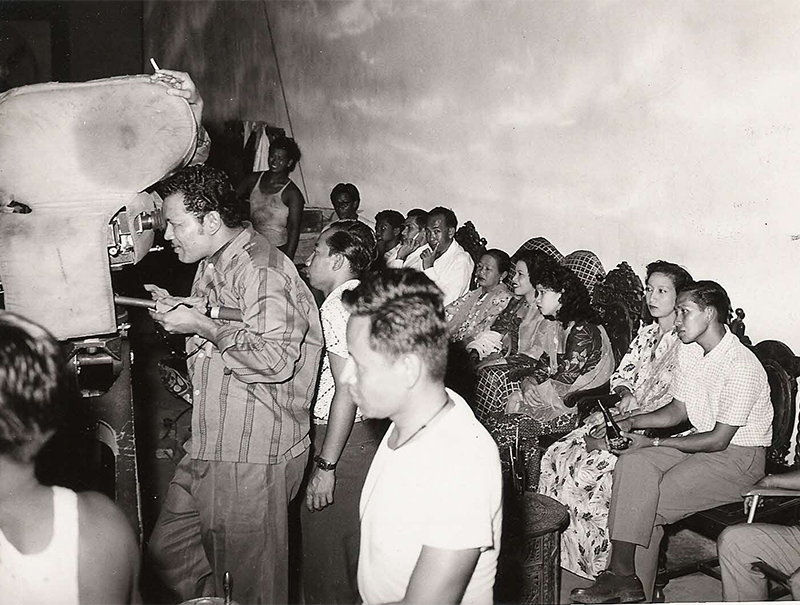
In Seniman Bujang Lapok (The Nitwit Movie Stars, 1961), the fourth film in the Bujang Lapok series, Ramlee not only was the director but also played one of the protagonists who attempts to become an actor despite his inexperience and ignorance of the film industry. Its unmatched portrait of Singapore’s Malay film industry remains both irresistibly funny and strikingly detached.19 What began as a satirical take on studio life has acquired remarkable archival value, capturing with unusual vividness the world that shaped his craft.
Mapping Singapore on Screen
Among the most evocative aspects of Ramlee’s career in Singapore is the way his films chart the growth and progress of the island city. Although not every production was shot entirely on location, many placed real streets, landmarks and coastlines at their heart, turning the city into both setting and silent actor.20
Across his films, Singapore appears at moments of arrival, ambition and sorrow. Penarek Becha moves from the clock tower of Victoria Memorial Hall and Anderson Bridge to Katong and Joo Chiat, then along Ceylon Road, East Coast Road, Balestier Road and Jalan Kemaman, finally reaching a shoreline thought to be Punggol. These routes mirror the story’s contrasts of class and circumstance, tracing a movement from the colonial civic centre and established residential districts to more modest neighbourhoods and peripheral spaces, thereby spatialising the gulf between privilege and precarity that structures the narrative.
As for the Bujang Lapok series, the bachelor protagonists traverse a wide range of Singapore locations: from Robinson Road and Shaw Chambers to the Nanyang Siang Pau building and MacRitchie Reservoir, even leaping playfully from Ngee Ann Building on Orchard Road back to Robinson Road. Seniman Bujang Lapok, in particular, sweeps across Empress Place and City Hall, then follows a lorry promoting a Malay Film Productions release past Capitol and Lido before entering a village.
Ibu Mertuaku traces a path through the Capitol Blue Room in Capitol Theatre, a clinic, a hotel on Geylang Road and a seaside villa. Other films showcase the Padang, Clifford Pier, Collyer Quay, Great World Amusement Park, Bukit Batok Hill, Tanjong Pagar and Bukit Timah. Even period costume films drew on local terrain, with Hang Tuah staging a coastal fight on Pulau Sekudu and Madu Tiga using Sembawang beach. Jalan Ampas itself, where the studio of Malay Film Productions was located – with its gates and side lanes – often slipped quietly into view.
Malay Life in a Changing City
Ramlee’s films – in which class, modernity and moral choice were the focus – also traced the social currents underpinning Malay life in a city changing at great speed. In Penarek Becha, for example, a trishaw rider shows that dignity is not confined to wealth. Antara Dua Darjat turns on a love constrained by status, while Ibu Mertuaku reveals how talent can be broken by a society enthralled by appearances.
His comedies – including Labu dan Labi, Madu Tiga and Seniman Bujang Lapok – mock vanity and pretence with a light touch that never obscures the moral of the stories. In Anakku Sazali, the city offers promise to the father and ruin to the son, capturing the uneven pull of urban life.
His work echoes the debates that animated the Malay literary and publishing intelligentsia in the 1950s and ’60s. Angkatan Sasterawa ’50 or ASAS ’50 (Malay Literary Movement of the ’50s) called for “Seni untuk Masyarakat” (Art for Society); its motto urging clarity, purpose and attention to everyday experiences.21 Ramlee knew figures from that movement, and Bintang (Star), the film magazine he published between 1953 and 1955, was edited by Fatimah Murad, wife of Asraf, one of the movement’s leading thinkers.22 The realist inclination of films such as Penarek Becha reflects the call by ASAS ’50.
Ramlee’s engagement with tradition was deliberate rather than nostalgic. Hang Tuah ends with a reflection on justice, suggesting that inherited values must be tested against present demands. The past is honoured yet questioned. His female characters also embody the social changes of their time. The women in Bujang Lapok, Seniman Bujang Lapok and Madu Tiga challenge and negotiate, mirroring transformations in work, education and aspiration.
As for his comedies, these capture the average Malay working man in the city – short on money and rich in wit – using humour to bridge the divide between hope and means. The tone remains kind, for his sympathy lies with those trying to find their footing in a modern economy.
Home and Family in Singapore
Ramlee’s own life reflects the porous and creative world of mid-century Singapore. Born in Penang of Acehnese descent, he rose to fame in a cosmopolitan studio where Indian, Chinese, Malay and Indonesian talent worked side by side. He sang Malay songs infused with jazz, Latin and keroncong influences. He filmed folktales in a modern studio and contemporary anxieties on actual streets and wove Singapore’s landmarks into his stories.
Ramlee’s first marriage, to actress Junaidah Daeng Harris in 1950, was solemnised at her father’s house on Boon Teck Road and it was she who accompanied his earliest steps in cinema. By 1955, the union had ended; that same year, he married Noorizan Mohd Noor, also an actress, at the kadi’s (an official who solemnises Mulim marriages) office. Her care brought comfort and order. Each day, her driver delivered Ramlee’s lunch in a tiffin carrier along with fresh clothes for the end of shooting, and she expected him home by eight in the evening. However, what began as love later felt restrictive, and the marriage ended in 1961.23
Later that year, he married singer-actress Saloma, born Salmah Ismail, in Pasir Panjang.24 The couple moved to 28 Cedar Avenue, a four-room terraced house rented by Shaw Brothers and only half an hour from the studio on Jalan Ampas. Their work together on stage and screen made them one of the most admired pairs of the era. Between filming, composing and late-night rehearsals, Ramlee relaxed with poker and mahjong among friends, living a life modest in its pleasures yet rich in companionship. In these domestic rhythms, Singapore became more than a workplace. Yet he left.
Leaving Singapore
By the early 1960s, P. Ramlee seemed to feel that his long creative season at Malay Film Productions was nearing its end. In April 1964, the studio held a farewell ceremony to wish him well and encourage him as he prepared to take up new duties at Merdeka Film Productions in Kuala Lumpur. On 19 April, he drove north with his family in his American convertible to settle in the capital where he continued to act, direct and compose.
Ramlee lived the rest of his life in Malaysia but would return to Singapore regularly until the very end of his life. For instance, he attended the 19th Asian Film Festival at the Singapore Conference Hall from 18 to 23 May 1973.25 There, he moved through receptions and screenings, presenting Laksamana Do Re Mi (The Admirals Do, Re, and Mi, 1972) – his final completed film – a playful work drawn from One Thousand and One Nights.26 It would be his last public appearance abroad. A few days later, on 29 May 1973, he was gone, felled by a heart attack at his Malaysian home at the age of 44.27 There is a quiet, sad and almost fated symmetry in the fact that Singapore – the city that shaped his youth and launched his career – was the last place he visited.
An Enduring Legacy
The roads and memorials named in his honour in Malaysia testify to P. Ramlee’s substantial achievements there. In his nine years in Kuala Lumpur, he acted in 21 films and directed 18. In comparison, during his 16 years in Singapore, he performed in 42 films, made three cameo appearances, narrated one and directed 17, substantial in its own right.
Although no roads or landmarks bear Ramlee’s name in Singapore, his presence can be seen in Singapore’s cultural life. The Singapore International Film Festival helped renew interest in his work through screenings in 1989 and a major tribute in 1999.28 The Asian Film Archive has continued this effort, presenting a curated selection of four of his classic films such as Patah Hati in May 2025 at the Oldham Theatre.29 His music has also returned to the stage, most recently in Wild Rice’s Tunggu Sekejap: The P. Ramlee Suite in May 2025 where Singaporean musician, composer and music director Julian Wong re-arranged some of Ramlee’s most beloved songs. (Tunggu Sekejap will return to the stage again in August 2026).30
Contemporary artists from Singapore have been inspired by Ramlee’s work. In 2005, Berlin-based Ming Wong re-enacted key scenes from four of Ramlee’s best-known films in Four Malay Stories, playing a total of 16 different characters, both male and female. The video installation was screened at the Singapore Pavilion of the 53rd Venice Biennale in 2009. More recently, in 2025, Wong presented Four Malay Stories Redux at the National Gallery Singapore, weaving Ramlee’s movie clips with his earlier re-enactments.31
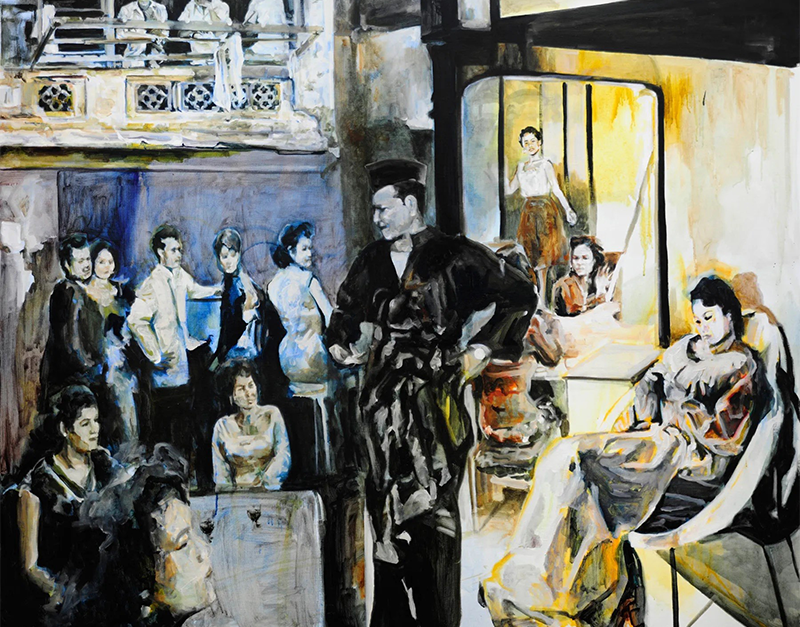
For artist Hilmi Johandi’s series of work, Dusk to Dawn (2013–14), he referenced old films, such as those by Ramlee, and reworked film stills and posters in paintings that reflect on modernity.32 These multiple artistic engagements show that Ramlee’s mid-century Singapore remains a living archive to be constantly revisited rather than just a mere nostalgic walk down memory lane.
While Singapore has yet to create something as lasting as the memorials in Malaysia, one might hope that, in time, it will choose to honour not only the man but also its own film history through one of its most legendary figures.
Notes
-
Alan Teh Leam Seng, “How KLʼs Streets Got Their Names,” New Straits Times, 21 October 2019, https://www.nst.com.my/news/nation/2019/10/531943/how-kls-streets-got-their-names; “Rumah Kelahiran P. Ramlee,” National Archives of Malaysia, last updated 3 February 2026, https://www.arkib.gov.my/ms/perkhidmatan/arkib-memorial/info-galeri/rumah-kelahiran-p-ramlee; “The P. Ramlee Memorial Library,” National Archives of Malaysia, last updated 3 February 2026, https://www.arkib.gov.my/en/perkhidmatan/arkib-memorial/info-galeri/the-p-ramlee-memorial-library. ↩
-
For more on P. Ramlee’s early life, see Abdullah Hussain, P. Ramlee: Kisah Hidup Seniman Agung [P. Ramlee, the life story of the great artist] (Kuala Lumpur: Dewan Bahasa Pustaka, 1984), 216. (From National Library Singapore, call no. RSING 791.40924 RAM.A); Raphaël Millet, Singapore Cinema (Singapore: Editions Didier Millet, 2006), 48–51. (From National Library Singapore, call no. RSING q791.43095957 MIL) ↩
-
A.H. Ahmad Sarji, P. Ramlee, Erti Yang Sakti [P. Ramlee, the magical meaning] (Subang Jaya, Selangor Darul Ehsan, Malaysia: Pelanduk Publications, 1999), 314. (From National Library Singapore, call no. RSEA 791.43092 AHM) ↩
-
James Harding and Ahmad Sarji, P. Ramlee: The Bright Star (Kuala Lumpur: Pelanduk Publications, 2002), 15. (From National Library Singapore, call no. RSEA 791.43028092 HAR) ↩
-
Harding and Ahmad Sarji, P. Ramlee: The Bright Star, 20; Millet, Singapore Cinema, 48. ↩
-
“Bakti Launches the Film Careers of L. Krishnan and P. Ramlee,” National Library Online. Article published 2014. ↩
-
“Patah Hati (Broken Heart, 1952),” Asian Film Archive, accessed 11 February 2026, https://asianfilmarchive.org/event-calendar/patah-hati-broken-heart-1952/; “Miskin,” IMDb, accessed 11 February 2026, https://www.imdb.com/title/tt15140978/. ↩
-
“Hujan Panas,” IMDb, accessed 11 February 2026, https://www.imdb.com/title/tt0261741/; Gerree Read, “Kris Duels Put Hollywood to Shame,” Sunday Standard, 29 January 1956, 9. (From NewspaperSG) ↩
-
“Anakku Sazali,” IMDb, accessed 11 February 2026, https://www.imdb.com/title/tt0235978/; “The Old Ramlee Magic in Search of a Place to Call Home,” Straits Times, 2 March 1998, 9; “Search for P. Ramlee’s Successor Continues,” Straits Times, 28 June 1988, 7. (From NewspaperSG) ↩
-
Harding and Ahmad Sarji, P. Ramlee: The Bright Star, 243–59. ↩
-
Adil Johan, “Cosmopolitan Sounds and Intimate Narratives in P. Ramlee’s Film Music,” Journal of Intercultural Studies 40, no. 4 (July 2019): 474–90, https://doi.org/10.1080/07256868.2019.1628723. ↩
-
Yusnor Ef, P. Ramlee Yang Saya Kenal [The P. Ramlee I knew] (Subang Jaya: Pelanduk Publications, 2000), 149. (From National Library Singapore, call no. RSING 791.40924 YUS). ↩
-
Rohayati Paseng Barnard and Timothy P. Barnard, “The Ambivalence of P. Ramlee: Penarek Beca and Bujang Lapok in Perspective,” Asian Cinema 13, no. 2 (September 2002): 9–23, https://intellectdiscover.com/content/journals/10.1386/ac.13.2.9_1. ↩
-
Jan Uhde, “P. Ramlee and Neorealism,” Kinema: A Journal for Film and Audiovisual Media, 15 April 2015, https://doi.org/10.15353/kinema.vi.1323. ↩
-
“Semerah Padi,” IMDb, accessed 11 February 2026, https://www.imdb.com/title/tt0278027/. ↩
-
“Antara Dua Darjat,” IMDb, accessed 11 February 2026, https://www.imdb.com/title/tt0277581/. ↩
-
“Ibu Mertua Ku (My Mother In-Law, 1962),” Asian Film Archive, date accessed 11 February 2026, https://asianfilmarchive.org/event-calendar/ibu-mertua-ku-my-mother-in-law-1962/. ↩
-
“Labu dan Labi ,” IMDb, accessed 11 February 2026, https://www.imdb.com/title/tt0216866/; “Madu Tiga,” IMDb, accessed 11 February 2026, https://www.imdb.com/title/tt0277810/; “The Three Abduls,” IMDb, accessed 11 February 2026, https://www.imdb.com/title/tt0278094/. ↩
-
“Seniman Bujang Lapok (The Nitwit Movie Stars, 1961),” Asian Film Archive, accessed 11 February 2026, https://asianfilmarchive.org/event-calendar/seniman-bujang-lapok-the-nitwit-movie-stars-1961/. ↩
-
For more on how P. Ramlee represented Singapore in his films, see Raphaël Millet, Singapore: A Cinematic Portrait (Singapore: Asian Film Archive, 2026), chapter 5. ↩
-
Aljunied Khairudin, “Films as Social History – P. Ramlee’s ‘Seniman Bujang Lapok’ and Malays in Singapore (1950s–60s),” The Heritage Journal 2, no. 1 (2005): 1–21, https://www.academia.edu/3015750/Films_as_Social_History_P_Ramlee_s_Seniman_Bujang_Lapok_and_Malays_in_Singapore_1950s_60s. ↩
-
A.H. Ahmad Sarji, P. Ramlee, Erti Yang Sakti, 47 ↩
-
Harding and Ahmad Sarji, P. Ramlee: The Bright Star, 31–41. ↩
-
A.H. Ahmad Sarji, P. Ramlee, Erti Yang Sakti, 338–40. ↩
-
A.H. Ahmad Sarji, P. Ramlee, Erti Yang Sakti, 35. ↩
-
“Shaws’ Two for Film Festival,” Straits Times, 30 April 1973, 23. (From NewspaperSG). [One Thousand and One Nights, or The Arabian Nights, is a collection of Middle Eastern folktales in the Arabic language.] ↩
-
A.H. Ahmad Sarji, P. Ramlee, Erti Yang Sakti, 181. ↩
-
“The Legend of P. Ramlee,” Thought Moments, 13 August 2019, https://thoughtmoments.wordpress.com/2019/08/13/the-legend-of-p-ramlee/. ↩
-
“Off the Catalogue: A P. Ramlee Focus (May 2025),” Asian Film Archive, accessed 11 February 2026, https://asianfilmarchive.org/event-calendar/off-the-catalogue-p-ramlee-may-2025/. ↩
-
Eddino Abdul Hadi, “Film and Music Icon P. Ramlee Remembered Through New Concerts and Mural in Singapore,” Straits Times, 9 April 2025, https://www.straitstimes.com/life/entertainment/film-and-music-icon-p-ramlee-remembered-through-new-concerts-and-mural-in-singapore. ↩
-
Joan Kee, “False Front: The Art of Ming Wong,” ArtForum, May 2012, https://www.artforum.com/features/false-front-the-art-of-ming-wong-199976/; Tan Siuli, “A Conversation with Ming Wong,” Art SG, accessed 13 February 2026, https://artsg.com/news/a-conversation-with-ming-wong/; Shawn Hoo, “National Gallery’s Revamped Singapore Gallery Spotlights More Women and Minority Artists,” Straits Times, 16 July 2025, https://www.straitstimes.com/life/arts/national-gallerys-revamped-singapore-gallery-spotlights-more-women-and-minority-artists. ↩
-
“Hilmi Johandi – Stagecraft: Landscapes and Paradise,” Ota Fine Arts, accessed 11 February 2026, https://www.otafinearts.com/exhibitions/67-hilmi-johandi-stagecraft-landscapes-and-paradise-hilmi-johandi/. ↩