

Rodolfo Nolli: The Quiet Sculptor Who Shaped a City
Between the 1920s and 1950s, this Italian craftsman created a number of significant sculptural works that are still seen in Singapore today.
By Nicola Kanmany John
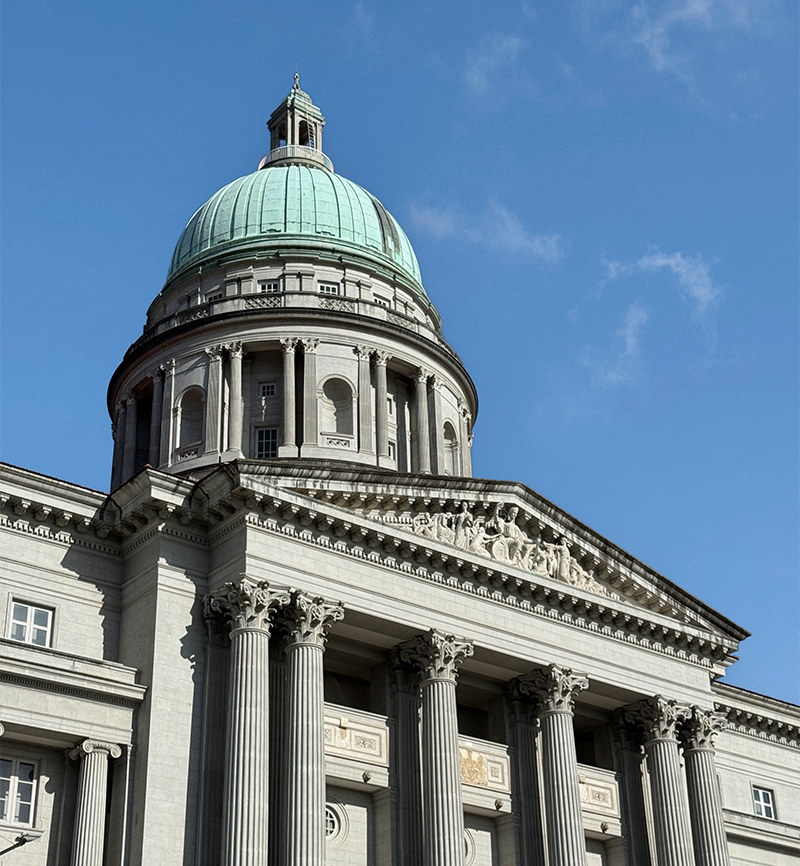
Although he was not an architect, the works of Rodolfo Nolli can be found in buildings all over Singapore. Details and ornamentation by this Italian sculptor and stonework contractor can be seen at the former Supreme Court building, the old King Edward VII College of Medicine, the Fullerton Hotel and other 20th-century landmarks.
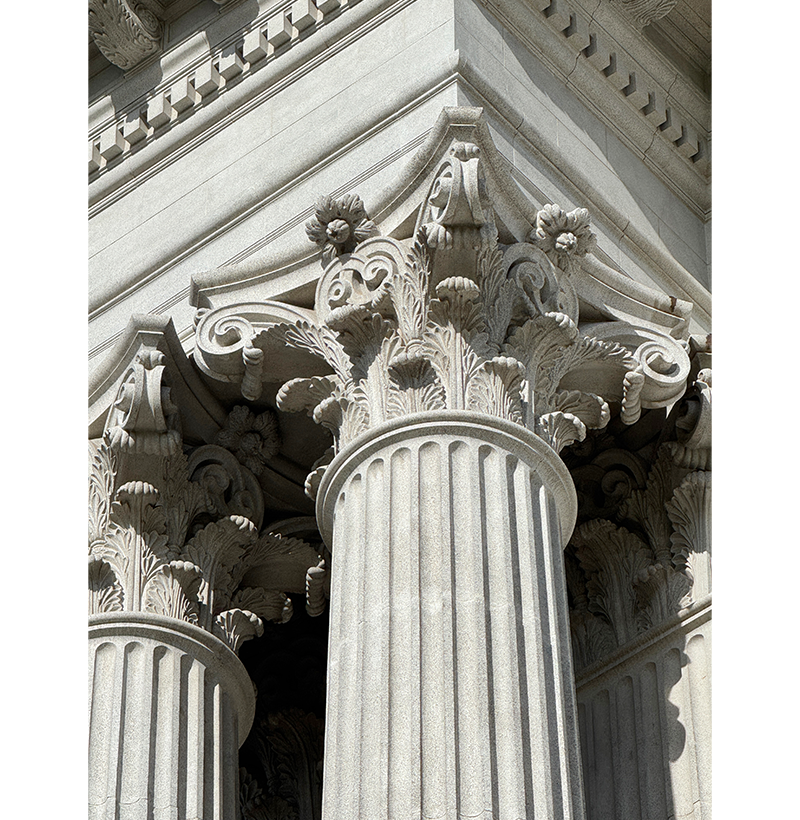
Nolli’s contributions to the old Supreme Court building (restored with the former City Hall building and now part of the National Gallery Singapore) are perhaps the easiest to observe. In addition to the Corinthian columns which make the facade so grand, Nolli worked on the relief (a wall-mounted sculpture raised from a flat base) in the tympanum, which is the triangular decorative section just above the columns. The sculpture shows Lady Justice holding weighing scales and a sword – symbolising law and judgment – alongside figures reacting to her judgment (see photograph on page 39).1
Nolli may not be familiar to many today but the Italian sculptor made a name for himself as an expatriate artist in Singapore between the 1920s and 1950s. His contributions to the city’s built heritage remain important to this day. Besides gaining attention for his professional work, Nolli made his presence felt at high-society gatherings, where he participated in a wide range of social engagements as well as once-in-a-lifetime events, including hunting down a man-eating tiger and welcoming the daughter of Benito Mussolini, the prime minister and Fascist dictator of Italy, to Singapore in 1930.2
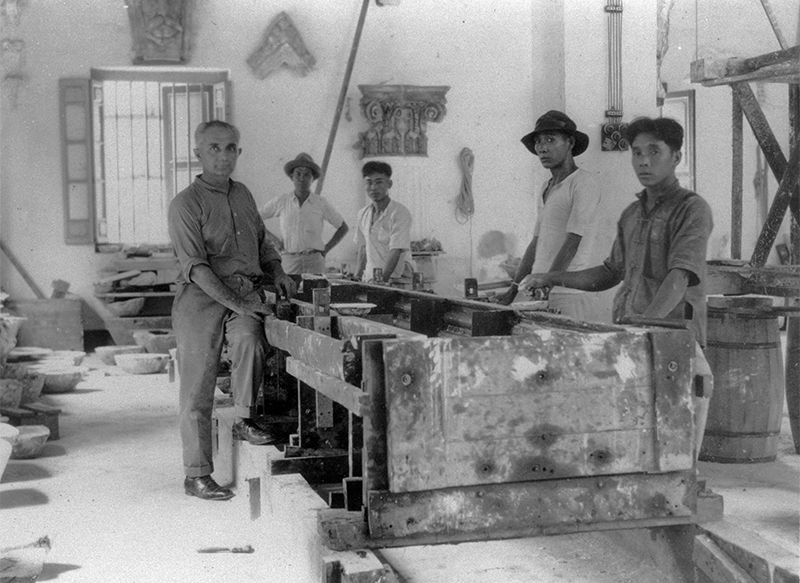
“Rodolfo Nolli, a young Italian sculptor with his head full of dreams and glory, left Milan 36 years ago to seek fame, fortune and adventure in the Far East,” the Singapore Free Press wrote in July 1949.3 In this, he certainly succeeded.
A Head Start in Sculptural Work
Nolli was born in Lombardy in northern Italy in 1888 to an extended family with an affinity for sculpture. His maternal uncle, Vittorio Novi, and granduncle did sculptural work in Milan, including for the Milan Cathedral (Duomo di Milano), and many of their contributions can still be seen in Lombardy today.4 Nolli’s move to Southeast Asia was also inspired by Novi.
In 1912, Novi found work in Bangkok, Siam (present-day Thailand), where work on the Ananta Samakhom Throne Hall commissioned by King Rama V had been ongoing since 1908. Nolli left Italy in 1913 to join Novi in Bangkok, and both men worked on this project and subsequent commissions for the next few years. Employed at his uncle’s studio, the young Nolli would have been able to perfect his craft while enjoying a steady income and future opportunities in the rapidly developing urban centres of Bangkok and, soon, Singapore.5
Although newspaper accounts show that Nolli had already moved to Singapore by 1921, the Straits Budget referred to him as “Mr. R. Nolli of Bangkok” in December 1922 while describing his ornamental work for Holt Enterprise’s Ocean Building. Nolli’s contributions included “decorative work in stone and plaster, both on the interior and exterior of the structure”.6 The reference to Nolli’s time in Bangkok suggests either that Nolli had not entirely committed to Singapore as a long-term prospect at this point or that his name was already famous, at least in architectural circles, in connection with the Siamese commissions he had worked on in his uncle’s studio.
It was only in May 1924, when Nolli created the “plaster ornamentation” for the new Sailors’ Institute on Anson Road, that the Straits Times described him as “an Italian architect living in Singapore”.7 A year later, in December 1925, he requested that the newspaper clarify that “he ha[d] not pronounced definitely on the authenticity” of a “supposed Roman vase in the possession of Mr W.H. Dop”.8
This was in response to an article from three days earlier in which the Straits Times reported that “a well-known Italian sculptor” had discovered “a Roman vase at least 1,900 years old and worth at least $1000” in Dop’s collection.9 Evidently, Nolli felt that he was famous enough by this time for readers to assume that this description applied to him. (The fact that the requested clarification was published suggests that the newspaper agreed with this assessment to at least a moderate extent.) But Nolli’s name was not universally known by any means: earlier in October 1925, the Straits Budget had to issue a correction that “Signor Nolli executed the plaster design of the Union Building illustrated in our last issue, and not Signor Valli as we stated”.10
Famous Works
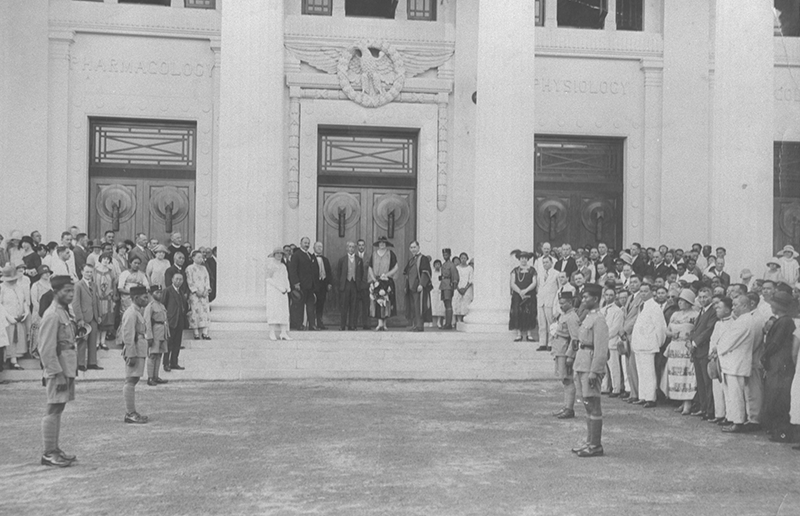
In February 1926, when the King Edward VII College of Medicine opened, the Singapore Free Press and Mercantile Advertiser described Nolli as “the Italian sculptor who was responsible for the sculpture” of the new building. Among the decorative details Nolli fashioned for the facade is an eagle encircled by a wreath, which bears a striking resemblance to 18th-century decorative details of the Royal Villa of Monza near Milan. Nolli also made a “presentation key” designed by Major P.H. Keys – a replica of an ancient Roman statue known as the Minerva Medica – for the official opening of the new building.11
Around this time, the King of Italy made Nolli a knight (“Cavaliere”) of the Order of the Royal Crown of Italy in recognition of “his work in the Far East”.12 From this point onwards, newspapers often referred to him as Cavaliere or Cav. Nolli, although he was occasionally still called Signor Nolli.
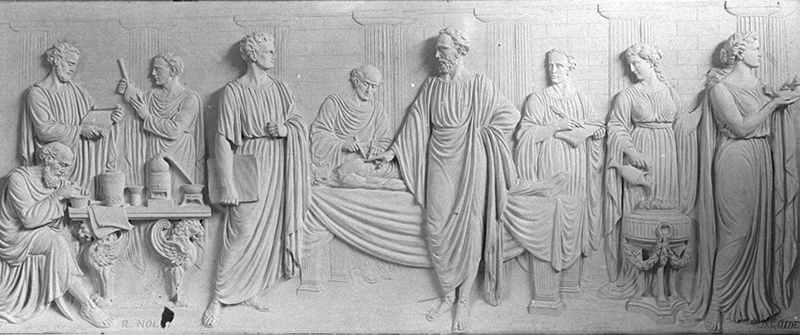
In 1928, a supplement to the Straits Budget featured photographs of Nolli with some of his recent work, including the top of a column intended for the Municipal Offices, a coat of arms and decorative feature for the Post Office Building and a relief (described as a “mural plaque”) for the College of Medicine. For much of the next decade, Nolli continued to work on similarly commissioned exterior and interior decoration.13
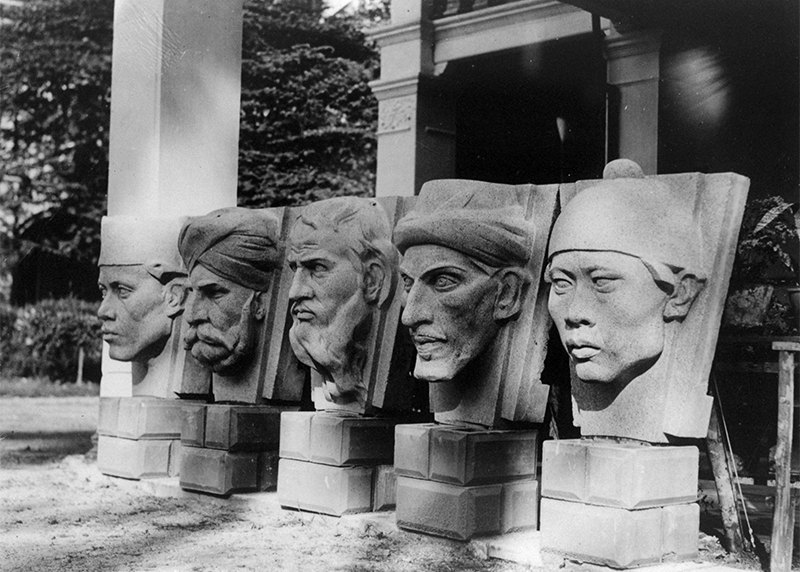

In the late 1930s, Nolli worked on what has become his most famous commission: the facade of the Supreme Court comprising the columns and tympanum. This took more than a year to complete. Looking back on this project, which he was most proud of, Nolli called it his baby, “from the first stone at the base to the lightning conductor on top of the dome”. In 1952, the Singapore Standard wrote that the facade would be “remembered as one of [Nolli’s] best efforts”.14
The tympanum, in particular, was a complex composition which drew on Nolli’s skills as a sculptor to a much greater degree than the more decorative work he was often commissioned to do. It is likely that this further endeared the project to him given that Nolli also complained that the lack of opportunity for more artistic work in Singapore during the 1920s and 1930s meant that he had spent most of his career as “just a contractor” rather than a sculptor.15
There is no specific record of Nolli’s political views, let alone his feelings on the subject of Fascism. Nonetheless, his Italian citizenship was enough to make him an enemy of the state when Italy entered World War II in 1940. Because of this, he was detained along with other Italian residents in Singapore and Malaya.16
Nolli spent four years in an internment camp in Australia before returning to Singapore in 1946. He appeared to have found work in postwar Singapore relatively easily, quickly securing commissions such as the Hongkong and Shanghai Bank crest, the mausoleum of the Sultan of Selangor and decorative work for the ballroom of the Raffles Hotel.17
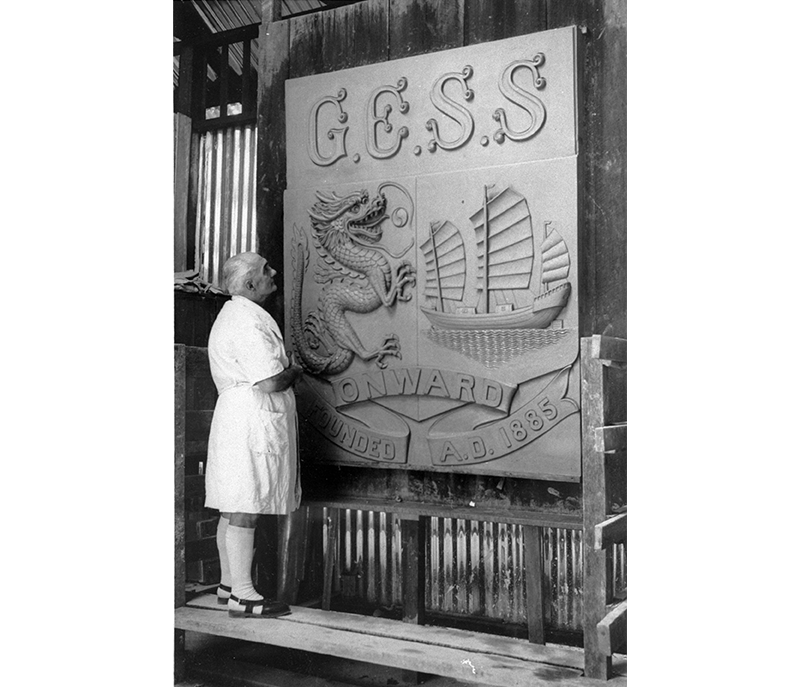
In 1951, Nolli designed and made the coat of arms for three High Court halls which had been “without a coat of arms since the re-occupation”.18 Nolli’s later works demonstrate the importance of architectural commissions in the postwar restoration of large-scale institutional buildings. He also worked on decorative details for schools that were built during this period, crafting the crest for the new Gan Eng Seng School and working on a set of reliefs of angels for the school chapel of St Anthony’s Convent in 1952.19 Nolli also worked on the Omar Ali Saifuddien Mosque in Brunei for some time, though the Straits Times 1964 report that he retired in 1956 suggests that he did not stay on to see the mosque being completed.20
Altogether, Rodolfo Nolli lived and worked in Singapore for more than 30 years. In February 1964, Nolli died in Italy at the age of 75. The Straits Times report of his passing noted that the sculptor spent “nearly half his lifetime in Singapore” and listed several of his more prominent works in Singapore, Kuching and Kuala Lumpur.21
Nolli the Celebrity
Outside of his prolific career, newspaper coverage of Nolli’s life and work in Singapore reveals a wealth of detail about his day-to-day life, his social calendar and even the various celebrities who crossed his path over his several decades here. In the news, his fame was consistently linked to his achievements as an artist: Nolli was often referred to as “well known sculptor R. Nolli” (or Cav. Nolli or Signor Nolli) regardless of whether the incident being reported had anything to do with his profession. The amount of media attention he received was certainly beyond the norm for artists based in Singapore not only during the 1920s but at any point since then. The extensive coverage of Nolli’s life and work testifies both to the strong media interest in architectural development in Singapore and his connections with interesting and influential people in the Italian and other expatriate communities in Singapore at the time.
As a well-known Italian based in Singapore, Nolli was actively involved in hosting prominent compatriots during their visits to the city. In June 1928, the Straits Times report on efforts to rescue the crew of the airship Italia noted that the Arctic expedition’s chief technician, Natale Cecioni, had been “a guest of Cav. R. Nolli” while passing through Singapore en route to Japan in 1926.22 Cecioni would be one of only eight survivors of the Italia expedition.
Nolli also formed part of the welcoming party that received Edda and Galeazzo Ciano, the daughter and son-in-law of Mussolini, during their visit to Singapore in October 1930. Although the Straits Times made no mention of Nolli in its coverage of the Cianos’ visit, it reported that “all the members of the Italian community in Singapore” attended the dinner held in their honour at the Europe Hotel. The Straits Budget, on the other hand, ran a photo of the couple’s arrival in which Nolli was both clearly visible and named as a member of the party. These incidents reveal Nolli’s prominence within the Italian community in Singapore.23
Nolli was also frequently mentioned in the press as an attendee at baptisms, weddings and funerals held in Singapore between the 1920s and 1930s, and even hosted one of the weddings. In February 1927, the Straits Budget reported that the wedding reception of Russian pianist Monia Litter and his bride, ballerina Mura Smirnova, was held “at the residence of Mr. R. Nolli in Gilstead Road”. Although the paper described the event as “typically Russian and very joyous”, it did not explain Nolli’s connection to the couple or the extent of his involvement beyond providing the venue.24
In June 1931, Nolli was part of a hunting team that tracked down and shot “a fierce, man-eating tiger” believed to have killed three people in Kulai, Johor.25 In April 1934, Nolli served as one of four judges at a beauty contest held at the old Racecourse.26 The range of Nolli’s social engagements during this period showed that he was friends with many prominent expatriates outside the Italian community in Singapore, including but by no means limited to other artists and performers.
In October 1934, multiple papers gave a great deal of attention to a serious car accident in which Nolli was badly injured, fracturing both his arms. The sculptor had been returning home from the Sea View Hotel when a car driven by D.C. Morgan of the Cold Storage Company collided with his on Meyer Road. The Malaya Tribune reported that “Mr R. Nolli, the Italian sculptor, who has lived in Singapore for a number of years, sustained serious injuries”, and was found unconscious with both arms fractured. The Sunday Tribune, which wrote that the accident involved “Mr R. Nolli, the well-known Italian sculptor”, even featured a photograph of the crash site illustrating the extensive damage done to both of the cars involved. Morgan was charged with “causing grievous hurt by a rash act” but released on bail. The Malaya Tribune ran a short update on 23 October, noting that Nolli was “making good progress” in his recovery.27
Nolli’s fame as a sculptor appears to have contributed directly to media interest in the accident. Although Nolli sustained serious injuries in the crash, it had no lasting impact on his career; he not only returned to work but remained prolific for decades afterwards.
Even Nolli’s more quotidian activities as an expatriate in colonial-era Singapore were recorded in the press. His performance as an amateur tennis player can be traced in regular updates published between 1927 and 1940. He played primarily in the “Handicap Men’s Doubles” category, often but not exclusively with a Mr Osborne as his partner.28
Besides tennis, Nolli also took an interest in horse racing; his name was mentioned in the papers alongside horse owners, including at the Singapore Turf Club’s Extra Meeting in 1938. His daughter was also photographed attending the races that year.29
Curiously, none of the many reports about Nolli’s life and work in Singapore made even a passing mention of his wife. His daughter Lina Nolli, however, became a minor celebrity almost as soon as she arrived in Singapore. In May 1936, the Singapore Free Press and Mercantile Advertiser reported that “Miss Nolli, daughter of Cav. Rodolfo Nolli” had arrived in Singapore upon completing her studies in Rome and was planning to live with her father for the foreseeable future. She received many more mentions in the society pages of the Singapore Free Press and Mercantile Advertiser, including a photograph from her 21st birthday party. While no mention has been found of Nolli’s wife, the death of his mother in Genoa merited an announcement in the Straits Times in April 1932.30
Nolli’s Legacy Today
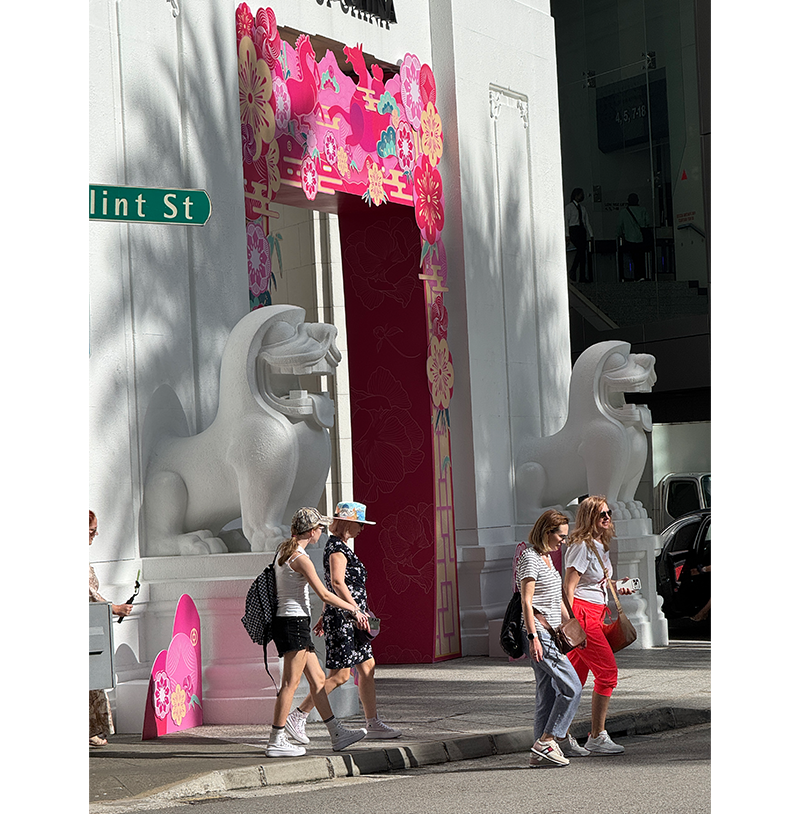
Many of Nolli’s works can still be seen at or close to the sites for which he made them. Apart from the tympanum and Corinthian columns of the former Supreme Court, he also created the Corinthian columns of the former City Hall building. The General Post Office is now the Fullerton Hotel, while the former St Anthony’s Convent is presently home to the National Design Centre. Similarly, the pair of lions that Nolli sculpted for the Bank of China can still be seen at the bank’s main branch on Battery Road.
Of all Nolli’s works in Singapore, the sculpture of Lady Justice in the tympanum of the former Supreme Court has attracted the most attention as it does not have a blindfold.31 Lady Justice, the Euro-American allegorical figure representing justice as an ideal, has been depicted blindfolded since at least the 16th century, originally with satirical implications that were later reconstrued so the figure represents impartiality rather than indifference.32
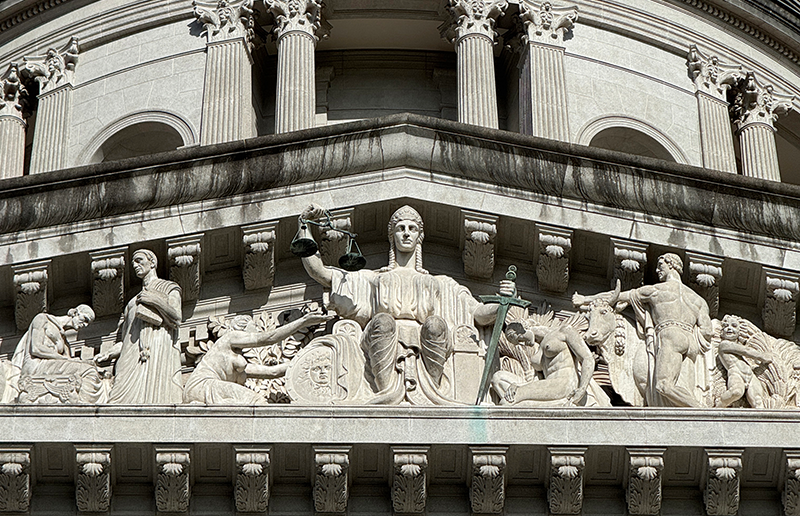
Nolli’s version of Lady Justice may be explained by the neoclassical aesthetic which informed much of Nolli’s work in the 1920s and 1930s. Nolli seemed to have combined aspects of Lady Justice with those of the Roman goddess Minerva. Closely associated with wisdom and justice in Roman mythology, Minerva is consistently depicted with a shield and sword.33 These attributes are clearly visible in Nolli’s tympanum. On the other hand, Minerva rarely, if ever, appears with the weighing scales that are also clearly visible in Nolli’s Lady Justice, suggesting that his creation is a combination of both Lady Justice and Minerva.
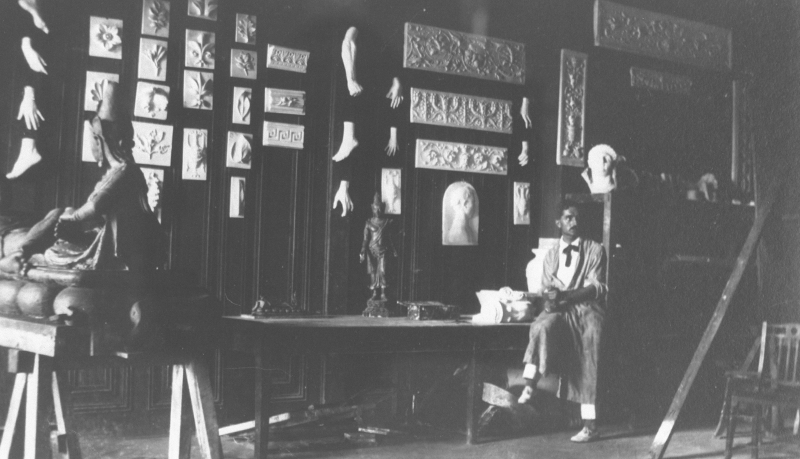
Works by Nolli are also preserved in the collections of the National Gallery Singapore and National Archives of Singapore. A relief titled “Commerce” from the series that Nolli made in 1937 for the Medeiros Building on Cecil Street is currently on display at the National Gallery Singapore.34 In 1996, Nolli’s daughter Lina donated a collection of 83 photographs of her father at work in Singapore and Bangkok to the National Archives of Singapore.35
Taken between 1913 and 1960, these images (which can be accessed at Archives Online; https://www.nas.gov.sg/archivesonline/) supplement the information on Nolli’s life and works from newspaper reports, and offer further insight into his craft and process as a sculptor. In addition to documenting works in progress as well as projects not reported in the news, they show the sculptor at work in Bangkok, on-site at various commissions around Singapore and at his Scotts Road stoneyard, including works lost to modernisation and redevelopment over time.
In fact, Nolli was so closely associated with Singapore’s built heritage between the 1920s and 1950s that he has often been mistaken as the creator of others’ work. In particular, he is often mentioned in connection with the “Merdeka lions”, a pair of stone lions originally flanking Merdeka Bridge when it opened in 1956 but were removed in 1966 when Nicoll Highway was widened.36
At the time of their installation, the Straits Times simply described the Merdeka lions as having been “ordered from Manila”. Further details in the Singapore Standard revealed that the lions were designed by L.W. Carpenter of the Architects’ Branch of Singapore’s Public Works Department before being modelled by Italian sculptor Raoul Bigazzi, who was based in Hong Kong but travelled to Manila to have the final version of the statues cast.37 That Nolli did sculpt a pair of lions may well have added to this confusion although these were made in a very different style for the Bank of China’s main branch on Battery Road.
Considering how prominent Nolli’s work was and still is in Singapore, relatively few scholars have offered much detailed research into his work. The first to do so was photographer Marjorie Doggett, who featured the Supreme Court in the opening pages of her book, Characters of Light: Early Buildings of Singapore, first published in 1957. She highlighted Nolli’s work on various buildings, and included a description of his career in Bangkok and Singapore.38
Later commentary has tended to focus on Nolli’s choice of materials for his works, analyse the small but influential Italian community in Singapore to which he belonged, or debate the significance of a fully seeing Lady Justice presiding over Singapore. Nonetheless, many of the buildings to which he made important contributions have not only survived but remain an important part of Singapore’s history and built heritage, testifying to the tenacity and discipline Nolli brought to his work through several phases of the country’s development.
With thanks to the Ngee Ann Kongsi Library staff at Lasalle College of the Arts and Jerome Lim of the Long and Winding Road blog.
Notes
-
“Nolli: The Man with a Dream,” Singapore Free Press, 1 July 1949, 5; “Crest and Creator,” Singapore Standard, 12 May 1952, 2. (From NewspaperSG) ↩
-
“The Duce’s Daughter in Singapore,” Straits Budget, 9 October 1930, 17; “Man-eating Tiger Shot in Johore,” Straits Budget, 9 July 1931, 17. (From NewspaperSG) ↩
-
Jon S.H. Lim, “Cavalori Rudolfo Nolli: A Sculptor and Entrepreneur,” in Architecture Journal, ed. Lo Ching Ning and T.K. Sabapathy (Singapore: National University of Singapore, 1985), 10–17, 12. ↩
-
“Ocean Building, Holt Company’s Enterprise in Singapore,” Straits Budget, 22 December 1922, 8. (From NewspaperSG) ↩
-
“The New Sailors’ Institute,” Straits Times, 16 May 1924, 9. (From NewspaperSG) ↩
-
“Untitled,” Straits Times, 21 December 1925, 4. (From NewspaperSG) ↩
-
“Untitled,” Straits Times, 18 December 1925, 8. (From NewspaperSG) ↩
-
“Local and Personal,” Straits Budget, 2 October 1925, 1. (From NewspaperSG) ↩
-
“New Medical College,“ Singapore Free Press and Mercantile Advertiser, 16 February 1926, 9. (From NewspaperSG); “Overdoor with Eagle and Laurel Wreath (One of a Pair),” The Met, accessed 12 January 2026, https://www.metmuseum.org/art/collection/search/845847. ↩
-
Lim, “Cavalori Rudolfo Nolli: A Sculptor and Entrepreneur,” 15. ↩
-
“Nolli: The Man with a Dream”; “Crest and Creator,” Singapore Standard, 12 May 1952, 2. (From NewspaperSG) ↩
-
“22 Italians Detained,” Straits Times, 12 June 1940, 10. (From NewspaperSG) ↩
-
“High Court Gets Coat of Arms,” Straits Times, 29 December 1951, 8. (From NewspaperSG) ↩
-
“Crest and Creator”; Lina Brunner, “Sculpture at St Anthony’s Convent, Singapore, by Italian Sculptor Rodolfo Nolli,” 1952, photograph. (From National Archives of Singapore, accession no. 144619) ↩
-
“Sculptor Rodolfo Nolli Dies in Italy,” Straits Times, 19 February 1964, 10. (From NewspaperSG); Lim, “Cavalori Rudolfo Nolli: A Sculptor and Entrepreneur,” 17. ↩
-
“Arctic Explorers’ Ordeal,” Straits Times, 20 June 1928, 9. (From NewspaperSG) ↩
-
“The Duce’s Daughter in Singapore”; “Woman’s Part in a Fascist State,” Straits Times, 2 October 1930, 11. (From NewspaperSG) ↩
-
“Artistes’ Wedding,” Straits Budget, 10 February 1927, 23. (From NewspaperSG) ↩
-
“A Woman Peeps at Singapore,” Sunday Tribune (Singapore), 22 April 1934, 9. (From NewspaperSG) ↩
-
“Meyer Road Car Smash,” Malaya Tribune, 22 October 1934, 12; “Singapore Golden Wedding Celebration,” Sunday Tribune (Singapore), 28 October 1934, 24; “Sequel to Car Smash in Meyer Road,” Singapore Free Press and Mercantile Advertiser, 24 October 1934, 6; “Mr. Aw Boon Haw,” Malaya Tribune, 23 October 1934, 13. (From NewspaperSG) ↩
-
“L.L.T.C. Tournament,” Singapore Free Press and Mercantile Advertiser, 23 June 1927, 16; “Tennis,” Straits Times, 24 November 1927, 11; “Chinese New Year Tennis Tourney Begins,” Morning Tribune, 9 February 1940, 13. (From NewspaperSG) ↩
-
Statistics For S.T.C. Extra Meeting,” Singapore Free Press and Mercantile Advertiser, 19 September 1938, 12; “Around the Town with Mignon,” Singapore Free Press and Mercantile Advertiser, 2 September 1938, 4. (From NewspaperSG) ↩
-
Around the Town,” Singapore Free Press and Mercantile Advertiser, 1 May 1936, 4; “Notes from Fraser’s Hill,” Sunday Tribune (Singapore), 13 June 1937, 11; “Death,” Straits Times, 21 April 1932, 11. (From NewspaperSG) ↩
-
Lai Chee Kien, an architectural and urban historian and writer, made this observation during a talk at the National Gallery Singapore in 2020: “Do you realise there’s something quite interesting about the Lady of Justice? She’s not blindfolded. Justice may not be blind in Singapore, is that what it’s saying? I don’t know, okay, don’t kill me. I’m just the messenger.” (The original talk was given in 2020 but is also available as a podcast). See Lai Chee Kien, “Murals and Architecture in Singapore and Malaysia, 1945–1969,” The Padang Sessions, 1 February 2023, video, 46:00, National Gallery Singapore, https://podcasts.apple.com/be/podcast/murals-and-architecture-in-singapore-and-malaysia/id1535734112?i=1000597483584. ↩
-
Desmond Manderson, “Blind Justice,” McGill Law Journal 66, no. 1 (January 2020): 5, https://www.erudit.org/en/journals/mlj/2020-v66-n1-mlj06426/1082030ar/. ↩
-
Britannica Editors, “Minerva,” Encyclopedia Britannica, 6 November 2025, https://www.britannica.com/topic/Minerva-Roman-goddess. ↩
-
“Commerce: Relief from Medeiros Building, Cecil Street,” National Gallery Singapore, accessed 8 February 2026, https://www.nationalgallery.sg/sg/en/our-collections/search-collection.artwork.html/national-collection/rudolfo-nolli/2016/2016-00367.tif.html. ↩
-
Stephanie Yeo, “Landmarks for All, from Old Girls to Food Lovers,” Straits Times, 11 October 1996, 6. (From NewspaperSG) ↩
-
National Heritage Board, “The Merdeka Bridge,” 1960s–1980s, photograph, Roots, last updated 15 October 2020, https://www.roots.gov.sg/Collection-Landing/listing/1193824; “Missing,” Straits Times, 23 May 1993, 22. (From NewspaperSG) ↩
-
“Two Lions Will Keep Watch on Motorists,” Straits Times, 1 July 1956, 11; “‘Freedom’ Guardian,” Singapore Standard, 23 August 1956, 5. (From NewspaperSG). [Note: this article erroneously gives the sculptor’s name as Raoul Eigazzi.] ↩
-
Marjorie Doggett, Characters of Light: Early Buildings of Singapore (Singapore: Times Books International, 1985), 4–5. (From National Library Singapore, call no. RSING 722.4095957 DOG) ↩