
Article
Rediffusion’s Golden Years
Topics
History
1 January 2020
Singapore’s only cable radio service was an instant hit when it was launched in 1949. Barbara Quek charts the history of the pioneering broadcasting station.
By Barbara Quek
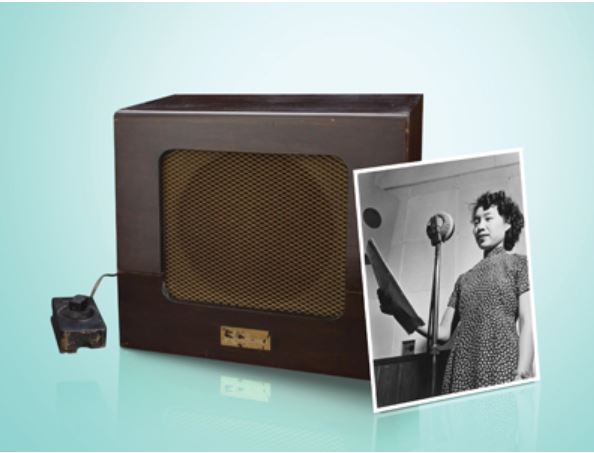
(Left) A Rediffusion set from the 1950s. The radio service was transmitted via cable. Courtesy of National Museum of Singapore, National Heritage Board. (Right) An undated recording session in progress at a Rediffusion studio. Image reproduced from Rediffusion Singapore, photographs, circa 1948–1987. (Call no.: RCLOS 384.540655957 RED)
For a generation of Singaporeans, the name Rediffusion brings back warm memories of a little nondescript brown, rectangular box blaring music and entertainment in homes and coffeeshops across Singapore in the 1960s and 1970s. This iconic radio station – known as 丽的呼声 in Mandarin (Li Di Hu Sheng) – provided countless hours of enjoyment to its listeners with the latest American pop music, dramatic stories told in Chinese dialects like Hokkien and Cantonese, and the friendly chatter of DJs at a time when home entertainment options were in short supply.
Before the production of Channel 8 dramas, people were hooked on traditional tales narrated by the likes of Lee Dai Soh (李大傻) in Cantonese, Ng Chia Kheng (黄正经) in Teochew, Ong Toh (王道) in Hokkien and Chong Soon Fat (张顺发) in Hakka. Their work on Rediffusion was in the tradition of the storytellers of old who went around Chinatown, Telok Ayer and Boat Quay to entertain the crowds in the late 19th and early 20th centuries.1
Storytellers like Lee Dai Soh and Ong Toh helped make Rediffusion popular.2 Their efforts left a mark on people like James Seah who, on the Singapore Memory Project,3 recalled how these stories affected the daily rhythms of life at home. Seah had become a Rediffusion fan in 1960 when he was still in Primary 5 and was living in a kampong in Bukit Ho Swee. He wrote:
“My mother would stop whatever housework, and I had to complete school homework before 9 pm to sit attentively on a stool beside the wooden partition of my next door neighbour. The Rediffusion was subscribed by my neighbour and he kindly shared it with us… The radio was located nearest to our side of the wooden partition and the volume… turned on to its maximum."4
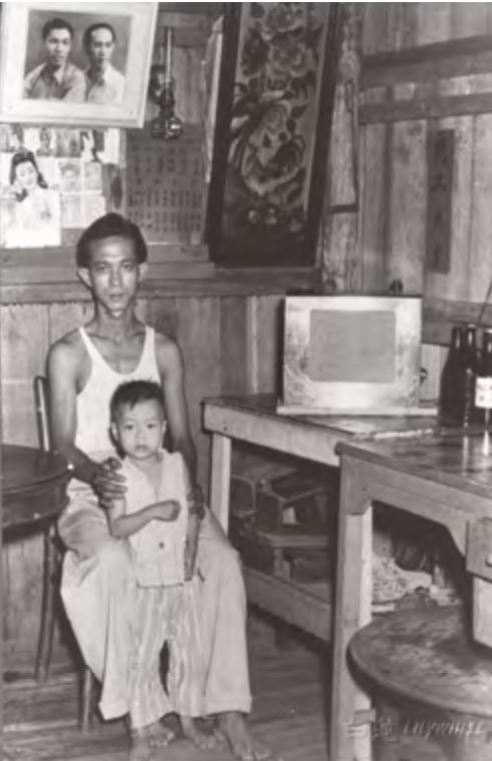
Rediffusion became an important source of entertainment in Singapore when it was introduced here in 1949, especially for people living in kampongs that did not have access to electricity. Rediffusion sets, which were essentially loudspeakers with built-in amplifiers, did not depend on electricity because power was supplied by the same cable that delivered the radio signal. Courtesy of National Archives of Singapore.
Apart from stories, Rediffusion also broadcast recordings of outdoor stage shows such as concerts and music programmes, which were mainly in Chinese. Recordings of Chinese wayang (street opera) performances, in particular, were well received until the 1970s when boxing match commentaries took over.5
Rediffusion became popular at a time when the majority of Singaporeans lived in rural areas and not many households could afford a television set. Besides, Rediffusion triumphed over the state-owned broadcaster because it had a clear advantage over conventional radio services operated by the state.6
Unlike AM or FM radios, Rediffusion boxes did not have receivers; they were largely loudspeakers with a built-in amplifier. As Rediffusion’s service was transmitted via cable, the audio quality was much better compared with over-the-air radio services of the time. In addition, Rediffusion sets did not depend on electricity, as power was supplied via the same cable that delivered the radio signal. This was a boon especially in rural areas that were not connected to the electrical grid.7
At its peak, Rediffusion, which was dubbed “the people’s network”, had more than 100,000 subscribers.8 It provided a novel way of delivering entertainment programmes, the majority of which were in Chinese dialects. On the other hand, government-owned radio stations like Radio Malaya and its successors broadcast mainly news and educational programmes from England that were deemed as lacking “life and originality”. People also found Rediffusion to be more “intimate” and “homely” as listeners could call in to chat with their favourite DJs.9
However, due to changing market conditions, new government policies and competition from television and free-to-air radio, Rediffusion began to wane in popularity in the 1980s and its audience numbers declined. The radio station ceased operations in 2012, and although it was revived a year later, Rediffusion no longer functioned as a radio station.
The Formative Years
Rediffusion was launched as a cable radio service in the town of Clacton, England, in the 1920s by Broadcast Relay Services (Overseas) Ltd, a London-based company, and introduced to Singapore in 1949. Jack Snowden, a young English engineer with the company, arrived with a core team to set up Rediffusion (Singapore). He stayed with the company for 38 years until his retirement as managing director in 1986.10
The company operated out of the Rediffusion Building that was built on the site of the old railway station on Tank Road (now Clemenceau Avenue) in 1948. Before the company could begin its radio service, miles of trunk cables were laid throughout the streets of Singapore.11The building was later sold and, in 1989, Rediffusion relocated to the four-storey Rediffusion House on Jalan Selanting, off Upper Bukit Timah Road. The new facility had six broadcasting studios, two commercial studios and a suite for the rehearsal and production of dramas.12
Rediffusion soon became a household name in Singapore.13 At a monthly subscription rate of $5,14 Rediffusion offered a cheaper alternative to households that could not afford more expensive radio sets back in the day.15 Rediffusion subscribers enjoyed Chinese programmes over the Gold Channel that ran 18 hours daily, while English programmes on the Silver Channel were available around the clock.16 Paul Chan Poh Hoi, who spent his childhood tuning in to Rediffusion programmes, recalled:
“… this brown box has been a part of my family since its inception in 1949… We never switched off the set and it woke me up at six to go to Chung Cheng High School. I never missed a programme hosted by Lee [Dai Soh]. Our large family of 12 often squabbled over the channels. I used to clash with my sisters when I wanted to listen to popular songs by Pat Boone and Doris Day in Top Tunes of the Week, and they wanted to listen to Cantonese opera.”17
Initially, the station broadcast programmes from the United Kingdom, but later added programmes in Chinese dialects to meet growing local demand. Soon, the station’s programmes became more popular than those produced by the state-owned radio station.18 According to Lim Leng San, who used to work as a Hokkien voice actor, Rediffusion also held more appeal than television, which did not screen as many serial dramas in the Hokkien dialect.19 By the 1960s, the number of Rediffusion subscribers had increased to about 50,000. The radio station continued to experience steady growth and, by 1977, had garnered 90,428 subscribers.20
The People Behind the Voices
Rediffusion was an important part of the history of broadcasting in Singapore. Some big names in the industry had their first break on the station. Channel 8 MediaCorp actors Richard Low and Chen Shucheng, for instance, cut their teeth on Rediffusion after joining the station’s Chinese drama group as voice-acting talents.21
In the early 1970s, Rediffusion nurtured many local talents, such as veteran Mediacorp actress Xiang Yun, who started out as a child artiste with the radio station,22 popular radio DJ Mark van Cuylenberg (better known as The Flying Dutchman),23 and the late theatre doyen Kuo Pao Kun, who began his career with the station’s Mandarin Drama Group.24 Foong Choon Hon, former editor of the Chinese-language Shin Min Daily News, made his mark when he was a broadcaster with Rediffusion.25 Composer-singer Dick Lee has credited Rediffusion for helping him break into the entertainment industry. Lee had participated in a contest organised by Rediffusion in the early 1970s and the judge later invited him back as a guest performer, and “that’s how [his] career took off”.26
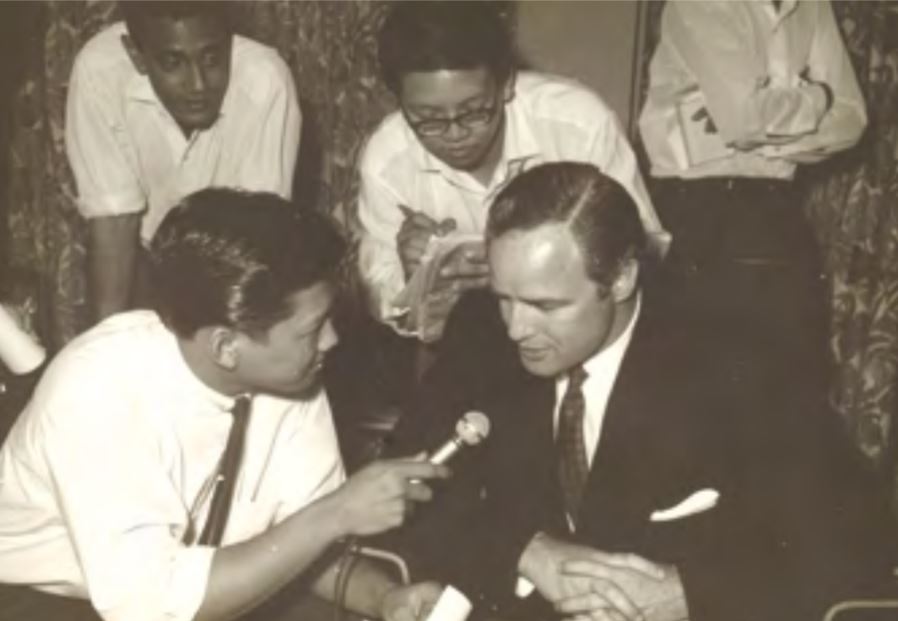
Rediffusion DJ Tan Swee Leong interviewing American actor Marlon Brando at the station’s studio in Clemenceau Avenue, 1956. Image reproduced from Rediffusion Singapore, photographs, circa 1948–1987. (Call no.: RCLOS 384.540655957 RED)
Rediffusion stalwart Tan Swee Leong, who was a popular radio and television host from the 1960s to 1980s, became a mentor to younger DJs and local bands like The Quests. Tan had a long and illustrious career with Rediffusion as one of the two popular DJs alongside Larry Lai. They were nicknamed the “terrible twins”, often engaging in friendly banter to entertain listeners. Veteran sports commentator and radio presenter Brian Richmond said he modelled himself after Tan, having been inspired by him to enter the industry when he was just a teenager.27
Frankie Sim, who was a fan of these Rediffusion DJs, recalled:
“I remember Top Tunes of the Week, hosted by DJ Joseph Goh, on Rediffusion… Next was the P.O. Box 608 Request programme that aired six days a week, with announcers Peggy Ross, Honey Zain, Eric Lim, Johnny Lau, Larry Lai and Tan Swee Leong. There was also From Your House, hosted by Noreen Sales; Stars on Wings, hosted by DJ Neville Powley; and Listen with Love, hosted by DJ Jeremy Ramsey Gary Love… To them and other staff, I say thank you for the music”.28
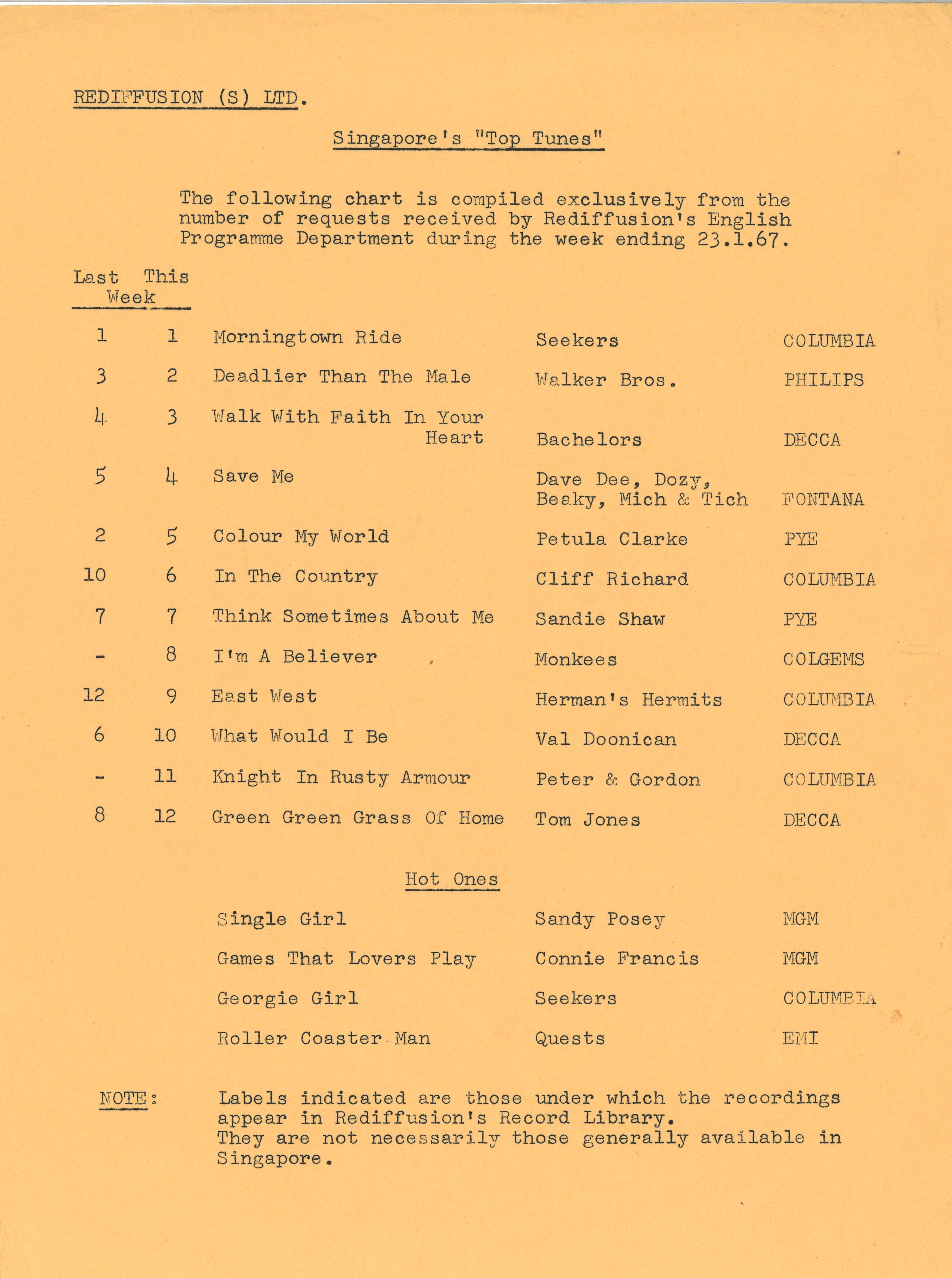
A weekly compilation of the most popular songs based on the number of requests received by Rediffusion’s English Programme Department for the week ending 23 January 1967. Image reproduced from Singapore’s “Top Tunes” (n.d.). Singapore: Rediffusion. (Call no.: RCLOS 016.78242 RSLSTT)
Rediffusion Singapore also had Roger Kool, the moniker adopted by Roger Kiew, who was blind. Roger Kool made his debut on air in 1973 at the age of 19 and would go on to amass a huge following, so much so that he became known as the “king of the airwaves”.29
Then of course there were the legendary storytellers who helped Rediffusion cement its leading position in Chinese radio broadcasting between the 1950s and 1970s. Lee Dai Soh, in particular, captivated generations of listeners with his animated narration of Chinese classics such as Journey to the West and Return of the Condor Heroes.30
Ann Tang, who fondly remembers her grandmother listening to the Cantonese raconteur, said:
“My early memories of Rediffusion were in the 1970s. It was my grandmother’s only pastime, listening to Cantonese storyteller Lee Dai Soh… Every night after dinner, my siblings and I would climb onto granny’s bed and she would re-tell the story she had heard. That was how I came to know the stories from Romance of the Three Kingdoms – General Cao Cao and Guan Yu, [the] war strategist who could borrow the north wind to defeat their enemies, and Dream of the Red Chamber, even though I did not study Chinese”.31
Another equally popular storyteller was Ong Toh, who narrated stories in Hokkien. Tan Bah Bah, a former journalist with the New Nation newspaper, was one of those spellbound by Ong’s storytelling when he was a child. He recalled:
“… minutes before 8.45 pm, just about every family who had [a] Rediffusion set at home would stop whatever they were doing and crowd around the little set… Around that time, too, one could hardly find a trishaw or taxi on the road! Every trishaw rider or taxi driver would be at his or her favourite coffee shop listening to the inimitable Ong Toh… At 8.45 pm sharp, everybody at home or coffee shop stopped talking. Coffee cups would cease clinking… There would be a complete hush… all problems would be forgotten as Ong Toh transported them through time to ancient China with tales of heroism, treachery, bravery, vanity, cowardice and the like”.32
The Sunset Years
After peaking in the early 1980s, Rediffusion began to decline as the rising popularity of new FM radio stations and the failure of Rediffusion to obtain a free-to-air broadcasting licence in the 1990s sealed its fate. Its subscription plunged by more than 40 percent, from 110,348 subscribers in 1982 to 62,940 in 1988. By 2006, it had only 8,000 subscribers.33
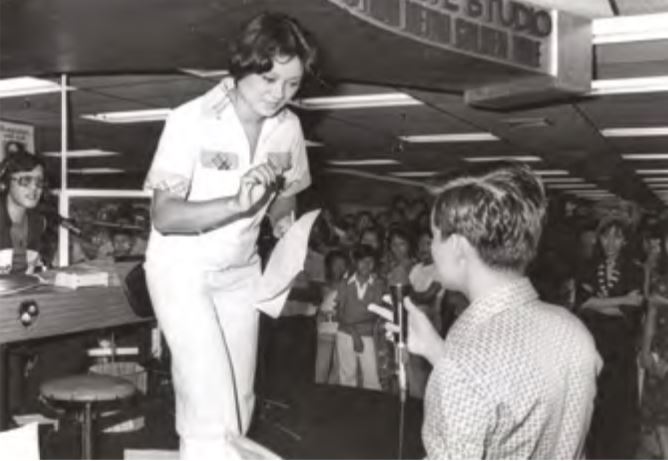
Cantopop diva Frances Yip with Rediffusion DJ Larry Lai at a satellite station in Metro Golden Mile, 1971. Image reproduced from Rediffusion Singapore, photographs, circa 1948–1987. (Call no.: RCLOS 384.540655957 RED)
The Speak Mandarin Campaign that was launched in 1979 is often cited as a major reason for Rediffusion’s decline. To promote the use of Mandarin, Rediffusion was required to stop all dialect programmes by 1982. The removal of all Hokkien, Cantonese, Teochew and Hakka storytellers took away a major pillar of its programming.
However, this alone may not necessarily have been the death blow for Rediffusion.34 In fact, the switch to Mandarin potentially gave the station access to a new target audience: young Mandarin-speaking listeners instead of middle-aged and older people.35 In 1981, when Rediffusion introduced a new educational programme in Mandarin for secondary four students called “Revise Your Lessons with Us”, it became very popular, attracting as many listeners as some variety quiz shows.36
Ironically, one of the key reasons for Rediffusion’s early success contributed to its eventual decline. Rediffusion’s receiving boxes were not plugged into electrical sockets, which was an advantage for people who did not have access to electricity. However, as portable battery-powered radio sets became affordable, and more homes became wired up to the electrical grid, Rediffusion lost its initial allure. Moreover, Rediffusion could not compete with new radio stations that delivered better programming.
The cables that enabled Rediffusion to thrive in the kampong became a noose as it required an investment in cabling infrastructure, which AM and FM radios did not need. One academic study noted that Rediffusion’s “fateful mis-step may have been when it decided not to lay its wires into new HDB estates that were springing up from the 1980s”.37 Not investing in this meant that Rediffusion lost subscribers who had moved into these new housing estates and failed to attract new ones for a number of years.
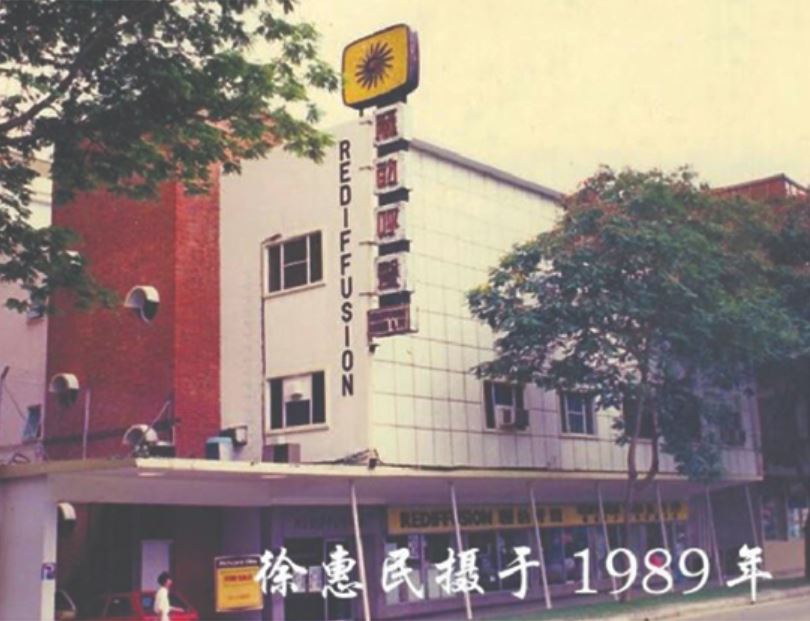
The Rediffusion Building on Clemenceau Avenue, 1989. The building was later sold and in 1989, Rediffusion relocated to the new four-storey Rediffusion House on Jalan Selanting, off Upper Bukit Timah Road. Courtesy of Xu Huimin.
The Revival Years
In 2003, Rediffusion (Singapore) was acquired by Ronald Reagin, a retired American lawyer, and Wong Ban Kuan, the company’s general manager. Reagin became the chief operating officer while Wong assumed the post of managing director.
The new owners decided to venture into digital audio broadcasting (DAB) to help boost subscription, which had shrunk to about 10,000 by then. Although this initiative was successful initially, it failed to sustain growth and in early April 2012, the company announced that it would stop broadcasting by the end of that month. By then, its subscriber pool had dwindled to around 3,000. On 30 April 2012, Rediffusion (Singapore) officially ceased operations, after having been in business for 63 years.38
Many long-time listeners were understandably upset by the closure of Rediffusion.39 There were proposals to resell Rediffusion’s content as one way of preserving some of it.40 Many also expressed concern that its archived programmes – an important slice of Singapore’s broadcasting history – were in peril.41
Hopes were raised when Eeva Chang Mei Hsiang (张美香), a popular Rediffusion host from 1985 to 1991, bought its brand name, audio-visual materials and broadcasting facilities for an undisclosed sum in June 2012.42 She also roped in Dick Lee as Rediffusion’s creative director to revive the flagging station.43
On 30 May 2013, the revamped station was relaunched as an internet-based service. Listeners could tune in to free podcasts and also subscribe to a mobile app (at US$1.99 or S$2.50 per month), which played old programmes from the station’s archives.44 However, this new strategy did not work and the company no longer has a mobile app offering the subscription service. Today, Rediffusion maintains an online presence with a website detailing its history,45 a Facebook page featuring interview broadcasts, a YouTube channel and the Ximalaya FM (喜马拉雅FM) channel that airs podcasts.46
With the support of the Singapore Tourism Board and Chinatown Business Association, the Chinatown Rediffusion Open Studio (牛车水街道透明播音站) opened on 26 October 2019. Since its launch, programmes such as interviews with Chinatown shop owners have taken place there. These interviews are broadcast on Rediffusion’s Facebook page.47
Some of the programming that made Rediffusion popular are held by the National Archives of Singapore (NAS). The collection comprises more than 5,000 recordings of popular Chinese classics, folk stories, comedy acts, opera performances and even children’s plays. The NAS also keeps a repository of oral history interviews with Lee Dai Soh and Ng Chia Keng as well as listeners recalling their fond memories of the radio station.48
The National Library’s Lee Kong Chian Reference Library also has a collection of Rediffusion materials that include issues of Rediffusion Times (丽的呼声周刊), photographs and rare drama scripts.
Master Storyteller Lee Dai Soh
Lee Dai Soh (李大傻) (1913–89) was a well-known storyteller who made his name on Rediffusion. His moniker is sometimes spelt as Lee Dai Sor, which means “Big Fool Lee”49 in Cantonese. He was born Lee Fook Hai and grew up in Tanjong Pagar. Although Lee only had a primary school education, he loved reading and collecting books.50
According to his daughter, Lee started out telling stories while sitting on a box under a tree in Chinatown, with a burning joss stick as his timer.51 His radio career began in 1938 when he joined the British Malaya Broadcasting Corporation. After the Japanese Occupation of Singapore, he returned to his job at the company, which by then had been renamed Radio Malaya. In 1949, Lee moved over to Rediffusion when the radio station began operations in Singapore.52
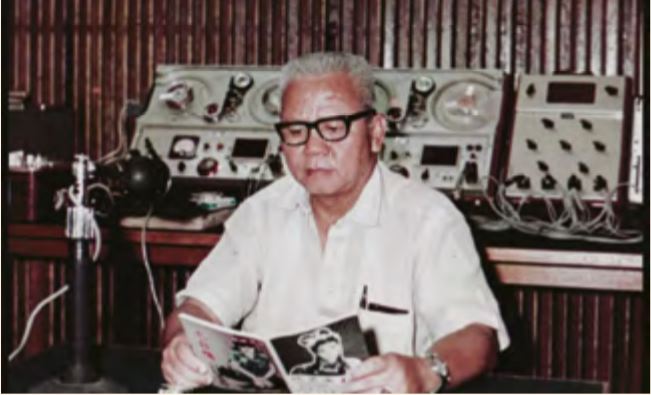
Cantonese raconteur Lee Dai Soh doing what he did best, 1966. Lee Dai Soh Collection, courtesy of National Archives of Singapore.
The master storyteller became a household name in the 1950s and 1960s. Apart from Rediffusion, he also made recordings for the Australian Broadcasting Commission station in Singapore, which were broadcast to countries such as Malaysia, Vietnam and Hong Kong.53
Lee is fondly remembered for his retelling of the Chinese classic Journey to the West (西游记), which he narrated in Cantonese over 175 episodes, each lasting half an hour. These were recorded in 1979 on 7-inch open reel audiotapes at the Rediffusion Building on Clemenceau Avenue.
When Rediffusion ceased its dialect programmes in 1982, Lee retired from broadcasting in Singapore. He went on to tell stories in Cantonese for Radio Australia, and also entertained audiences with his storytelling performances at clan associations and public events.
Lee died of a heart attack in 1989, having done a recording for Radio Australia just the day before.54 He left behind two wives, one son, two daughters and two grandchildren.55
The audiotapes of Lee’s Journey to the West form part of the more than 5,000 Rediffusion recordings held in the collection of the National Archives of Singapore (NAS). These recordings have been digitised and are available for public access on the Archives Online website.56 Lee was also interviewed by the Oral History Department of the NAS in 1983 and 1989.57
About the Author
Barbara Quek is a Senior Librarian with the National Library, Singapore. She is currently with the Advocacy & Statutory Function group that oversees the compliance of Legal Deposit in Singapore.
Endnotes
1 Fiona Tan, “Chinese Street Storytellers (opens in new tab),” Singapore Infopedia. Article published 29 July 2014.
2 June Cheong, “Redi-rection (opens in new tab),” Straits Times, 12 February 2006, 4. (From NewspaperSG)
3 The Singapore Memory Project, launched in 2011, is a whole-of-nation movement by the National Library Board that documented memories and moments related to Singapore from individuals and organisations.
4 J. Seah, “Farewell to Redifffusion,” Singapore Memory Project, 10 April 2012.
5 Goh Yee Ling, “The Entertainment House That Jack Built (opens in new tab),” Business Times, 6 October 1986, 8; Mike Watcher, “Commercial Radio is the Answer (opens in new tab),” Straits Times, 7 October 1956, 6. (From NewspaperSG)
6 Radio transmission in Singapore began in the 1920s, but progress was initially in fits and starts. The British Malaya Broadcasting Corporation, the predecessor to today’s Mediacorp broadcasting behemoth, began transmission on 1 March 1937. In 1946, the company was reorganised as Radio Malaya and renamed Radio Singapore 11 years later. In 1963, this entity merged with the television broadcaster to become Radio Television Singapore. This then became the Singapore Broadcasting Corporation in 1980. Today, the radio division is part of the Mediacorp conglomerate.
7 Singapore Rediffusion (opens in new tab) (Singapore: Rediffusion, 198–), 1. (From National Library Singapore, call no. RSING 384.540655957 RED)
8 Rachel Chan, “Rediffusion Launch Pad (opens in new tab),” Straits Times, 15 April 2012, 2; Eileen Aung-Thwin, “Tuning Out After 63 Years (opens in new tab),” Straits Times, 23 April 2012, 6–7. (From NewspaperSG)
9 Goh, “The Entertainment House That Jack Built (opens in new tab)”; Watcher, “Commercial Radio is the Answer (opens in new tab).”
10 Singapore Rediffusion (opens in new tab), 1; Goh, “The Entertainment House That Jack Built (opens in new tab).”
11 Singapore International Chamber of Commerce, From Early Days (opens in new tab) (Singapore: Singapore International Chamber of Commerce, 1979), 136. (From National Library Singapore, call no. RSING 380.10655957 SIN)
12 “Move to New Home Will Help: Rediffusion (opens in new tab),” New Paper, 3 February 1989, 6; “Revamp a Boost for Rediffusion (opens in new tab),” Straits Times, 6 February 1989, 12. (From NewspaperSG)
13 Singapore Rediffusion (opens in new tab), 2.
14 Rafael Oei, Borderless Bandwidth: DNA of Digital Radio (opens in new tab) (Singapore: Times Academic Press, 2002), 111. (From National Library Singapore, call no. RSING 384.54 OEI)
15 Rafael Oei, Riding the Bandwidth (opens in new tab) (Singapore: Marshall Cavendish Academic, 2005), 48–49 (From National Library Singapore, call no. RSING 384.54 OEI); “Remembering Rediffusion Singapore,” Rediffusion (Singapore) Limited, 2010.
16 Singapore Rediffusion (opens in new tab), 4; “Move to New Home Will Help: Rediffusion (opens in new tab),” New Paper, 3 February 1989, 6. (From NewspaperSG)
17 “Stories and Memories (opens in new tab),” Straits Times, 21 April 2012, 8. (From NewspaperSG)
18 Oei, Riding the Bandwidth (opens in new tab), 48–49.
19 Toh Wen Li, “The Lives They Live: Blast from the Past of Rediffusion’s Heyday (opens in new tab),” Straits Times, 21 September 2017, 12. (From NewspaperSG)
20 Drew O McDaniel, Broadcasting in the Malay World: Radio, Television, and Video in Brunei, Indonesia, Malaysia, and Singapore (opens in new tab) (Norwood, New Jersey: Ablex Publishing Corporation, 1994), 183 (From National Library Singapore, call no. RSING 302.2340959 MAC); Yearbook of Statistics, Singapore (opens in new tab) (Singapore: Dept. of Statistics, 1977/78), 238 (From National Library Singapore, call no. RCLOS 315.957 YSS). [Note: Number of subscribers was 48,040 in 1960, 176 (1967), peaking at 110,792 in 1981 and dropping to 55,406 in 1989, 238; (1989).]
21 Hong Xinyi, “Big Fool’s Reign (opens in new tab),” Straits Times, 2 August 2007, 54. (From NewspaperSG)
22 K.F. Tang, “Storyteller Lee Dai Soh Dies While Waiting to See Doctor (opens in new tab),” Straits Times, 24 March 1989, 22; “Obituary (opens in new tab),” Straits Times, 24 March 1989, 38. (From NewspaperSG)
23 “Obituary (opens in new tab).”
24 Hong, “Big Fool’s Reign (opens in new tab)”; Liew Soon Chin, “The Storyteller (opens in new tab),” New Nation, 9 May 1978, 10–11; “Radio Malaya’s (opens in new tab),” Straits Times, 18 April 1996, 16; N. Balakrishnan “Man Who Brought the ‘Sound Box’ to S’pore (opens in new tab),” Straits Times, 6 October 1986, 15. (From NewspaperSG)
25 Liew, “The Storyteller (opens in new tab).”
26 “Obituary (opens in new tab)”; Hong, “Big Fool’s Reign (opens in new tab).”
27 Tang, “Storyteller Lee Dai Soh Dies While Waiting to See Doctor (opens in new tab).”
28 Rediffusion Singapore, “粤语通俗故事: 西游记 (opens in new tab)” [Journey to the West], 16 January 1979, video 28:37 (175 audiotapes). (From National Archives of Singapore accession no. 1996000865)
29 Lee Dai Soh, oral history interview by Liana Tan and Yeo Geok Lee, 13 March 1989, transcript (opens in new tab) and MP3 audio, Reel/Disc 4 of 7, National Archives of Singapore (accession no. 000260 (opens in new tab))
30 Chan, “Rediffusion Launch Pad (opens in new tab).”
31 Teo Pau Lin, “The Original Ah Jie (opens in new tab),” Straits Times, 12 December 2005, 4. (From NewspaperSG)
32 Jeanine Tan, “Time To Move On (opens in new tab),” Today, 24 May 2006, 38. (From NewspaperSG)
33 Dana Lam, “Passionate Pursuit (opens in new tab),” Straits Times, 22 November 1990, 10. (From NewspaperSG)
34 Zakir Hussain, “Telling Stories so That Others May Remember (opens in new tab),” Straits Times, 17 April 2009, 28. (From NewspaperSG)
35 Christopher Toh, “Rediffusion Returns As Digital-Only Service (opens in new tab),” Today, 31 May 2013, 30. (From NewspaperSG)
36 Anjali Ragaratman, “Veteran Radio, TV Presenter Tan Swee Leong Dies of Cancer at Age 77 (opens in new tab),” Straits Times, 19 December 2015, 10. (From NewspaperSG)
37 “Stories and Memories (opens in new tab).”
38 “Stories and Memories (opens in new tab)”; Xu Huimin, “Rediffusion and Its Glorious 63 Years,” Remember Singapore, May 2012.
39 Xu, “Rediffusion and Its Glorious 63 Years.”
40 “Stories and Memories (opens in new tab).”
41 Tan Bah Bah, “Times We Spent Around the Set (opens in new tab),” New Nation, 7 April 1979, 8. (From NewspaperSG)
42 “Sorry, Rediffusion (opens in new tab),” New Paper, 13 August 1990, 4 (From NewspaperSG); Xu, “Rediffusion and Its Glorious 63 Years.”
43 Ang Peng Hwa, “Study Showed Dialect Ban Need Not Have Caused Rediffusion’s End (opens in new tab),” Straits Times, 14 May 2012, 21. (From NewspaperSG)
44 Tan Ban Huat, “Rediffusion’s Mandarin Switch Pulls in More Listeners (opens in new tab),” Straits Times, 18 June 1981, 8. (From NewspaperSG)
45 “Revision Lessons a Big Hit With Listeners (opens in new tab),” Straits Times, 31 July 1981, 12. (From NewspaperSG)
46 Ang, “Study Showed Dialect Ban Need Not Have Caused Rediffusion’s End (opens in new tab).”
47 Daryl Chin and Royston Sim, “Station Was ‘Part of Singapore Way of Life’ (opens in new tab),” Straits Times, 9 April 2012, 3. (From NewspaperSG)
48 Eddino Abdul Hadi, “All-Local Radio Station (opens in new tab),” Straits Times, 20 September 2008, 15; Mak Mun San, “Rediffusion Now Has 22 Channels (opens in new tab),” Straits Times, 12 June 2008, 69. (From NewspaperSG)
49 Oo Gin Lee, “Preserve the Spirit of Rediffusion (opens in new tab),” Straits Times, 16 April 2012, 2. (From NewspaperSG)
50 “Rediffusion Back on Air With Free Podcasts and Mobile App (opens in new tab),” Straits Times, 31 May 2013, 17. (From NewspaperSG)
51 Jermyn Chow, “Rediffusion Reaching Out Via Cable TV, Online Radio (opens in new tab),” Straits Times, 28 October 2013, 4; Jermyn Chow, “Rediffusion Back on Air in February (opens in new tab),” Straits Times, 29 October 2012, 2. (From NewspaperSG)
52 Toh, “Rediffusion Returns As Digital-Only Service (opens in new tab).”
53 Yip Wai Yee, “Rediffusion Back on Air With Free Podcasts and Mobile App (opens in new tab),” Straits Times, 31 May 2013, 17. (From NewspaperSG)
54 Rediffusion (Singapore) Limited, “Remembering Rediffusion Singapore.”
55 The Rediffusion channel is hosted on Ximalaya FM, an online audio-visual sharing platform. Retrieved from Ximalaya FM website.
56 “Our story,” Facebook, 2019, Retrieved from Rediffusion Singapore 丽的呼声; Yang Hanjing 杨涵净, “Lì de hūshēng shè tòumíng bòyīn zhàn wèi niú chē shuǐ qúnzhòng’jiǎng gùshì’” “丽的呼声设透明播音站为牛车 水群众’讲故事’ (opens in new tab)” [Rediffusion Television is setting up a transparent broadcasting station to “tell stories” for the people of Chinatown], 联合早报 Lianhe Zaobao, 28 October 2019, 7. (From NewspaperSG)
57 “Lost to History (opens in new tab),” Straits Times, 15 April 2012, 3; Eric Tan, “No Rediffusion Materials Destroyed: National Archives (opens in new tab),” Straits Times, 20 April 2012, 26. (From NewspaperSG)