

The Architect of Separation
Rather than being unilaterally kicked out in 1965, the decision that Singapore should separate from Malaysia was a mutual one, driven in large part by the efforts of Singapore’s Finance Minister Goh Keng Swee.
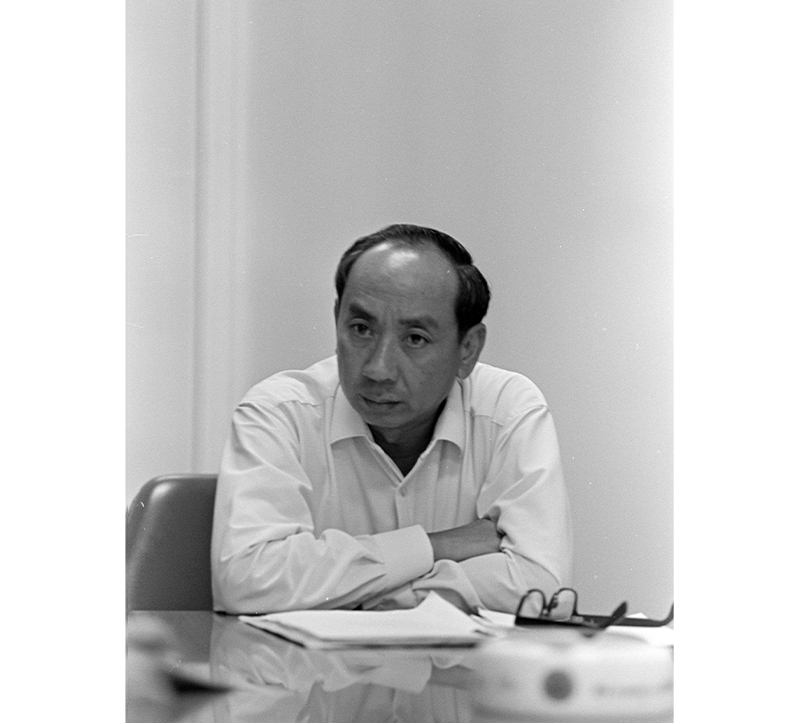
Malaysia’s Prime Minister Tunku Abdul Rahman (Tunku) was in London in June 1965 when he was laid low by an attack of shingles. Lying in hospital gave him time to think and on 1 July, he wrote a letter to Acting Prime Minister Tun Abdul Razak about the possibility of cutting Singapore out from Malaysia.
In the two years that Singapore had been part of the Federation, tensions between the two had ratcheted up considerably. Singapore’s ruling People’s Action Party (PAP) blamed extremists in Malaysia for fomenting two race riots in Singapore in 1964. To gain leverage, the PAP formed a coalition of opposition parties in the Federation that the Tunku saw as a threat to Malaysia’s ruling National Front coalition that he led. (Albert Lau’s essay “Separation” in The Albatross File: Inside Separation explores the deep fissures in the relationship between the two countries while Tan Tai Yong’s “Merger” in the same volume provides the historical context for understanding why Singapore joined Malaysia in the first place.1)
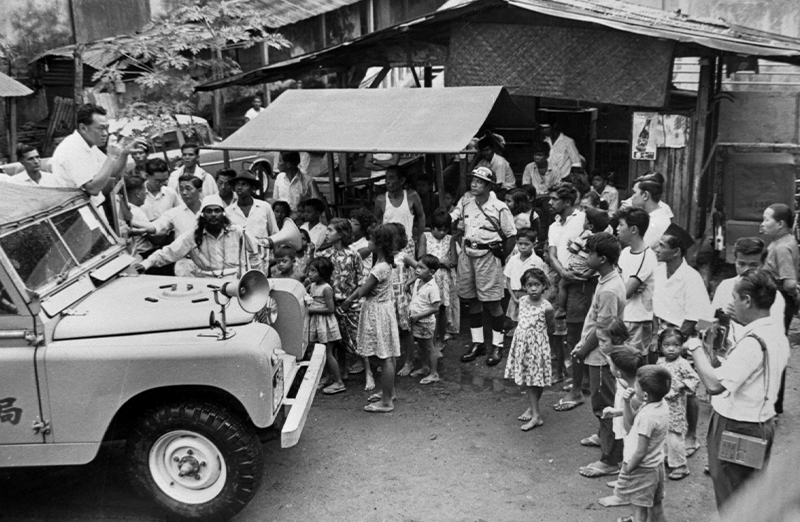
While the Tunku was mulling the possibility of separating Singapore from the Federation, similar thoughts were swirling through the mind of Singapore’s Finance Minister Goh Keng Swee. During a meeting with Razak and others in mid-July 1965, Goh told Razak that “the best thing would be to call it quits, and that we should go our separate ways”.2
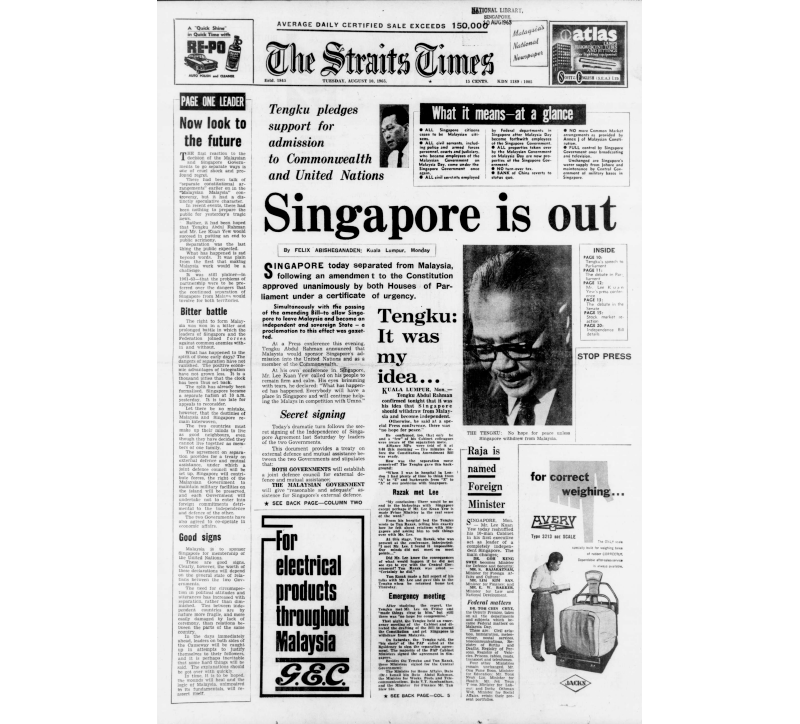
In his oral history interview in 1982, Goh explained: “I’d had enough of Malaysia. I just wanted to get out. I could see no future in it, that the political cost was dreadful and the economic benefits, well, didn’t exist. So it was an exercise in futility. So [as] far as I was concerned, you know, it was a project that should be abandoned once you say that it was worthless.”3
Less than a month after that first fateful meeting in Kuala Lumpur, Singapore was out.
The following extract from The Albatross File: Inside Separation describes the two meetings that Goh had with Razak in Kuala Lumpur in July 1965. It also presents a transcript of Goh’s handwritten notes from the second meeting which outlined the mechanics of how the separation would be carried out.
Goh was in Germany for medical treatment for most of June 1965; his liver problems had started to flare up in late May 1965 and a medical specialist had recommended he receive treatment at the German spa town of Bad Kissingen.4
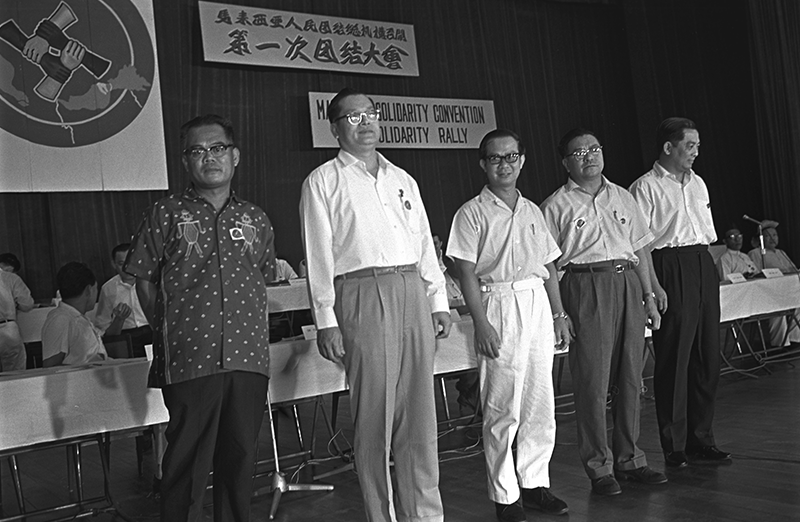
In his absence, Toh [Chin Chye, Deputy Prime Minister of Singapore] and Rajaratnam [S. Rajaratnam, Minister for Culture of Singapore] launched what by most accounts was a successful first meeting of the Malaysian Solidarity Convention (MSC) on 6 June that “rang alarm bells in KL”, Goh noted in his oral history interview in 1982. Calls for Lee’s [Lee Kuan Yew, Prime Minister of Singapore] arrest were also beginning to alarm the British Government. When rumours of a possible coup against Lee surfaced, British Prime Minister Harold Wilson felt compelled, as he wrote in his 1970 memoirs, The Labour Government 1964–1970: A Personal Record, “to let the Tunku know that if he were to take actions of this kind, it would be unwise for him to show his face at the Commonwealth [Prime Ministers’] Conference [in London from 17–25 June], since a large number of his colleagues including myself – would feel that such action was totally opposed to all that we believed in as a Commonwealth”.
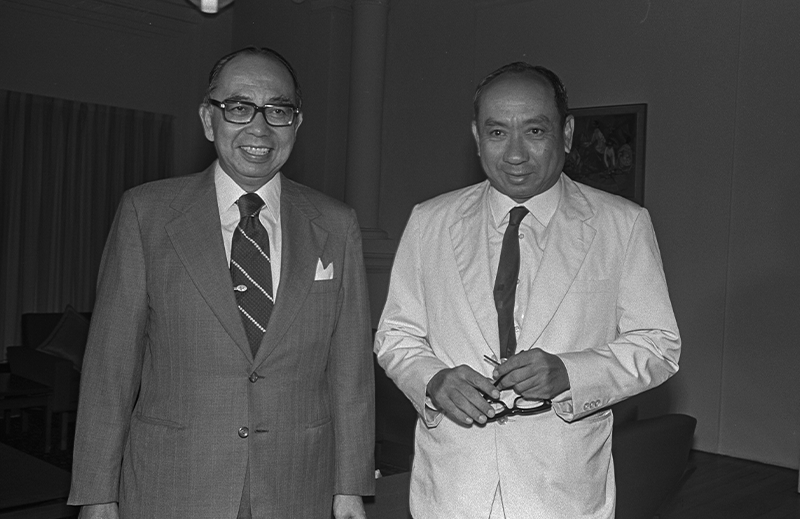
Goh returned to Singapore in early July. Soon after, he was asked to call on then Acting Malaysian Prime Minister Razak. Also present at the meeting, which he remembered as taking place in Razak’s house in Kuala Lumpur, were [Malaysia’s] Minister of Home Affairs Ismail Abdul Rahman and Umno [United Malays National Organisation] Secretary-General Jaffar Albar. “It started with the usual belly-aching session against Lee – his alleged misdemeanours, his character defects and so on and so forth – to which I listened with usual patience. And then Razak said: ‘We can’t go on like this.’ And he asked whether I had any ideas to offer,” Goh recounted in the 1982 interview. Taken aback and “totally unprepared”, Goh replied: “We should go our separate ways. … we leave Malaysia, become an independent state, and you’ll be relieved of all these troubles and we would have also been relieved of troubles from you. All these tensions that built up, communal tensions, will all be over. We’re on our own, you’re on your own.” Razak had then asked Goh to talk to Lee and to let him know if Lee was “willing to go along with it”.
Goh told his oral history interviewer that he did not make a record of this meeting with Razak on 15 July 19655 because “it was rather unexpected”. He might have known that Razak had met Lee on 29 June, but would not have known that Razak had then reported to the Tunku, who was in London for the Commonwealth Prime Ministers’ Conference, that he “could not get through” to Lee and persuade him to stop politicking. This had confirmed the Tunku’s determination to get Singapore out of Malaysia.6
In his 1977 memoirs, the Tunku revealed that he had written to Razak from London on 1 July 1965, saying that while it would be good to talk with Lee, “ultimately I fear we will have no choice but to cut out Singapore from Malaysia in order to save the rest of the body from gangrene”.
Lee, however, was still keen to keep some form of union with Malaysia. In his memoirs, Lee recalled that after being briefed by Goh on his first meeting with Razak in July 1965, he had discussed with Goh “all the possible alternatives and decided that anything was worth trying if we could avoid a racial collision”.7
Goh then saw Razak and Ismail again on 20 July. This time, Goh made a record of the discussion and kept his handwritten notes in the Albatross file. It was very likely not circulated to the rest of the Cabinet since, as Goh told the Malaysian leaders on 20 July, the “only ones privy to this” were Lee, Lim Kim San [Singapore’s National Development Minister], E.W. Barker, Singapore’s Law Minister] and himself. Toh and Rajaratnam, Goh told Razak, were “too deeply involved” in the MSC to consider any rearrangements.
Goh secured Razak and Ismail’s agreement on three issues at this 20 July meeting:
• Singapore’s separation from Malaysia “must be presented as a fait accompli to the British” so they could not prevent it.
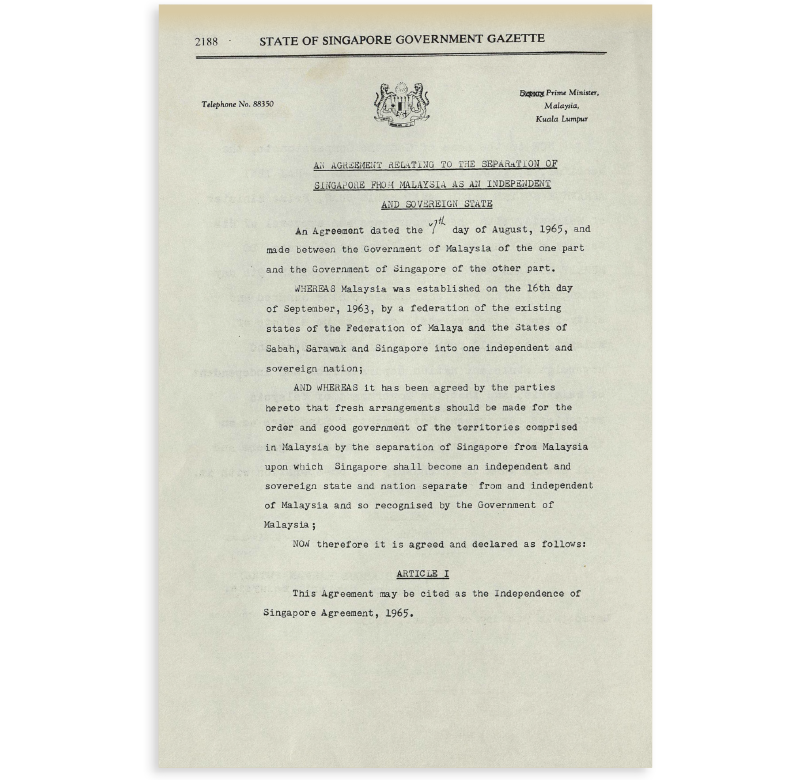
• The constitutional amendments to make Singapore independent should be passed no later than 9 August, when the Federal Parliament next convened.
• Singapore’s Minister for Law Barker would draft the legal documents and show them to the Malaysians within a week to 10 days.
Goh recorded that Razak was not only greatly relieved, but also grateful to Goh for “getting this solution on the move”.
The next day (21 July), Goh learnt from Ghazali Shafie,8 the Secretary-General of the Malaysian Ministry of External Affairs, that the Tunku had already given instructions to “return Singapore to Lee Kuan Yew” if no way to avoid communal trouble could be found. Ghazali, who had not been at previous negotiations, had been present at a lunch meeting between the Tunku and Lee on 14 April 1965, where the Malaysian leader had asked Lee to “list all complaints to Ghazali”, as Lee revealed in his oral history interview in 1982.
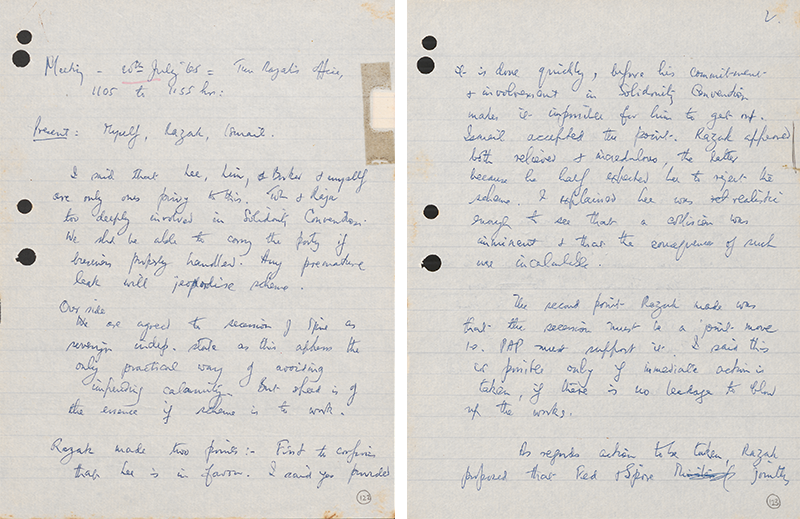
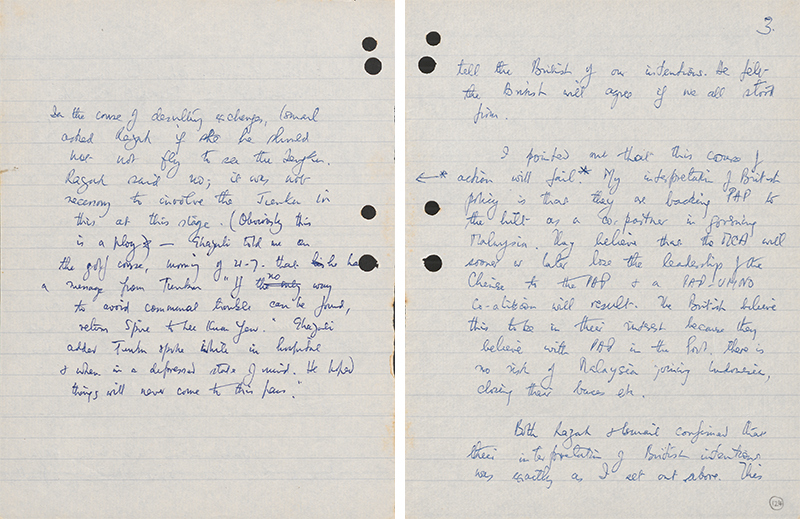
Goh Keng Swee’s Notes on His Meeting with Acting Malaysian Prime Minister Abdul Razak and Minister of Home Affairs Ismail Abdul Rahman on 20 July 1965
Meeting: 20 July 1965, Tun Razak’s office, 1105 to 1155 hours
Present: Myself, Razak, Ismail
I said that Lee, Lim [Kim San], Barker & myself are only ones privy to this. Toh and Rajaratnam too deeply involved in [Malaysian] Solidarity Convention. We should be able to carry the party if business properly handled. Any premature leak will jeopardise scheme. Our side are agreed to secession of Singapore as sovereign, independent state as this appears the only practical way of avoiding impending calamity. But speed is of the essence if scheme is to work.
Razak made two points: First to confirm that Lee is in favour. I said yes, provided it is done quickly, before his commitment and involvement in [Malaysian] Solidarity Convention makes it impossible for him to get out. Ismail accepted the point. Razak appeared both relieved and incredulous, the latter because he half expected Lee to reject the scheme. I explained Lee was realistic enough to see that a collision was imminent and that the consequences of such were incalculable.
The second point Razak made was that the secession must be a joint move i.e. PAP [People’s Action Party] must support it. I said this is possible only if immediate action is taken, if there is no leakage to blow up the works.
As regards action to be taken, Razak proposed that Federation and Singapore jointly tell the British of our intentions. He felt the British will agree if we all stood firm.
I pointed out that this course of action will fail.
In the course of desultory exchanges, Ismail asked Razak if he should not fly to see the Tunku. Razak said no, it was not necessary to involve the Tunku at this stage. Obviously this is a ploy. Ghazali told me on the golf course in the morning of 21 July that he had a message from Tunku: “If no way to avoid communal trouble can be found, return Singapore to Lee Kuan Yew.” Ghazali added Tunku spoke while in hospital and when in a depressed state of mind. He hoped things will never come to this pass.
My interpretation of British policy is that they are backing PAP to the hilt as a co-partner in governing Malaysia. They believe that the MCA [Malaysian Chinese Association] will sooner or later lose the leadership of the Chinese to the PAP and a PAP–Umno coalition will result. The British believe this to be in their interest because they believe with PAP in the government, there is no risk of Malaysia joining Indonesia, closing their bases etc. Both Razak and Ismail confirmed that their interpretation of British intentions was exactly as I set out above. This established credibility in the soundness of my judgement that the British will never agree to the scheme.
I then proposed that it must be presented as a fait accompli to the British. This should be done no later than 9 August, when Parliament re-assembles. The Constitutional amendments may be made granting Singapore independence – all three readings to take place on that date.
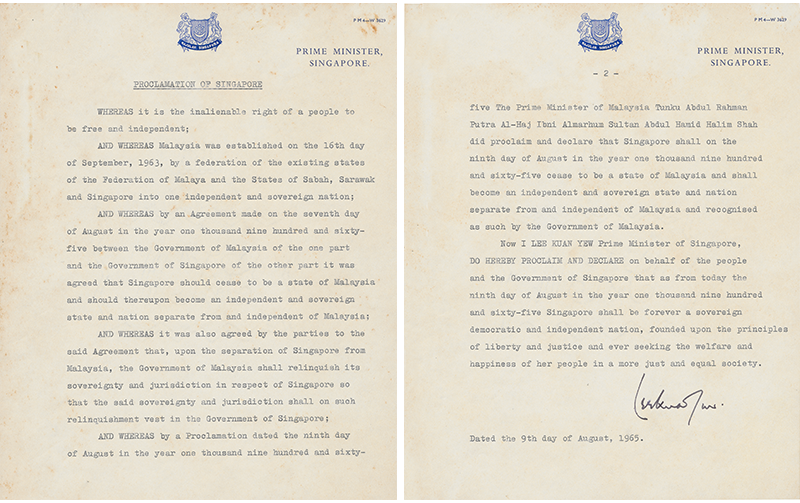
Ismail readily agreed to this proposal. Razak was greatly amused and said that perhaps PAP tactics were the best. I said I saw no objection if Lord Head [Antony Head; British High Commissioner] were informed as an act of courtesy of our intentions at 9.30 am on 9 August, half an hour before the Bill of Independence for Singapore is introduced. This was received with great merriment.
Ismail said two things were necessary – an amendment to the Constitution making secession of Singapore possible and an act giving effect to this article. He said that in the interests of security, civil servants should not be brought into this work and asked if we could do it. I said Eddie Barker will try a draft which we will show them in a week to 10 days’ time. This was agreed to. It shows Ismail had done some homework.
Razak said a defence treaty between Singapore and Malaysian Government[s] should also be proceeded with. I did not follow him nor did I think [it] wise to enquire what sort of treaty he had in mind. The matter was not pursued then but it will be brought up again – I am certain of that – but our best line may be to say this can wait until after independence or if he disagrees to it, to ask him to prepare a draft defence treaty himself. However, we should get this matter off if we could.
I impressed upon both of them the imperative need for secrecy and I think they understand this. I mentioned pointedly to Ismail that his expat[riate] civil servants must not be told anything about this.
All this was completed by 1130 hours or so. I sensed that Razak felt greatly relieved and was grateful to me for my contribution to getting this solution on the move. He really believed that this will not only avoid the calamity now dangerously impending, but also put an end to the tension and misery that he had to put up with in recent months.
The rest of the time was spent on pleasantries as Razak insisted that I should not leave so early. He also arranged for a police car to take me to the airport transit lounge on my homeward journey so as to avoid journalists etc.
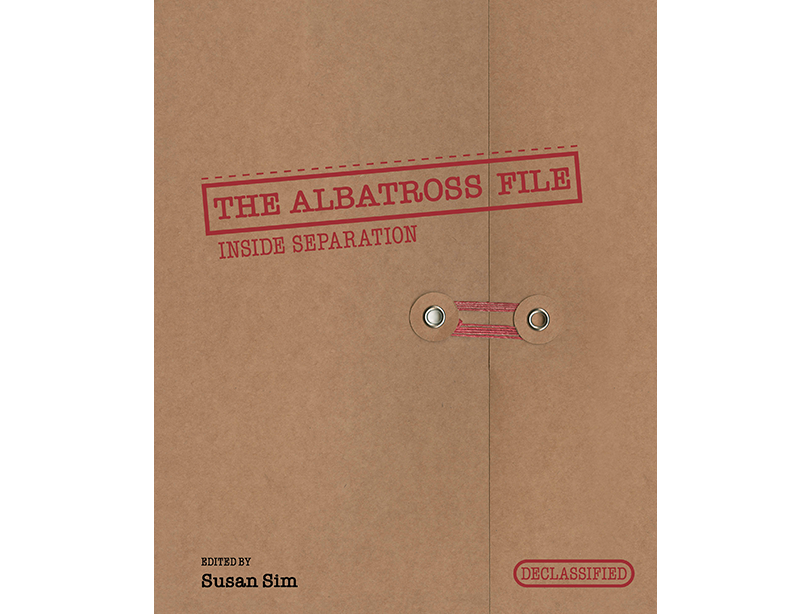
ALBATROSS EXHIBITION AND BOOK
The Albatross File is a secret file kept by Minister for Finance Goh Keng Swee, documenting the secret talks that led to Singapore’s separation from Malaysia. It contains Cabinet papers, memorandums as well as Goh’s handwritten notes of his discussions with Malaysian leaders in the tense days, weeks and months leading to Singapore’s independence on 9 August 1965. The original Albatross File has been in the custody of the National Archives of Singapore since 1996.
In conjunction with newly declassified documents and oral history accounts, a permanent exhibition, The Albatross File: Singapore’s Independence Declassified, and a book, The Albatross File: Inside Separation (National Archives of Singapore and Straits Times Press, 2025), were launched in December 2025.
Jointly organised by the National Library Board and the Ministry of Digital Development and Information, the exhibition on Level 10 of the National Library Building aims to deepen visitors’ understanding of Singapore’s journey to independence through interactive storytelling, historical replays and first-person narratives of Singapore’s founding fathers.
The book contains essays on merger and separation, documents from the Albatross File and other key documents relating to separation, as well as oral history interviews of key players involved. It is available for reference at the Lee Kong Chian Reference Library (call no. RSING 959.5705 ALB) and for loan at selected public libraries (call no. SING 959.5705 ALB). It is also available for sale at physical and online bookshops.
Notes
-
Albert Lau, “Separation,” in The Albatross File: Inside Separation, ed. Susan Sim (Singapore: National Archives of Singapore and Straits Times Press, 2025), 44–97. (From National Library Singapore, call no. RSING 959.5705 ALB); Tan Tai Yong, “Merger,” The Albatross File, 18–43. ↩
-
By the time Goh made the suggestion to Razak on 15 July 1965 that both countries should go their separate ways, the Tunku had already come to the same conclusion. And Razak was aware because the Tunku had written to him on 1 July that they might “have no choice but to cut out Singapore from Malaysia in order to save the rest of the body from gangrene” (Tunku Abdul Rahman Putra al-Haj, Looking Back: Monday Musings and Memories [Kuala Lumpur: Pustaka Antara, 1977]. [From National Library Singapore, call no. RSEA 959.5 ABD]). The Tunku had also told Razak that “it would be a good time to talk with him [Lee Kuan Yew] now”, which Razak might have interpreted as sounding out Lee on the idea of separation, a task he passed on to Goh at their 15 July meeting. ↩
-
Sim, The Albatross File, 351. ↩
-
Tan Siok Sun, Goh Keng Swee: A Portrait (Singapore: Editions Didier Millet, 2007). (From National Library Singapore, call no. RSING 959.5704092 TAN) ↩
-
Neither Goh nor Lee [Kuan Yew], in their oral history interviews, put a date to this first meeting between Goh and Razak in July 1965, except to note that it took place a few days after Goh’s return to Singapore in early July. Singapore historian Albert Lau, in his 1998 account of the negotiations leading to Separation, used the 13 July 1965 date that Australian High Commissioner Tom Critchley first reported might have been the day Goh went to Kuala Lumpur to offer Razak a “new Singapore initiative” (Cablegram 1795, Critchley to Canberra, 16 August 1965). Critchley subsequently corrected the date to 15 July 1965 in a follow-up cable, writing that “Mr Tan Siew Sin has checked up for me and tells me that Dr Goh Keng Swee first raised the disengagement when he came to Kuala Lumpur on July 15 (not the 13th as stated in my telegram)” (Savingram 40, Critchley to Canberra, 24 August 1965). In his essay on Separation in The Albatross File, Lau now uses 15 July 1965 as the date of Goh’s meeting with Razak when Goh first suggested Singapore should become an independent state. ↩
-
Mubin Sheppard, Tunku, His Life and Times: The Authorized Biography of Tunku Abdul Rahman Putra al-Haj (Petaling Jaya, Selangor Darul Ehsan, Malaysia: Pelanduk Publications, 1995). (From National Library Singapore, call no. RSING 959.5051092 SHE) ↩
-
Lee Kuan Yew, The Singapore Story: Memoirs of Lee Kuan Yew (Singapore: Times Editions: Singapore Press Holdings, 1998). (From National Library Singapore, call no. RSING 959.5705092 LEE) ↩
-
Ghazali Shafie, who served from 1959 to 1970 as Secretary-General of the Malaysian Ministry of External Affairs (which became the Ministry of Foreign Affairs in 1966), was later appointed Minister of Home Affairs, and then Foreign Affairs. ↩