
Article
Puff Love: A Deep Dive into Singapore's Beloved Snack
8 October 2026
Topics
Food
History
Curry puffs are crusty on the outside, and tender and heart-warmingly spicy on the inside, just like a good Singaporean.
By Christopher Tan
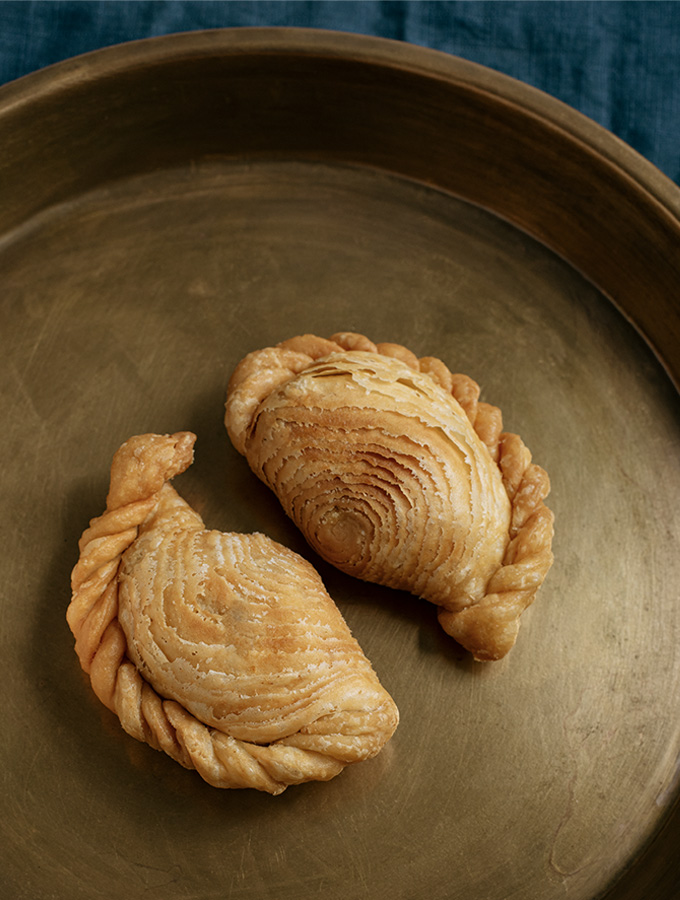
Christopher Tan’s fried lamb-fat curry puffs, 2026. Photo by Christopher Tan.
Portable pastries packing a potent punch, curry puffs have been quintessential staples in Singapore for a long time. As far back as 1917, Victoria Confectionery (the original “Red House” bakery on Victoria Street) advertised baked curry puffs on offer “every Saturday; on other days made to order only”.1
They were namechecked surprisingly frequently in local newspapers’ coverage of society events. In July 1927, for example, the Malaya Tribune reported on a dance held at the Fort Canning Garrison Staff Sergeants’ Mess, where “a plenitude of coffee, sandwiches and other refreshments (curry puffs greatly in demand) were served by a band of willing helpers”.2
In the 1970s and 1980s, Mackenzie Road was dubbed “Kali Pup Lane” (after a humorously mangled mispronunciation of “curry puff”) as three eateries opposite the Rex Cinema, namely Old Chang Kee, Selera Restaurant and Rex Restaurant, all sold curry puffs which were enormously popular with cinemagoers and diners.3
Further east, the area around the Geylang Serai Wet Market and Joo Chiat was another curry puff hub. Nooraisha Hashim, the fifth-generation owner of Haig Road Putu Piring and who grew up in that neighbourhood, recalled: “Every Friday my late grandfather would go to Masjid Khalid and then buy a full box of 10 puffs from the bakery [next door]. The triangle one with potato was my favourite.”4
A survey of local hawker foods published in 1940 lists no less than six distinct curry puff types sold by Cantonese, Hainanese, Bengali, Tamil, Malay and “Hokkien Straits-born” (probably Chinese Peranakan) hawkers. Hainanese ones were baked but all the others were fried. Malay “kari pop” and Cantonese puffs had beef and potato filling, while Hainanese “curry pop” and Hokkien “ipok ipok” used pork and potatoes. Bengali beef and potato puffs were “folded into fancy shape” and fried in mutton fat, whereas Tamil curry puffs paired potatoes with prawns and were fried in coconut oil.5 Echoes of these street snacks can be seen in the several kinds of curry puffs we still enjoy today.
Epok-epok Encounters
Perhaps the most perennially popular species, epok-epok puffs are familiar to most Singaporeans as school tuckshop and hawker centre staples, and were once commonly prepared by students in home economics classes. Made with a dough of flour, water, a fat such as ghee, oil or margarine – sometimes mixed in while hot to yield a more tender texture – and sometimes egg, these half-moon fried puffs have curved edges crimped by hand, or sealed with a fork or plastic press. Their name comes from the Riau Malay word epok, meaning a small pouch traditionally used to hold betel-chewing accoutrements, which the pastry may have resembled.6
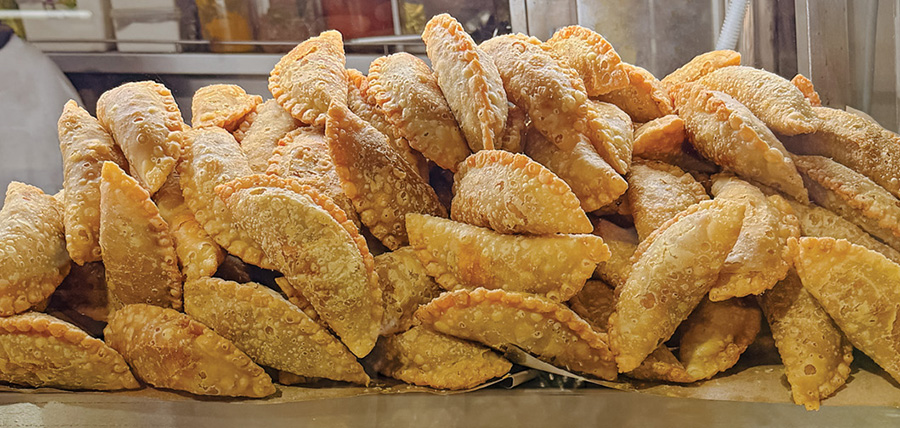
Epok-epok puffs are frequently sold in school tuckshops and hawker centres, 2026. Photo by Christopher Tan.
Adibah Ahmad, of local Malay kueh and snack specialist Deli Maslina, recalled that her family first started selling epok-epok at Mukmin Restaurant in Bedok North in 1981. “We only made one flavour, kentang – curried potato,” her grandmother’s recipe. After they opened a second larger outlet, their repertoire grew to include sardine, vegetable, egg, chicken and beef puffs. “As years went by, with many challenges in navigating the business, we even thought of [not] making our own epok-epok and selling frozen ones instead,” Adibah shared. “However, the demand remains consistent, hence we are still producing epok-epok today.” She observed that sardine puffs are currently the most popular flavour. “It’s evergreen… something that everyone in the family can enjoy.”7
In Malaysia, circular cousins of epok-epok called tembosa sandwich the filling between two plain (or spiralled – see below) dough discs crimped all around their circumference. According to Malaysian culinary doyenne Kalsom Taib, “Sekiranya ditanyakan kepada lelaki dari Johor, bakal isteri yang dicari mestilah tahu mengelim karipap.” [“If you ask a man from Johor, the future wife one seeks must know how to crimp curry puffs.”]8
The Indian-Muslim Karipap
Triangular or oblong, the karipap made by Indian Muslims uses a laminated (repeatedly layered and folded with fat) pastry dough which is sturdier and less airy than Western puff pastry. A particular rolling technique splays and displays its layers to give the baked puffs uniquely crunchy edges: Hazreen Mahmood Hussain explained this to me in her home kitchen, demonstrating how to press out a chunky dough cube into a thin square.9
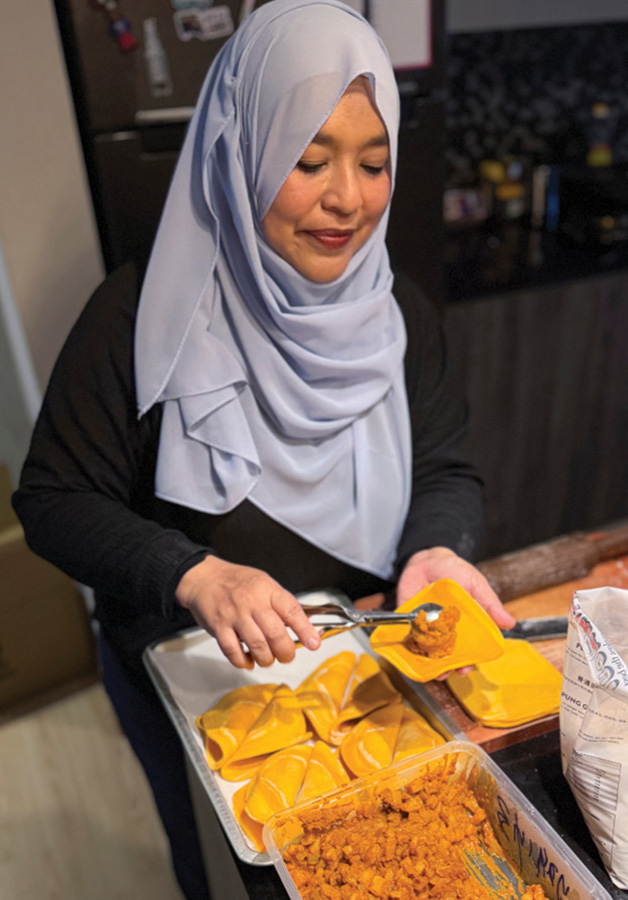
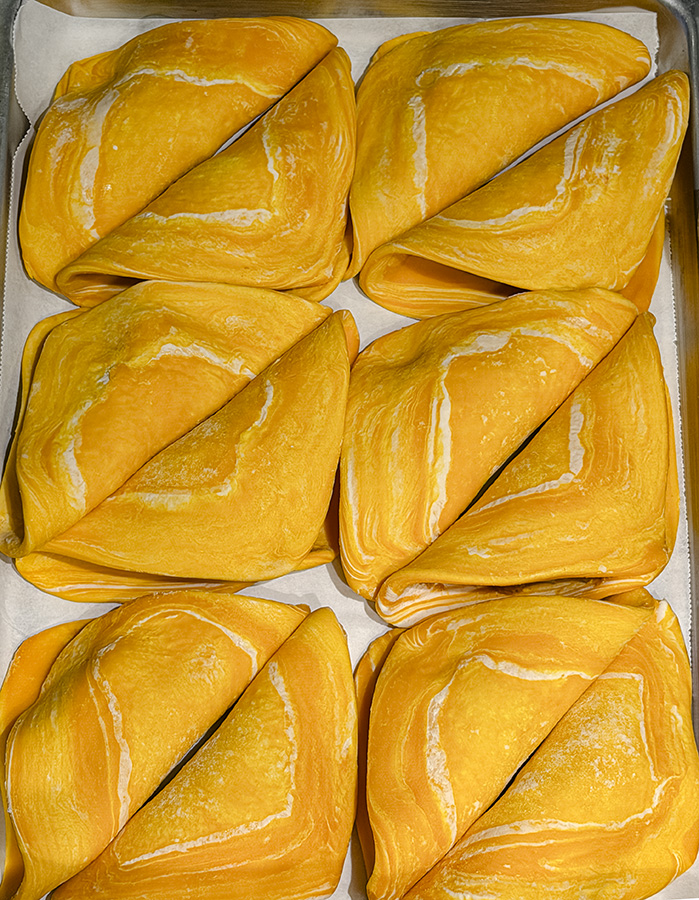
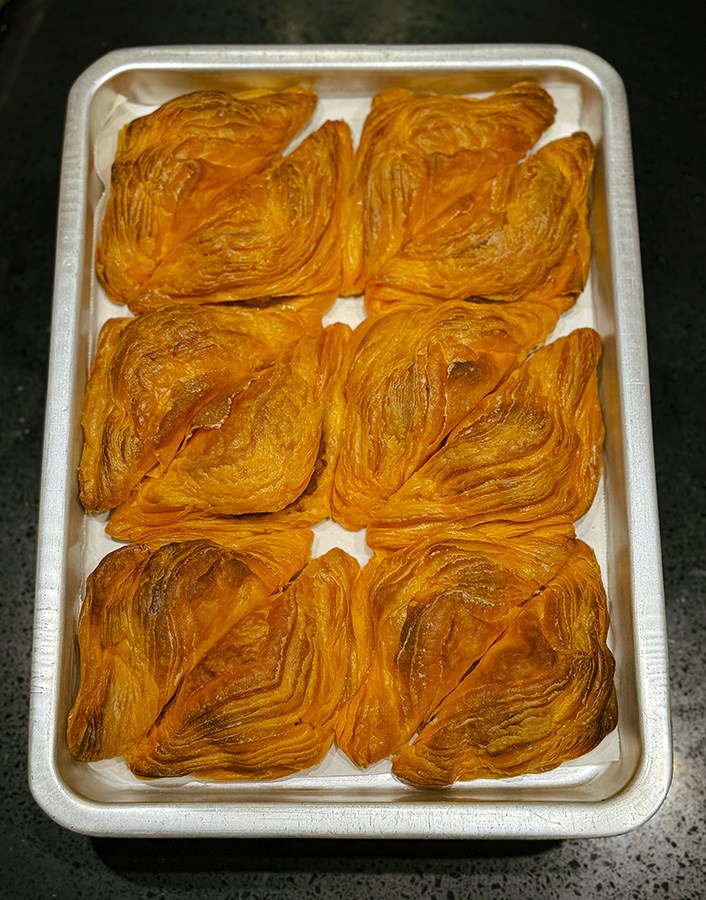
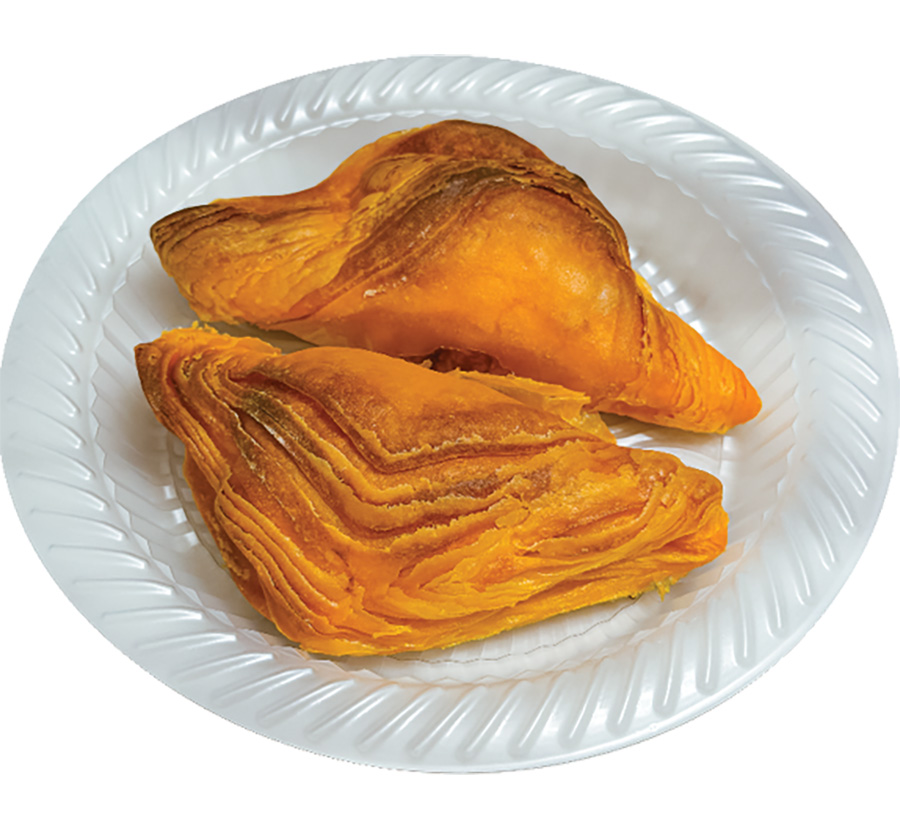
Karipap construction is layered deep into Hazreen’s heritage. Her grandfather Shaikh Jan Bux migrated from Bangladesh to Singapore and became an itinerant hawker, selling bread from a head-mounted basket. He accrued enough success to eventually open Joo Chiat’s Indian Muslim Bakery & Confectionery in 1942, which became famous for its wares baked in large stone-floored ovens – “bread, curry buns, sugee cookies,” said Hazreen.10
The bakery eventually became known to regulars – such as Nooraisha Hashim’s grandfather – as “Onan Road Karipap”,11 after Hazreen’s father, Jan Bux’s eldest son Mahmood, took over as boss in 1977 and began to highlight the pastries. “It’s my mother, who is very creative, who came up with different types of puffs,” Hazreen recalled. “Beef karipap – which was the signature that really made us different from other places – chicken karipap, egg, sardine… I’m proud to say that we served the best [puffs] back then.”12
Hazreen would bring her mother’s custom spice blends to the local mill to be ground into curry powder. Growing up in and around the bakery, she and her siblings regularly lent a hand, and sometimes took the opportunity to play. “We would chase each other around the table… jump here, jump there until we were covered with flour.” Now a school canteen operator, Hazreen still sells her homemade family karipap during school holidays, churning out a few hundred by hand each weekend. It is literally back-breaking work – “I injured my spine because of too much rolling,” she shared. But when customers tell her that her karipap reminds them of her father’s, it is all worth the effort, she said.13
Spiral Symmetries
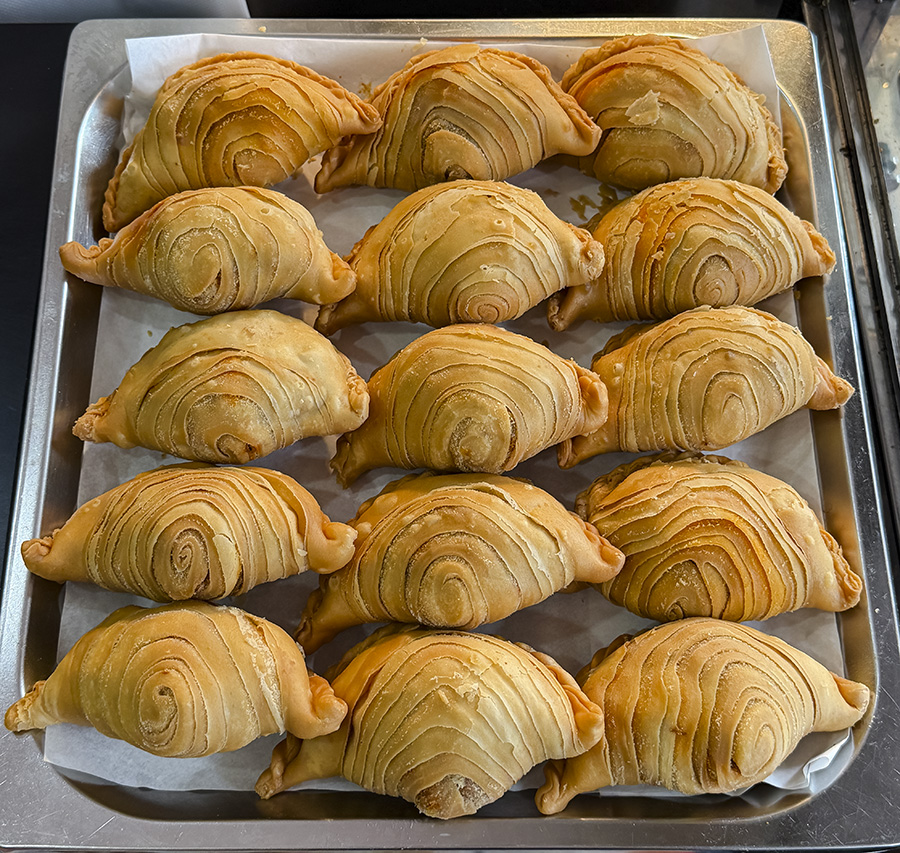
If a water-based dough is laminated with a fat-based dough, rolled out and then rolled up into a log, slicing this crosswise yields discs which, once flattened, folded around a filling and fried or baked, yields puffs with beautifully flaky concentric ridges. This puff style is made by both Malay and Chinese hawkers here, and is also known as karipap gulung, or karipap pusing (gulung meaning “roll”, pusing meaning “turn”, both referring to the spiralling technique) or epok-epok pusar (pusar meaning “navel”, referring to the spiral’s visible centre).
Tay Mui Lan is the third-generation owner of Soon Soon Huat Curry Puff, which began life as 1A Crispy Curry Puffs in Eunos Block 1A in the 1990s. The business later moved to Henderson and is now at Katong. Its founder, her Teochew grandmother Madam Lim Sai Hong, was a keen and expert cook: inspired by the different curry puffs she saw around the Chai Chee kampung where she lived, she created her own spiralled version. Mui Lan fondly recalled, “My Ah Mah, she will tell us, can you please fold 28 [crimps]? She would count them,” because scrimping on crimping makes the edge unpalatably thick. Also, “the pastry has to be light, not greasy, not thick, and the curry should be moist, not dry”.14
 and her mother Ow Siew Kheng in the kitchen at Soon Soon Huat Curry Puff mak.jpg)
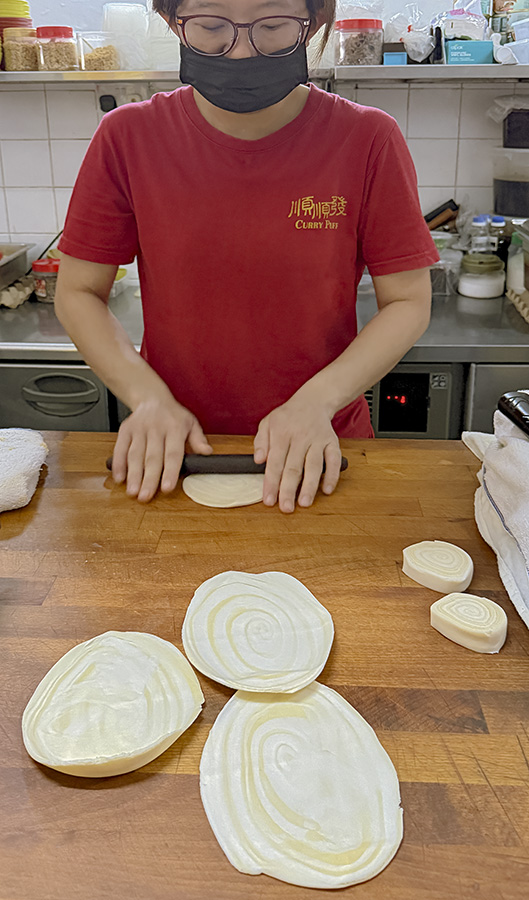
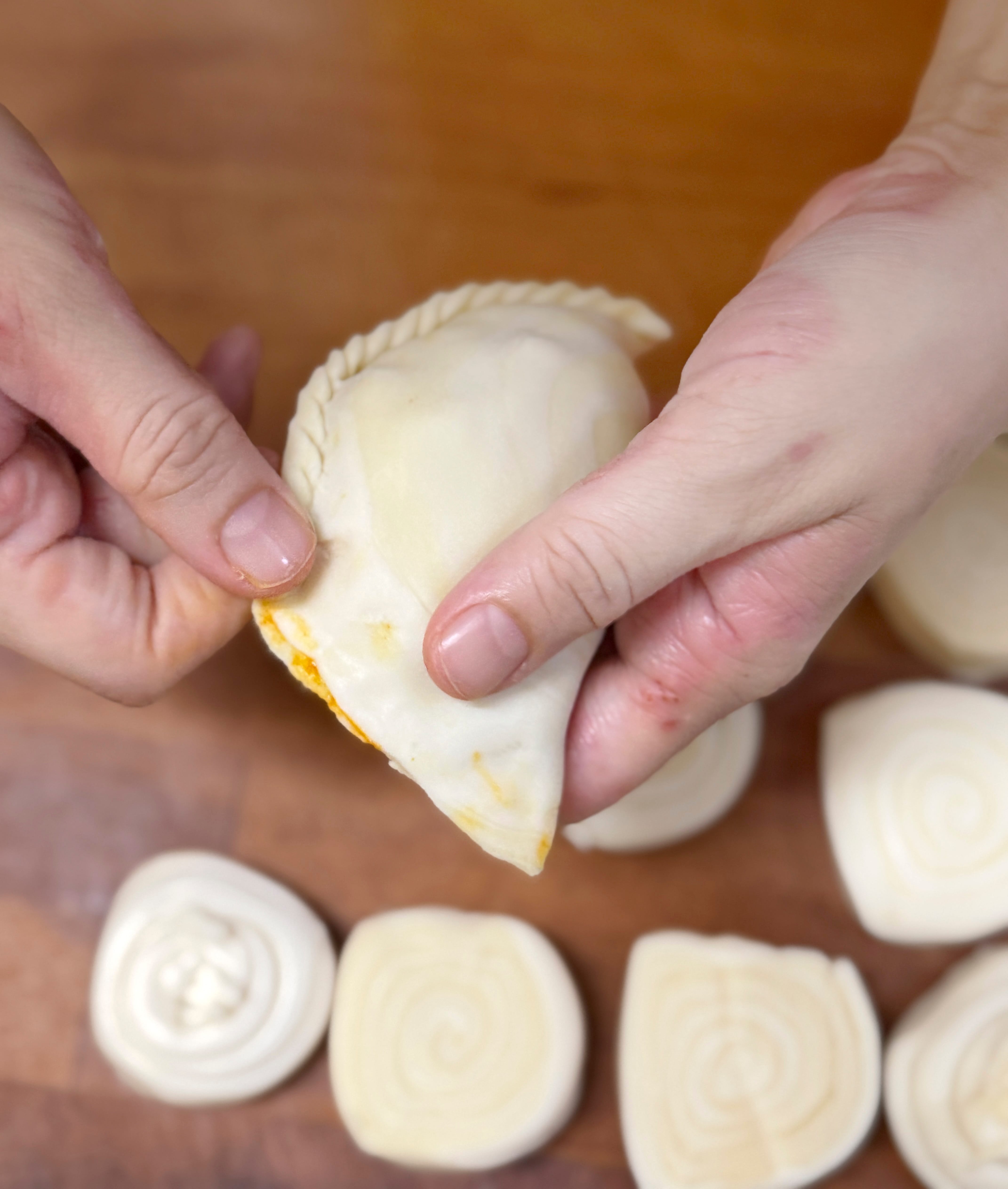
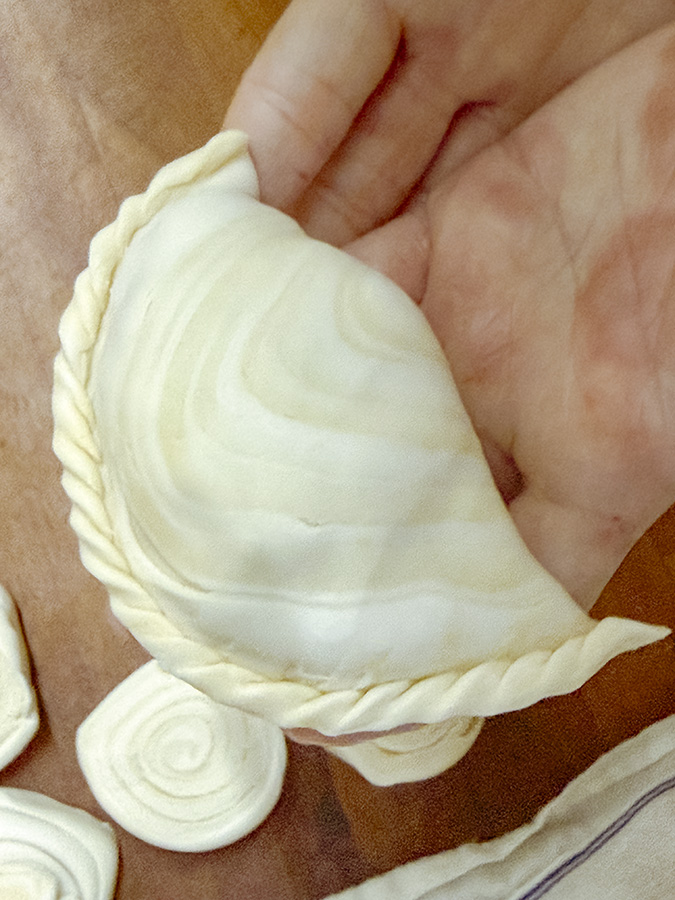
While she has added new filling options like custard and durian, Mui Lan still sticks rigorously to her grandma’s crust, chicken-potato curry and sardine filling recipes after 35 years, albeit with necessary tweaks to account for fluctuations in ingredients and environment. The puffs are made from scratch by hand, fried and sold out every day, with no leftovers for the next. Mui Lan told me about a recent customer who, for her 80th birthday celebrations, ordered “10 chicken and 10 sardine puffs each day on Friday, Saturday, Sunday, because she was meeting different friends for her birthday!” and came by to pick them up each day without fail.15
Knowing that she is feeding the community is precious to Mui Lan. “It’s very important that you have the heart to make this food taste good. People appreciate that this is the old-time taste.” And not only in Singapore – in 2025, visiting chefs from Macau’s Wynn Resort tasted her puffs and were so impressed that they requested a collaboration. With Mui Lan’s tutoring, Soon Soon Huat-branded puffs are now served at the resort, all still hand-made to her Ah Mah’s exacting standards.16

Puff-Pastry Perspectives
Puffs made with many-layered, high-rising Western-style butter puff pastry were popularised by local bakeries from the mid-20th century onwards, many of which were run by Hainanese chefs who were trained in Continental cuisine.
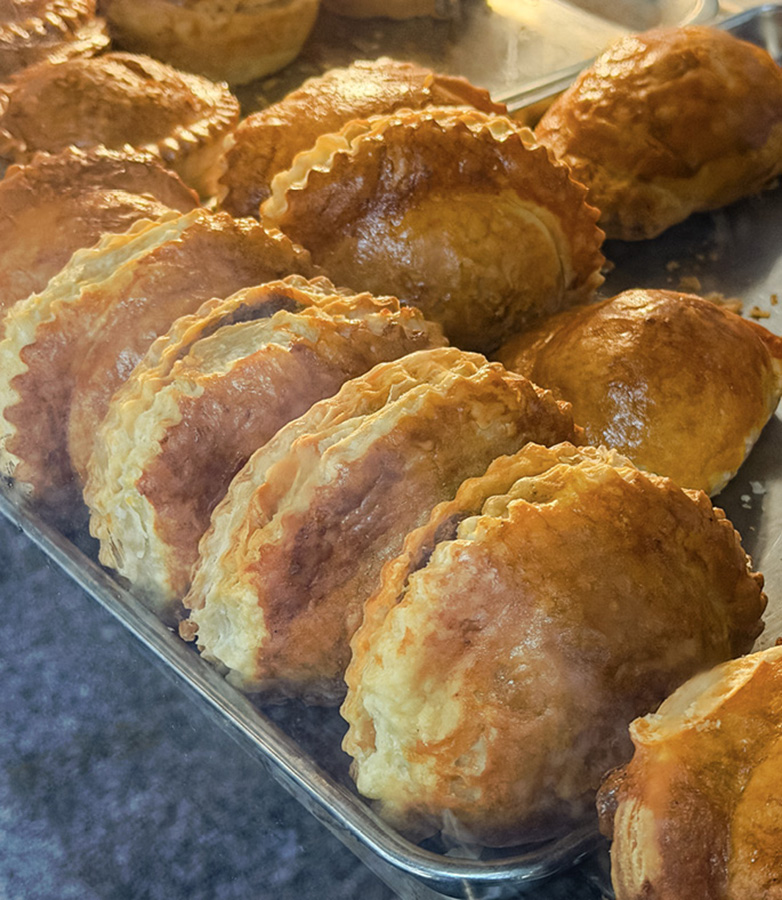
Puff-pastry curry puffs from Balmoral Bakery, 2026. Photo by Christopher Tan.
To take just two iconic examples: Mont d’Or in Ngee Ann Building (where Ngee Ann City stands today) and Polar Café on High Street rose to fame on the strength of their curry puffs and other baked goods. Advertisements from the late 1950s extolled Mont d’Or as an “ice cream, milk and snack parlour” serving “delicious ice-cream and appetising snacks, curry puffs and also Sunday Special Gado Gado”.17
Next to the former Parliament House, Polar Café was a popular haunt of politicians, parliamentarians, lawyers, court reporters and other City Hall denizens. In a Straits Times article from March 1986, then Member of Parliament Tan Soo Khoon recalled Polar puffs being regular teatime fare in the Members’ Room at Parliament House, beloved for “fragrance in the stuffing which could not be matched” and for their signature crisp, light pastry.18
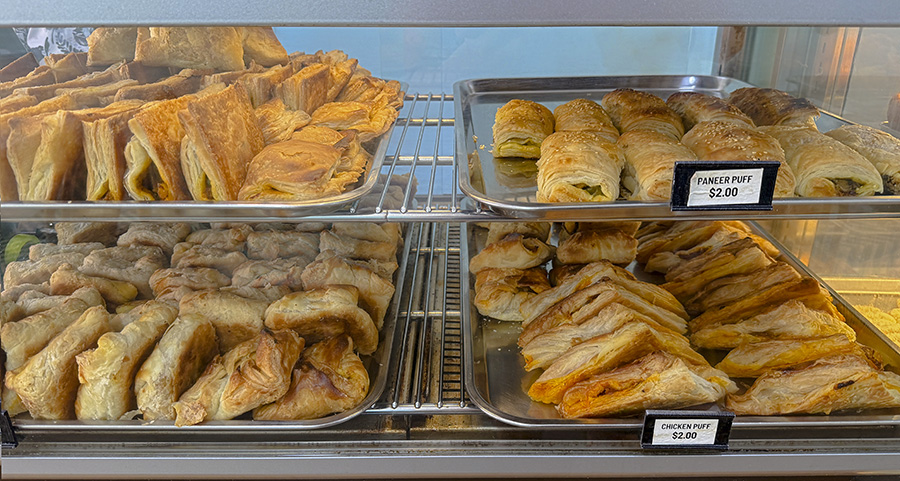
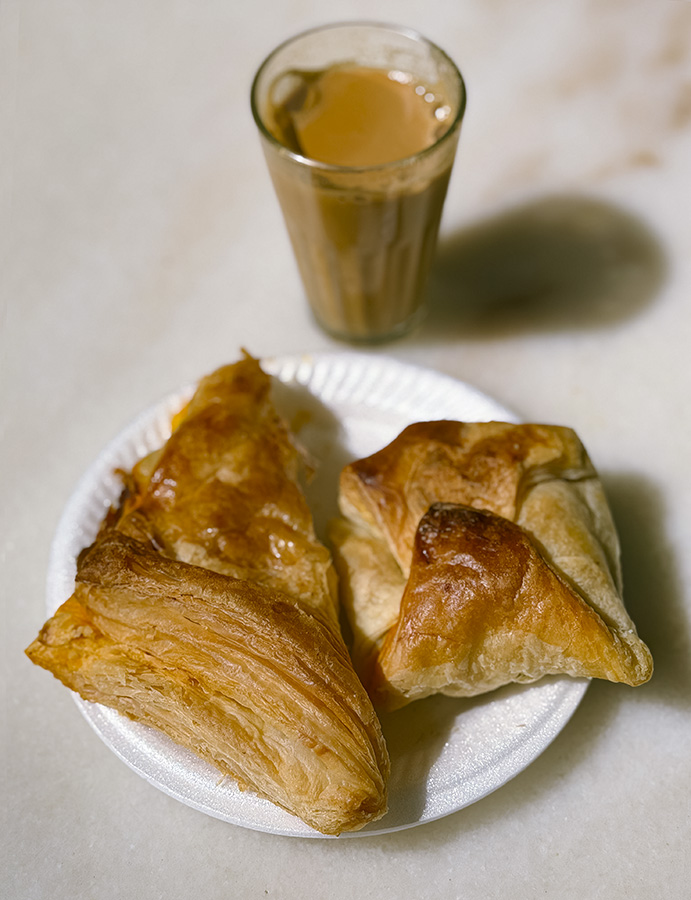
The most recently flourishing puff species in Singapore also uses puff pastry likely learnt from Continental or Portuguese sources, but is now made with vanaspati, an Indian vegetable shortening. Found across Little India’s latest crop of cafe-bakeries, such as Madras Bakery and Star Café, these classic South Indian snacks from states like Kerala and Tamil Nadu are typically filled with egg, paneer, chicken and vegetables, spiced a little differently from Southeast Asian curry puffs, all the better to pair with a cup of hot chai.19
Passage From India
How did curry puffs arrive in Southeast Asia? Britain’s Cornish pasties are often invoked as possible curry puff forebears, but is there any truth to this? Similarities in their shaping may not have any significance. After all, there are only two basic ways to make a filled pastry, geometrically speaking: fold a single dough piece around a filling, or sandwich a filling between two dough pieces. Stuffed dough foods with both geometries are found in virtually every cuisine.
The 1970s domestic science textbook, Let’s Learn to Cook, by teacher Christina Fones contains clearly differentiated recipes for Cornish pasties; fried curry puffs made with Chinese lard pastry or Western shortcrust; and baked shortcrust, flaky or puff-pastry curry puffs.20 We can plainly see from this and other vintage texts that classic Cornish pasties are large and sturdy, wrapping thick shortcrust pastry around raw meat and vegetables, which during a relatively lengthy bake release their own gravy.
Curry puffs differ markedly: smaller and daintier, they have precooked fillings bound by (if any) thickened sauces, and are cooked for a short time only, often in hot oil, if not an oven. Crimps aside, any resemblance to pasties is scant.
As is true for many heritage foods, curry puffs have a more complex backstory than you might expect. The terms “curry” and “curry puff” can both be traced to colonial India, during which era the British expatriate and Anglo-Indian communities blended Indian and English culinary traditions in their kitchens. The wrapping of leftover or purpose-made curry in pastry was a natural, logical and commonplace result.21
Author Jennifer Brennan, raised in Punjab under the British Raj, features a sardine curry puff recipe in her cookbook, Curries and Bugles: A Memoir and Cookbook of the British Raj, citing them as being “very convenient for the khansamer [house chef] to make because we always had sardines in the store cupboard”.22
Curry puffs subsequently travelled with the British to Malaya. Written by Seremban-based “mem” Mrs W.E. Kinsey and published in 1929, The “Mems” Own Cookery Book is a vivid example of how British expatriates abroad ran their home kitchens. Kinsey’s succinct baked puff recipe folds a mixture of minced beef or mutton leftovers, curry powder, onion and butter in shortcrust pastry.23
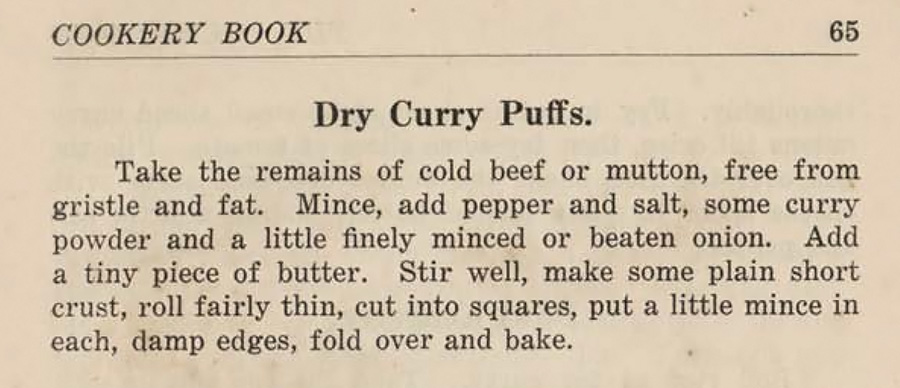
Mrs W.E. Kinsey’s recipe in “The ‘Mems’ Own Cookery Book: 420 Tried and Economical Recipes for Malaya”, 3rd ed. (Singapore: Kelly & Walsh Ltd., 1929), 65. (From National Library of Singapore, call no. RRARE 641.59595 KIN).
Such recipes were rapidly assimilated into local cuisines up and down the Malay Peninsula. For instance, Penang’s Jawi Peranakans adopted the colonial habit of Sunday tiffin, a light meal taken at lunch or at teatime. According to ethnographer Mareike Pampus, a Jawi Peranakan tiffin would regularly feature curry puffs, which Pampus describes as “a deep-fried pastry shell filled with either chicken or potato curry… varieties with tuna, sardines, and beef rendang also exist”. Her interlocutor rather more colourfully observes, “basically what would happen if a British chicken pie and an Indian samosa would have a baby”.24
Eastern Promise
Speaking of samosas, these are thought to descend from pastries originally detailed in Arabic cookery texts penned between the 10th and 15th centuries, which also contain the first recorded recipes for laminated doughs.25 These snacks and techniques subsequently spread along trade and exploration routes from the Middle East to Europe, Central Asia and South Asia. Southeast Asia received these recipes and traditions from South Asia via Muslim traders, and also on a separate track from the Iberian (Al-Andalus) region via Portuguese and Spanish colonisers – who notably also brought from the New World the chillies and potatoes that are inseparable from the curry puffs we know today.26
Within India, the medieval recipes flowered into several samosa species beyond the flat triangles or chunky cones now familiar to most people outside India. Hyderabad has square or rectangular lukhmi samosas (from the Arabic word luqma, meaning “morsel” or “bite”), while Bhopal has triangular warqi samosas with crisply defined thin pastry layers (from the Arabic warq, meaning “leaf”, “sheet” or “paper”). Delhi has Japani (“Japanese”) samosas, assuredly not from Japan but named for how their edges spread open into a fan shape as they are fried.27 As befits its colonial heritage, Goa has Portuguese-inflected incarnations of the samosa, chamuças, which may be filled with pork, beef or other meats.28
Iberian influences are especially apparent in the globe-spanning family of spiral-laminated puffs. Meat-filled pastéis (pastries) from Chaves in northern Portugal boast extravagantly fine, ruffled edges.29 Murcia in southeastern Spain has pasteles de carne (meat pies) whose tops boast dizzyingly, densely concentric spirals.30 Similarly spiralled discs are hand-pressed to make the ultra-flaky bases of pastel de nata, Portugal’s iconic egg custard tarts.31
All of the above are very old recipes which could very well lie in the direct lineage of Asian spiral puffs. Karipap gulung has many visually identical cousins across Southeast Asia. Its Filipino relative is the empanada de kaliskis (kaliskis meaning “fish scales” in Tagalog, a poetic allusion to the pastry’s ridges) from Bulacan province, whose meat or vegetable fillings are typically sweeter and milder than our curry puffs.
Over in Thailand, “karee pup” are also spiralled but usually a little smaller than their Singaporean relatives, and their filling only mildly spiced: Thai food scholars attribute them at least partially to the Portuguese.32 In Indonesia, puffs made with both plain and spiral pastry and stuffed with many different filling varieties are often called “pastel”, meaning “pastry” in both Spanish and Portuguese.33
Laminated and spiral pastry techniques may have reached China from Central Asia via the Silk Road. Such influence is visible, for instance, in northern China’s many varieties of shaobing (烧饼, a genre of traditional Chinese flatbreads and pastries).34 Whether shaobing have a contiguous connection to the laminated lard pastries of southern China is unclear, or at least not well documented. Nonetheless, there are many visual and technical commonalities between spiral puffs and, for example, Shanghai’s “eyebrow pastries”, named for their curvy evocation of the God of Longevity’s eyebrows. Featuring shells of water and fat-based wheat-flour doughs interleaved with a “three-fold, one-turn” lamination, these encase a melange of shredded pork, shiitake mushrooms, and either winter bamboo shoots or carrots.35
A Panoply of Puffs
Between the 1970s and 1990s, local newspaper Berita Harian published articles featuring a fascinating range of karipap varieties, including “karipap India”, a version of Indian Muslim puffs, and “‘karipap jagung istimewa”, shaped like a sweetcorn ear with yellow pastry “kernels” and green pastry “husks”.36
Appearing in 1998, “karipap tanduk” were puff-pastry cones that looked very much like Western cream horns, but filled with meat and potato curry instead of whipped cream. A follow-up article even showed how to arrange 30 “karipap tanduk” around a doll figurine to look like a flounced ballgown, a savoury twist on doll cakes typically made with skirts of jelly or cake.37
These recipes all used butter or pastry margarine for the puff dough. However, two 1970s “karipap lapis” recipes instead laminated the dough with mutton or beef fat.38 Hazreen Mahmood Hussain recalled her uncle telling her how bakers would “boil mutton fat, then… harden it and layer it [in the pastry]. He said that that was the bestkaripap, a lot better than now”. This use of animal-fat pastry formulas rings true to Hazreen’s belief that her grandfather and his peers learnt their baking techniques from the British.39
Colonial-era Anglo cookbooks certainly did likewise. The “Mems” Own Cookery Book makes shortcrust with butter and fat drippings from roast meat.40 In Susie Hing’s recipe from In a Malayan Kitchen (1956), puff dough is laminated with a mixture of butter and “5 ozs mutton suet, pounded”.41 The Malayan Cookbook, published in Ipoh before 1964, also specifies raw mutton suet for curry puff pastry, instructing readers to roll it “until fine, remove stringy bits, etc.”.42 The same book’s chicken pie pastry uses a whopping 2.5 pounds (1.1 kg) of suet to 3 pounds of flour, shaping a spiralled pie lid very much like Murcian pastel de carne.43
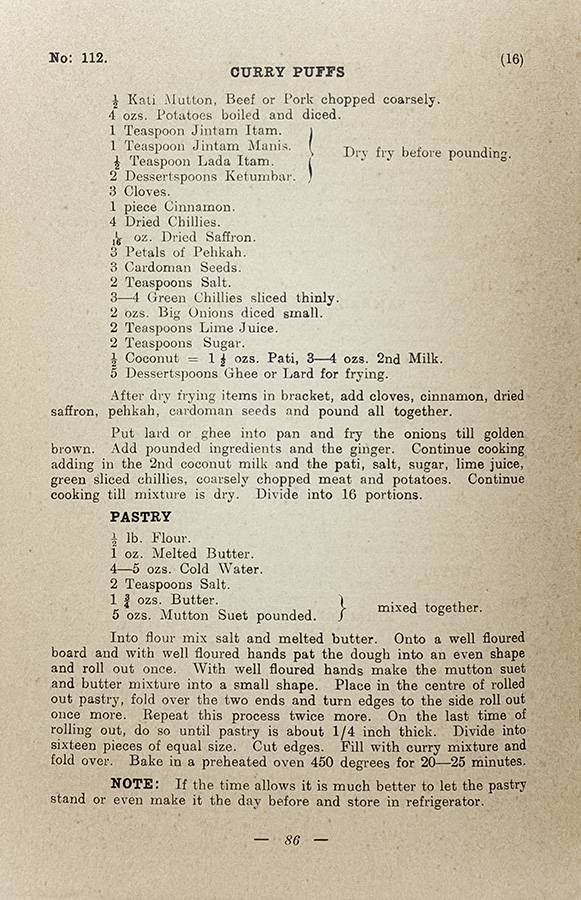
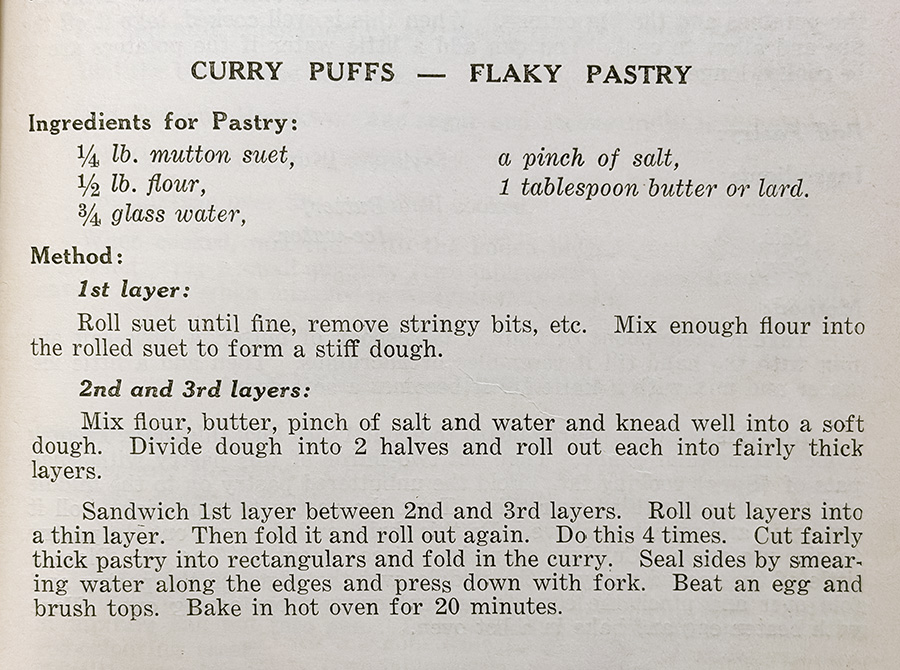
After digesting texts from all of the above, I created my own version of lamb fat pastry, folding and shaping it into fried and baked curry puffs, which you can see in episode 13, “How Did Curry Puffs Come to Singapore?” (opens in new tab), of From Book to Cook (Season 3) on the National Library Board’s YouTube channel.44 Lamb fat gives the pastry a unique and distinctively savoury aroma and crisp flakiness, which lasts for a few days after frying and baking. (Refer to the online version of this article for a simplified recipe of the spiral curry puffs featured in the video.) I also talked about curry puffs in a BiblioAsia Podcast episode, “The Crisped, the Baked, the Spiralled: Curry Puffs and Their History” (opens in new tab), available on Spotify, Apple Podcasts and melisten.45
CHRISTOPHER TAN’S SPIRAL CURRY PUFF RECIPE
To make the fat dough, finely chop 160 g of cleaned lamb or beef fat, then whizz it with 40 ml ice-cold water and 75 g rice flour in a blender to make a smooth paste. On a sheet of plastic wrap or baking paper, spread the paste into a rectangle roughly 12 cm wide by 16 cm high. Wrap up tightly and chill for 30 to 45 minutes, until it is very firm.
To make the water dough, stir 450 g plain flour, 20 g icing sugar, 8 g baking powder, 6 g fine salt and 1/2 teaspoon turmeric powder together, and pour into a blender. Add 110 g cold diced butter, then pulse-blend until the mixture looks like sand. Pour the mixture into a bowl. Whisk two egg yolks with 130 g ice-cold water until smooth, then stir into the flour mixture to make a soft dough. Briefly knead the dough to even it out, then shape it into an oblong, wrap in plastic wrap and chill for 20 minutes.
Dust a rolling pin and work surface with plain flour. Roll out the water dough into a rectangle 25 cm wide by 16 cm high. Place the fat dough on top of the water dough, then fold in the sides of the water dough to completely enclose the fat dough. Pinch the seams to seal. Roll out the dough parcel into a long rectangle 20 cm wide by 50 cm tall. Fold it in thirds, like a business letter. Wrap up the dough and chill for 30 minutes. Then, roll it out again into a strip 24 cm wide by 45 cm long. Starting from a short side, roll up the dough rectangle into a log. Wrap it in plastic wrap and chill it for 40 minutes, until completely firm.
Trim the log ends to flatten them, then cut the log into 12 equal slices. Flatten a slice with your palm, pushing from its centre to its perimeter, then roll it out into a circle 10 to 12 cm in diameter. Top the circle with a spoonful of your chosen filling, then fold it in half and pinch the curved edge firmly to seal: try not to trap any air inside the puff. Crimp the edge. Shape all the puffs likewise. Deep-fry the puffs in hot oil (about 150–160°C), stirring occasionally. They should bubble steadily but gently and slowly rise to the oil surface. Scoop them out when they are golden brown, and drain on a rack before serving. (Watch the video on NLB’s YouTube channel to see this being made.)
About the author
Christopher Tan is a food writer, author, educator and photographer. His most recent books are NerdBaker 2: Tales from the Yeast Indies (Epigram Books, 2024), about yeast cookery, and The Way of Kueh: Savouring & Saving Singapore’s Heritage Desserts (Epigram Books, 2019), a celebration of local kueh culture. He is a regular BiblioAsia contributor who has also appeared in the From Book to Cook video series and BiblioAsia Podcast.
Endnotes
1 “Page 7 Advertisements Column 6 (opens in new tab),” Malaya Tribune, 28 April 1917, 7. (From NewspaperSG)
2 “The Social Whirl (opens in new tab),” Malaya Tribune, 19 July 1927, 7. (From NewspaperSG)
3 Margaret Chan, “Stroll Down Kali Pup Lane (opens in new tab),” Straits Times, 26 December 1982, 16. (From NewspaperSG)
4 Personal interview with Nooraisha Hashim, 9 June 2026.
5 N.A. Canton, J.L. Rosedale and J.P. Morris, Chemical Analyses of the Foods of Singapore (opens in new tab) (Singapore: S.S. Government Publications Bureau, 1940), 21, 35, 116, 150. (From National Library of Singapore, call no. RRARE 664.07 CAN)
6 R.J. Wilkinson, A Malay-English Dictionary (opens in new tab) (Singapore: Kelly & Walsh, 1901), 56. (From National Library of Singapore, call no. RRARE 499.230321 MAL)
7 Personal interview with Adibah Ahmad, 1 July 2026.
8 Kalsom Taib and Hamidah Abdul Hamid, Makanan Warisan Malaysia: Resepi Masakan Autentik Dan Tradisional (opens in new tab) [Malaysian heritage food: Authentic and traditional cooking recipes] (Kuala Lumpur: Kalsom Taib Publishing, 2021), 176. (From National Library of Singapore, call no. Malay RSEA 641.59595 KAL)
9 Personal interview with Hazreen Mahmood Hussain, 9 June 2026.
10 Personal interview with Hazreen Mahmood Hussain.
11 Belmont Lay, “Onan Road Karipap Shop, Opened in 1942, Closing Sown on Sep. 10, 2023,” Mothership, 7 September 2023, https://mothership.sg/2023/09/indian-muslim-bakery-confectionery-closing-down/ (opens in new tab).
12 Personal interview with Hazreen Mahmood Hussain.
13 Personal interview with Hazreen Mahmood Hussain.
14 Personal interview with Tay Mui Lan, 17 June 2026.
15 Personal interview with Tay Mui Lan.
16 Personal interview with Tay Mui Lan.
17 Nancy Koh, “A Stroll in to Bygone Time (opens in new tab),” New Nation, 17 August 1979, 26; Angelica Tan, “They Serve Curry Puffs with a Long History (opens in new tab),” City Weekly, 29 May 1998, 2; “Page 1 Advertisements Column 1 (opens in new tab),” Singapore Free Press, 15 April 1959, 1. (From NewspaperSG)
18 Lee Wai Wun, “‘Polar Puffs' Put to Tastebuds Test (opens in new tab),” Straits Times, 15 March 1986, 13. (From NewspaperSG)
19 Priyaja Bakshi, “Egg Puff: Make These Flaky and Crispy South Indian Puff for Evening Chai,” NDTV Good Times, 21 April 2022, https://food.ndtv.com/food-drinks/egg-puff-make-these-flaky-and-crispy-south-indian-puff-for-evening-chai-2907029 (opens in new tab).
20 Christina M.C. Fones, Let’s Learn to Cook (opens in new tab) (Macmillan & Co. Pte. Ltd, 1970), 205–08. (From PublicationSG)
21 Bridget White-Kumar, “Mince Curry Puffs,” Anglo Indian Cuisine, 4 April 2017, https://anglo-indianfood.blogspot.com/2017/04/mince-curry-puffs.html (opens in new tab).
22 Jennifer Brennan, Curries and Bugles (Hong Kong: Periplus Editions [HK] Ltd., 2000), 143. See Jennifer Brennan, Curries and Bugles: A Memoir and Cookbook of the British Raj (opens in new tab) (India: Penguin, 1992). (From National Library of Singapore, call no. RUR394.1208921054 BRE-[CUS]). It is tempting to speculate whether Singapore’s sardine puffs ultimately descended from Anglo-Indian ones.
23 W.E. Kinsey, The “Mems” Own Cookery Book: 420 Tried and Economical Recipes for Malaya (opens in new tab), 3rd ed. (Singapore: Kelly & Walsh Ltd., 1929), 65. (From National Library of Singapore, call no. RRARE 641.59595 KIN)
24 Mareike Pampus, “More Than Colonial Vestige? Afternoon Tea as Heritage Practice in Penang (Malaysia),” Heritage 6, no. 3 (2023): 2936, https://doi.org/10.3390/heritage6030155 (opens in new tab).
25 Vir Sanghvi, “Samosas Did Not Originate in India,” Vir Sanghvi, accessed 3 September 2026, https://www.virsanghvi.com/Article-Details.aspx?key=1659 (opens in new tab).
26 Nelson Foster and Linda S. Cordell, eds., Chilies to Chocolate: Food the Americas Gave the World (Tucson: University of Arizona Press, 1992), 1–14, 81–93.
27 Gautam Anand, “Snacking on a Bit of History,” UpperCrust, accessed 3 September 2026, https://uppercrustindia.com/v3/posts/1030/snacking-on-a-bit-of-history (opens in new tab).
28 Inês Tavares, “Chamuça: Savory Legacy of Portugal’s Indian Connection,” Lisbon.vip, accessed 3 September 2026, https://www.lisbon.vip/lisbon-essentials/gastronomic-exploration/chamuca (opens in new tab).
29 Pastel De Chaves IGP, “História,” Feel the Street, accessed 3 September 2026, https://pasteisdechaves.pt/pastel-de-chaves-igp/ (opens in new tab).
30 Mikel López Iturriaga, “Pastel de Carne: La Delicia Que Sobrevivió En Murcia,” El Pais, 8 February 2021, https://elpais.com/gastronomia/el-comidista/2021/01/14/articulo/1610616730_518964.html (opens in new tab).
31 David Leite, “Pastel de Nata ~ Portuguese Custard Tarts,” Leite’s Culinaria, last updated 15 July 2026, https://leitesculinaria.com/7759/recipes-pasteis-de-nata.html (opens in new tab).
32 สิ่งมีชีวิต, “‘กะหรี่ปั๊บ’ มรดกร่วมจากวัฒนธรรมโปรตุเกสของประเทศโซนเอเชียตะวันออกเฉียงใต” [‘Curry puffs’ are a shared cultural heritage from Portugal in Southeast Asian countries], BrandThink, 30 January 2021, https://www.brandthink.me/content/karipap (opens in new tab).
33 Dani, “Dibalik Renyahnya Pastel: Sejarah dan Kreasi Tak Terduga, Sang Empanada ala Indonesia” [Behind the crispy pastry: The history and unexpected creation of the Indonesian empanada], Aswaja News, 18 January 2025, https://aswajanews.isnuponorogo.org/2025/01/18/dibalik-renyahnya-pastel-sejarah-dan-kreasi-tak-terduga-sang-empanada-ala-indonesia/ (opens in new tab).
34 Margaret Leeming and May Huang Man-hui, Dim Sum: Light Meals, Pastries and Delicacies (California: Macdonald & Co, 1985), 74–75.
35 “Three-Shred Eyebrow Pastry,” BaiduWiki, accessed 4 September 2026, https://baike.baidu.com/en/item/Three-Shred%20Eyebrow%20Pastry/118088 (opens in new tab).
36 Aini Salim, “Karipap India (opens in new tab)” [India curry puff], Berita Harian, 18 April 1999, 13; “Karipap Jagung Istimewa (opens in new tab)” [Special corn curry puff], Berita Harian, 31 August 1986, 7. (From NewspaperSG)
37 Khairani Ahmad “Karipap Tanduk (opens in new tab)” [Horned curry puff], Berita Harian, 25 October 1998, 19; “Anak Patung Karipap Tanduk (opens in new tab)” [Horned curry puff doll], Berita Harian, 1 November 1998, 18. (From NewspaperSG)
38 “Daging, Mentega, Rempah Untok Karipap Lapis (opens in new tab)” [Meat, butter, spices for layered curry puff], Berita Harian, 18 April 1972, 7; “Resepi Karipap Lapis... (opens in new tab)” [Layered curry puff recipe], Berita Harian, 19 August 1978, 5. (From NewspaperSG)
39 Personal interview with Hazreen Mahmood Hussain.
40 Kinsey, The “Mems” Own Cookery Book (opens in new tab), 162–63.
41 Susie Hing, In a Malayan Kitchen (opens in new tab) (Singapore: Mun Seong Press, 1956), 86. (From National Library of Singapore, call no. RCLOS 641.59595 HIN-[RFL]). Suet is the fine white fat culled from around the kidneys of a meat animal, which has a milder flavour and higher melting point than fat found next to muscle layers, and historically has long been valued as a pastry and pudding ingredient in British cooking.
42 Perak Catholic Centre, The Malayan Cookbook, 117. The book is undated but was published before 1964.
43 Perak Catholic Centre, The Malayan Cookbook, 22.
44 “The Curious Case of Curry Puffs,” BiblioAsia, 5 August 2026, https://biblioasia.nlb.gov.sg/all-sections/video-curry-puffs/ (opens in new tab).
45 “The Crisped, the Baked, the Spiralled: Curry Puffs and Their History,” BiblioAsia, 5 August 2026, https://biblioasia.nlb.gov.sg/all-sections/podcast-the-crisped-the-baked-the-spiralled-curry-puffs-and-their-history/ (opens in new tab).