
Article
Beyond the Red Light: Geylang and Its Storied Lorongs
8 April 2026
Topics
History
Places and Buildings
Geylang and its infamous side lanes have a rich history that is often overshadowed by its reputation as a red-light district.
By Andrea Kee
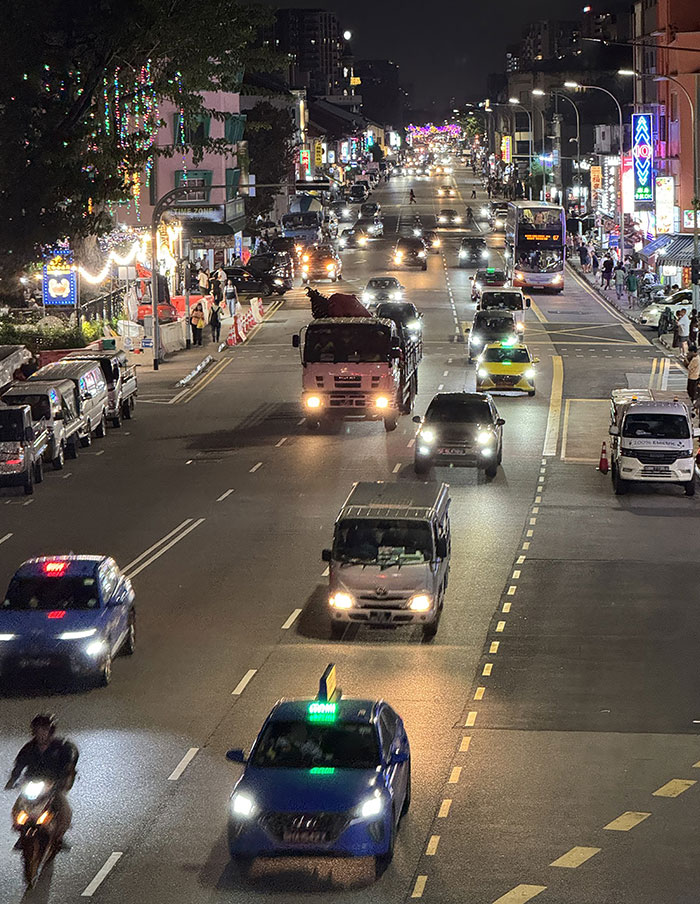
Bustling Geylang Road with its shophouses, eateries and vibrant nightlife, 2026. Photo by Jimmy Yap.
Mention Geylang today and images of seedy back lanes hosting shady vice activities come to mind. At the same time, it is also a magnet for foodies, drawn to iconic Geylang dishes like fresh frog porridge and beef kway teow.
Situated at the city fringe, Geylang is bound by Guillemard Road, Sims Avenue, Lorong 1 Geylang and Paya Lebar Road, and was developed into a commercial and residential district at the turn of the 20th century. The Urban Redevelopment Authority (URA) gazetted it as a conservation area in October 1991, recognising the shophouses constructed between the 1910s and 1950s for their architectural and cultural value, the low-rise bungalows with Malay, European and Chinese influences, and the compound houses with their eclectic designs.1
Beyond its colourful built heritage and relatively recent seedy reputation, bustling Geylang Road and its lorongs – a series of lanes branching off from both sides of Geylang Road – are replete with lesser-known stories about Singapore’s earliest inhabitants, kampong life on stilts, crime-infested swamps and community ties that bind.
Becoming Geylang
One of the earliest written records of Geylang appears in Captain James Franklin and Lieutenant Philip Jackson’s “Plan of the British Settlement of Singapore”, first published in 1828. The map marked out a river, “R. Gilang”, which when transposed onto modern maps, coincides with the location of Geylang River.2
The origin of the placename is unclear. Some sources suggest that it came from the Orang Kallang, an indigenous seafaring tribe (Orang Laut) that settled on houseboats in Kallang Basin formed from the confluence of the Kallang, Geylang and Rochor rivers.3 Interestingly, the Kallang River is also said to be named after these inhabitants.4 Another possible origin is the Malay word kilang, meaning “press”, “mill” or “factory” – a reference to the coconut plantations and agricultural processing works that once covered the area.5
The sandy soil here proved suitable for the cultivation of coconut trees. From the early 1820s, European planters such as Francis Bernard, son-in-law of the first Resident of Singapore William Farquhar, ventured eastward, purchasing land from Siglap Road to the Geylang River and from Geylang Road to the southern shore to establish plantations. By the 1840s, coconut trees covered most land between the Kallang and Geylang rivers. During this period, the British also constructed Geylang Road, setting the scene for further development.6
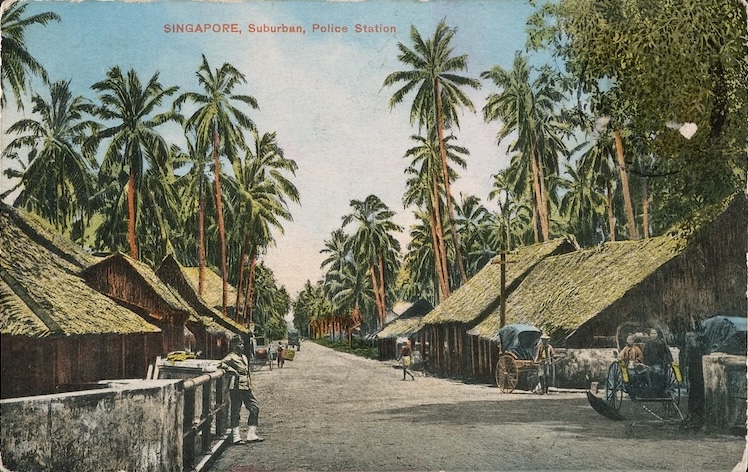
A police post in Geylang, late 19th century. Collection of the National Museum of Singapore, National Heritage Board.
At the turn of the 20th century, two distinct parts of Geylang began to emerge. The eastern part was occupied mainly by the Malay communities who farmed the land. This section of Geylang would eventually develop into present-day Geylang Serai. Chinese immigrants settled in the western part and established small businesses in the lorongs.7
This period also saw a building boom with shophouses, terrace houses and bungalows appearing along Geylang Road and its side lanes. New means of motorised transport – such as the electric tramway and trolley bus service – and municipal support enabled middle-class Chinese and Eurasian communities to leave the congested urban centre and build homes in Geylang.8 By the 1920s and 1930s, the area had become a city-fringe residential suburb.9
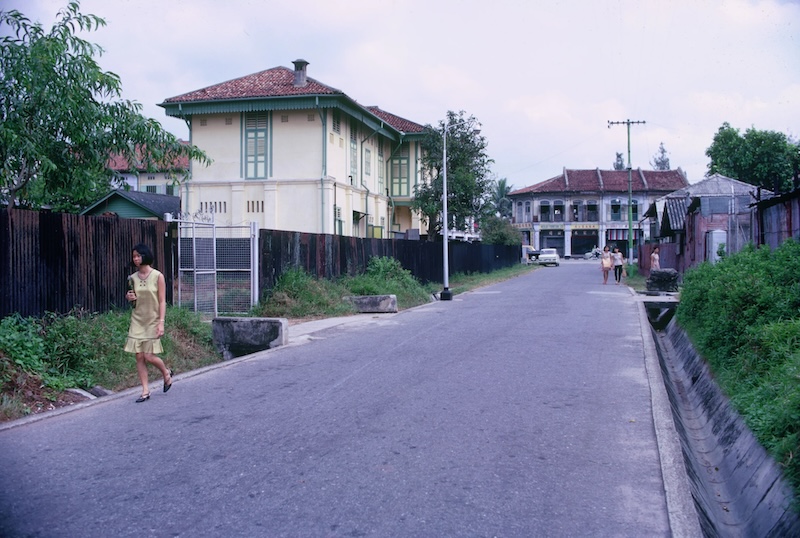
Lorong 24 Geylang, 1968. Lee Kip Lin Collection, National Library Singapore.
Life in the Lorongs and Its Boundaries
While most residents living in shophouses along Geylang Road and in houses lining the side lanes lived in relative comfort, life at the northern boundaries, where squatter colonies and kampongs existed, was starkly different. A 1959–1960 survey by Maris Stella Vocational School students found at least a hundred families living door-to-door in attap huts between Lorongs 27 and 29A. This part of Geylang was considered a slum and had no running electricity, gas or water supply.10
In September 1950, a police manhunt for two Chinese gunmen in the area bordered by Aljunied Road and Sims Avenue, likely at the end of Geylang Lorong 25, uncovered a squatter colony that the Singapore Free Press described as “a rabbit’s warren of hovels unparallelled anywhere else in the Colony”. A reporter and his cameraman, who had accompanied the police, got lost in the maze of attap huts and had to be rescued.11
Before the reclamation of Kallang Basin in the 1960s,12 some of these side roads stretched beyond the confines of solid land into the swamps and streams of the Kallang River. Here, attap huts clustered together, some raised on stilts to avoid the rising tides of the swampy terrain.
One main settlement in the area was Kampong Kuchai (also known as Kampong Koo Chye or Kampong Koo Chuan13), a village on stilts situated at the end of Lorong 3 where present-day Boon Keng is located. This predominantly Malay village housed some descendants of the Orang Laut who were originally settled in Tanjong Rhu until the Second World War. Over time, a sizable Chinese population also began to call the kampong home, with only a muddy creek separating the two communities.14
Chia Soon Ann, the manager of Garrick Theatre and South-East Asia Film Company (which were owned and established by his brother-in-law Lim Chong Pang, a prominent businessman), grew up in a house built over a river in Kallang Basin, near the head of the Kallang River where Lorong 3 and Lorong 17 intersected. He recalled that living over water made it challenging for him to stay out late to play with friends. “[O]ur means of access [home] was by calling for a boat which usually came through my father or one of my brothers or sisters. And one day when I was returning from school after playing football, I was late. When I called for the boat, the boat refused to come because my mother wanted to teach me a lesson for coming home late, so I had to put my books on my head and [swim] across the river.”15
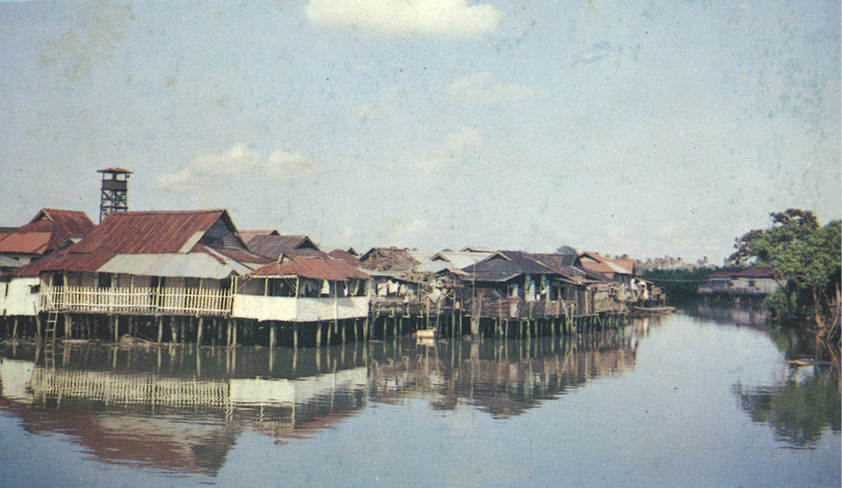
Attap houses on stilts at Geylang Lorong 3, before 1967. Collection of the National Library Singapore.
Lorong 3 was connected to Lorong 17 via an island of sand on which stood a sago factory, tanneries, brickworks, vegetable farms and fish ponds. At Lorong 17 was Kampong Sar Kong, home to a Cantonese community that lived and worked mainly as brickmakers and bricklayers, using the mud from the tidal basin to make bricks.16 According to Chia, “the best bricks were from that area”.17
Danger in the Lorongs
As early as the 1920s, Chinese secret societies began operating in Geylang’s side lanes. Chia recalled labourers from the nearby factories joining these gangs for protection. “They think that… the law and order cannot control, cannot help them…. so they joined the secret society [sic] to protect themselves… when they have trouble, they will seek out the leader of the gang to talk terms with the other side.”18
With the increase in secret societies, opium dens and even violent crimes became commonplace. The murky tidal basin proved conducive for dumping dead bodies when gang fights turned deadly. Chia’s family experienced this firsthand at their prawn pond one day. “When we open[ed] the mill to catch prawns, we found a body in the net… we threw everything away… [the police] couldn’t catch the murderer.” According to Chia, people were silenced by the intimidation of the triads and gangsters. “[They would say] ‘If you tell the police, we will murder you, or some trouble will befall your family’.”19
A February 1970 Straits Times article described Kallang Basin as a “smuggler’s creek, a home of gang chieftains, moonshiners and farmers who eked out a living rearing pigs and poultry in attap colonies on stilts”. Opium was smuggled into Singapore through the swamps, and drums of samsu, a type of illegally home-brewed rice wine, were buried in the mud to evade detection by authorities.20
So fearsome was its reputation that even police officers feared venturing into the kampongs and squatter huts over the waters. Eric Charles Pemberton Paglar, a census officer in the 1950s, recalled the notoriety of Kampong Minyak in Lorong 1: “[W]hen you go in there, sometimes people don’t come out. That was the reputation that place had… I remember once they had to bring the Gurkhas in there before [the police] could enter.”21
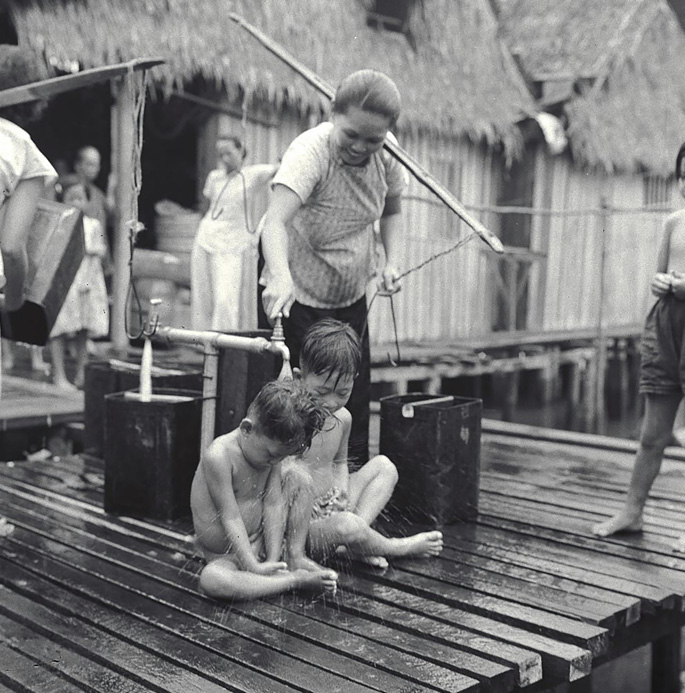
Having a bath using public taps in Geylang Lorong 1, 1956. Source: The Straits Times © SPH Media Limited. Permission required for reproduction.
Another layer of danger that Geylang’s kampong dwellers faced was the ever-looming threat of fires, which could quickly raze through the closely packed attap houses. As a precaution, like in other urban kampongs, residents of densely populated Lorong 23 formed their own 45-member firefighting unit who all underwent training with the Singapore Fire Brigade. Villagers also pooled resources to build a fire watch tower in their kampong.22
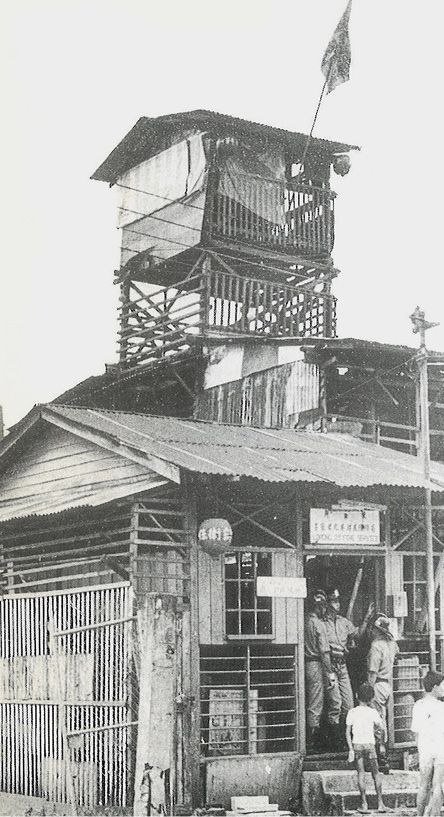
A fire post lookout tower at Geylang Lorong 29 used by volunteers to spot the first signs of fire in their neighbourhood. Image reproduced from Joan Hon, "100 Years of the Singapore Fire Service" (Singapore: Times Books International, 1988), 76. (From National Library Singapore, call no. RSING 363.378095957 HON).
Kampong residents had good reason for caution. In the panic of escaping a fire that broke out in July 1953 at Geylang Lorong 3, widow Lim Kui Chan “instinctively grabbed her iron first and waded through the knee-high mud with her children to safety.” As a washer woman, the clothes iron was her only thought, but in the chaos she left behind her lifesavings. In another heartbreaking story, grandmother Sim Guat had to choose between saving her four-year-old grandson or $2,000 worth of jewellery. “What else could I do but save my grandson. He is my treasure, and I had first to get him out of the house,” she said.23
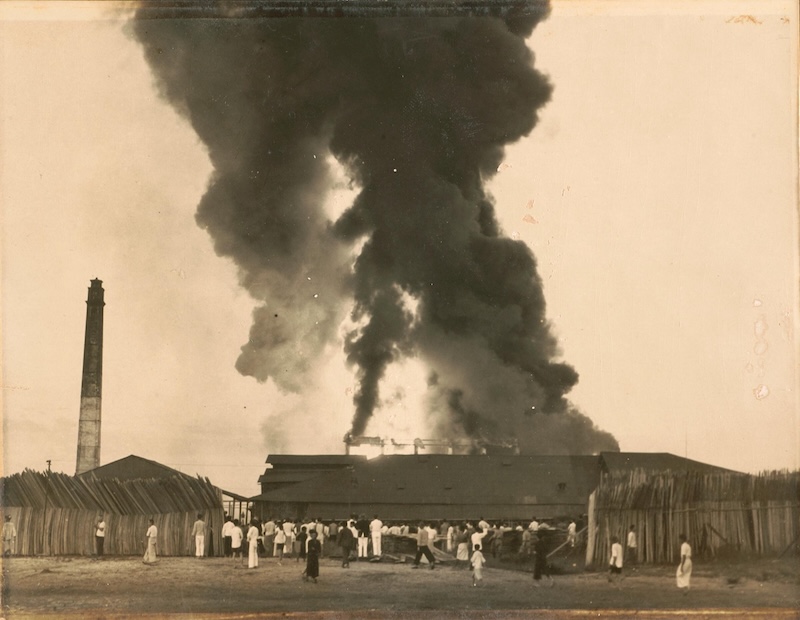
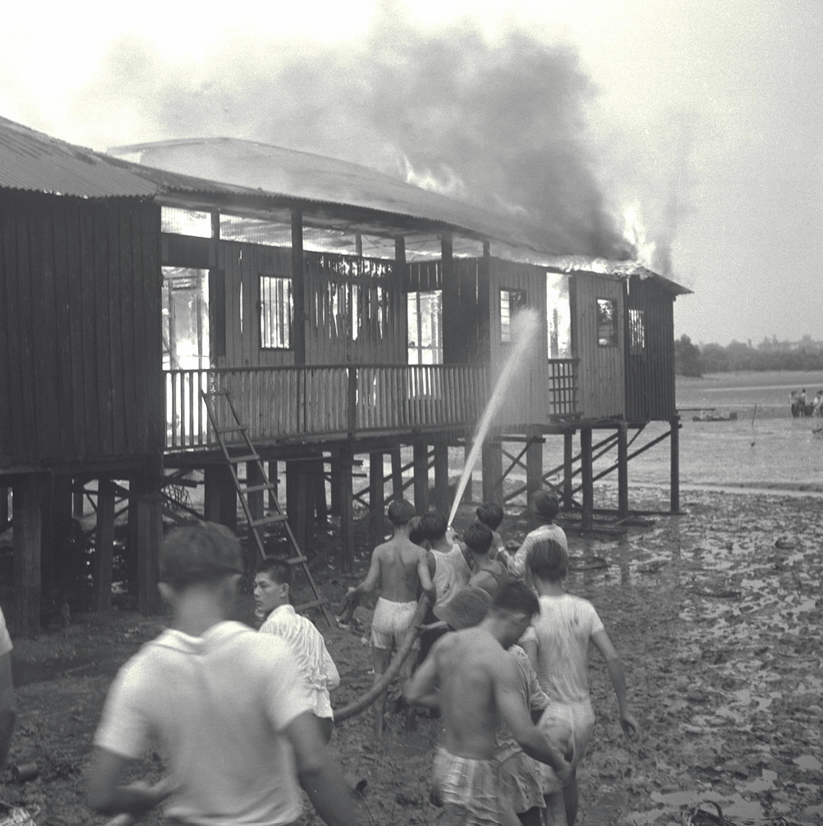
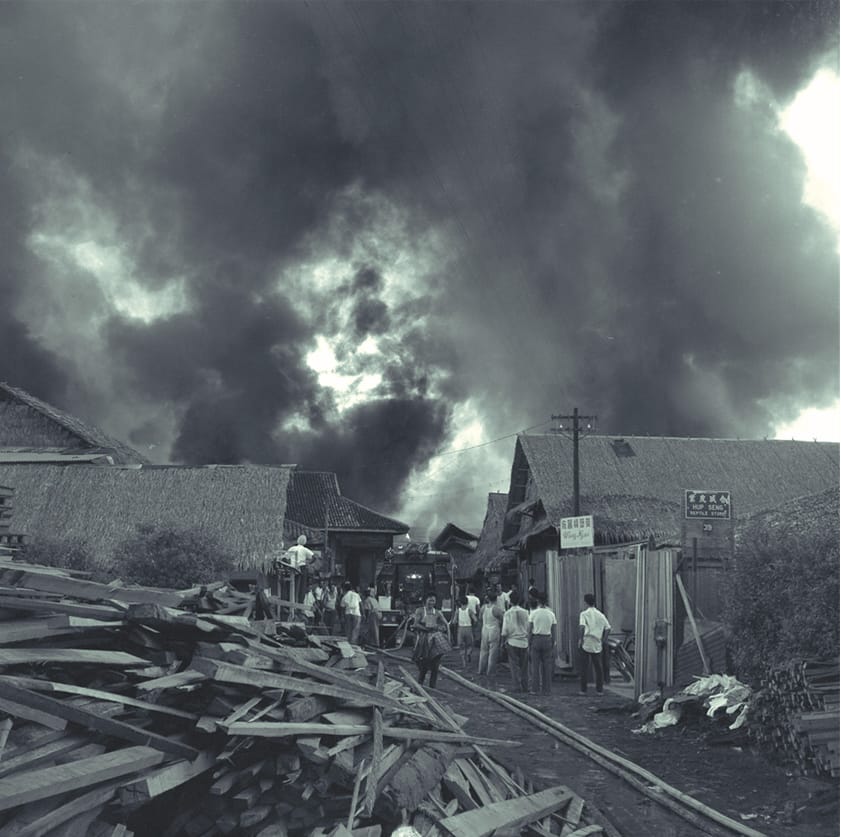
In April 1958, another large fire – noted by the Straits Times as “Singapore’s worst since the war”– razed Kampong Koo Chye in Lorong 3, leaving 2,050 people homeless and at least five dead.24 In the aftermath of the fire, the Singapore Improvement Trust (SIT) acquired seven acres of the Lorong 3 fire site and began construction of 192 low-cost terrace houses for the homeless. The houses were eventually completed by the Housing and Development Board (HDB) in 1960, with 196 out of 329 affected families applying for the new houses.25
Some families had earlier opted to be settled in SIT flats in Kallang and Queenstown, while others chose cash relief in lieu of housing. In 2020, these terrace houses became the first residential units to be returned to the government due to the expiration of their leases.26
The fires in Geylang, along with others in Singapore’s overcrowded kampongs (most notably in Bukit Ho Swee in May 1961), underscored the need for new public housing across the island. In the 1960s, Kallang Basin underwent land reclamation to convert the swampy areas into land that could support new flats, industries and businesses.27 Geylang’s kampong residents were resettled in new housing estates nearby and around Singapore.
Community Spirit
Community ties sometimes strengthen under the pressures of such disasters. After just one year, the volunteers’ fire station in Lorong 27, set up in 1961, had evolved into a communal meeting place and a Mutual Benefit Association formed under the same roof. They later became known as the Geylang Villagers’ Association. The association supported residents with funeral arrangements and even settled family disputes. It also formed its own Teochew opera troupe, which staged a series of charity shows at the Victoria Theatre in 1980 to raise funds for the Geylang East Home for the Aged and the Kuan In Welfare Society in Telok Kurau.28
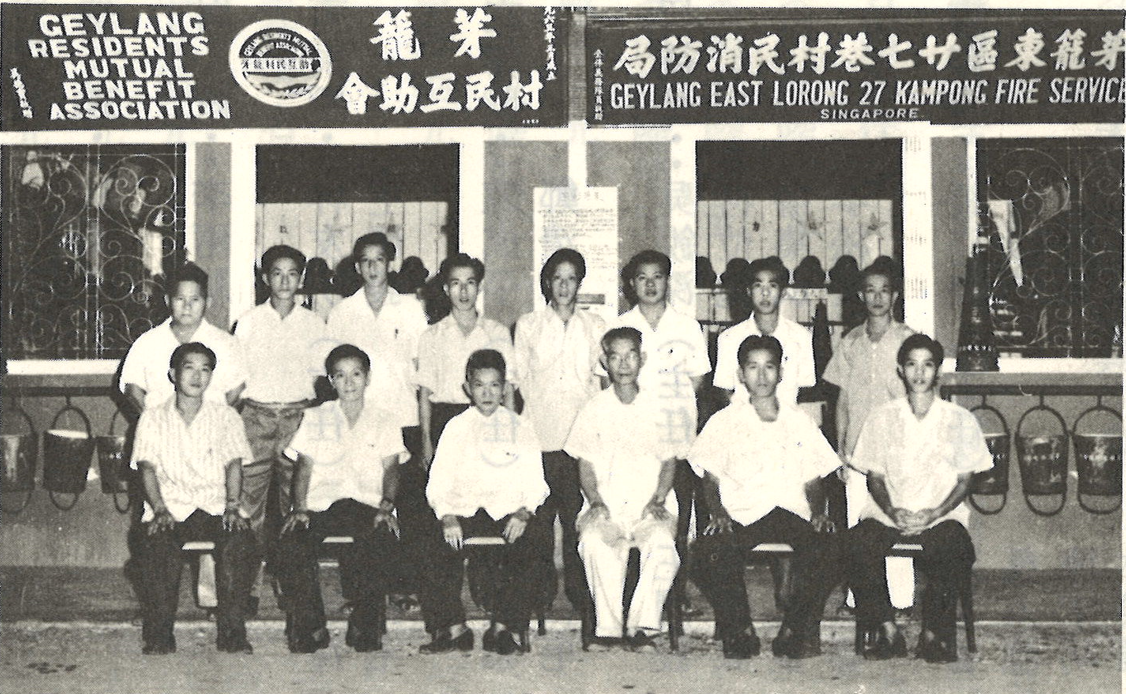
Group photo showing the first members of the Geylang Residents Mutual Benefit Association in 1963. Image reproduced from 芽笼村民公会 Geylang Villagers Association, 芽笼村民公会, 互助会庆祝成立第八, 十四周年暨新会所开幕纪念特刊 [Geylang Villagers Association Mutual Aid Association Commemorative Publication for the 8th and 14th Anniversaries and the Opening of the New Clubhouse] (新加坡: 芽笼村民公会, 1976), 24. (From National Library Singapore, call no. RCLOS q307.095957 YLC).
Geylang’s kampong residents also set up schools for less well-off families. At Lorong 17’s Kampong Sar Kong, the Mun San Fook Tuck Chee temple was not only a place of worship but also the kampong’s social centre. Besides a volunteer firefighting squad, it established a vigilante corps, the Sar Kong Athletic Association and the Mong Yang Chinese School. The small school operated from a room on the right side of the temple with fees kept low to be affordable. In 1962, the school was renovated with donations from kampong residents and alumni totalling over $4,300.29
The Happy Charity School was another Chinese-medium school for impoverished children with a unique origin story that students themselves did not know. “I always thought that the school was named ‘Happy School’ due to its proximity to Happy World. I never knew it was due to the cabaret girls from Happy World,” said former student Tan Chwee Thiam.30
The school was founded in 1946 by cabaret dancers from the nearby Happy World Amusement Park, led by He Yan Na, chairperson of the Happy World Dance Troupe, and fellow dancer Xu Qian Hong. Concerned that children were roaming Geylang’s streets when they should have been in school, He rallied her fellow cabaret girls to raise money to set up a free school.31
It first operated out of a rented shophouse in Geylang Lorong 14 before moving to two shophouses along the same lane. Tan recalled that the school did not look like the other schools near his home, which had fields, as it only had five classrooms. But his parents were of the view that “even though the school’s premises were simple in comparison to other government schools of the time…, the teachers and principal were good”.32
The Happy School building at No. 67 and 69 Geylang Lorong 14. Image reproduced from 王振春 Wang Zhenchun, 根的系列之二 [The Roots Series II] (新加坡: 胜友书局, 1990), 145. (From National Library Singapore, call no. RCLOS 959.57 WZC).
As operating costs rose, the school imposed school fees by 1950, which were kept low at a monthly fee between $2.50 and $3.50, and was renamed “Happy School”. With the growing emphasis on English education in the 1960s and 1970s, enrolment numbers at Happy School and other Chinese-medium schools began to dwindle. In 1979, Happy School closed its doors and donated approximately $400,000 earned from the sale of the school building to 11 schools and grassroots organisations, including the Geylang West Senior Citizens’ Recreation Centre.33
Becoming a Red-light District
Geylang and its lorongs were not known for vice activities until 1959 – ironically due to anti-vice raids in existing red-light districts concentrated in the city area.34
In August 1959, the government launched an island-wide campaign to “stamp out organised prostitution”. Frequent raids took place in known red-light districts such as Desker Road and Johore Road. Vice operators then dispersed to the “thickly-populated residential areas in the suburbs” of Serangoon, Tiong Bahru, Katong and Geylang. By November that year, the authorities found that approximately 100 residential homes in Geylang and Katong had been converted into brothels. To avoid detection, operators moved into these houses posing as husband and wife and claimed that the sex workers moving in with them were their daughters. Pirate taxi drivers solicited customers and ferried them to the brothels.35
Despite crackdowns, the use of Geylang’s private homes as brothels persisted into the 1990s, and by 1998, Geylang was noted as a Designated Red-Light Area.36 The late-night activities of the sex trade raised concerns among residents.
A letter from R. Tan to the Straits Times, published on 5 January 1971, implored the police to act on the excessive noise at night created by brothel customers in Lorong 24 Geylang, which was interrupting his sleep. “Nightly a continuous stream of pirate taxis and other cars come to pick up call-girls. These drivers deliberately sound their high-pitch horns several times to announce their arrival, shattering the peace of the vicinity.”37
Residents were most alarmed when sex workers began to encroach into residential spaces. In August 1971, some residents urged the anti-vice branch of the Criminal Investigation Department to step up the frequency of raids on brothels in Lorongs 18 and 20 “in the wake of growing ‘boldness’ by prostitutes in soliciting their business”, who were “standing in their balconies in very compromising positions”. Residents also sent copies of the letter to the Prime Minister’s Office, their Member of Parliament (MP), the Corrupt Practices Investigation Bureau as well as the Straits Times. Raids were subsequently conducted, resulting in the arrest of several sex workers.38
A similar outcry occurred in 1987, this time in Lorongs 10 and 12. Residents and visitors to the Buddhist temple, Jamiyah Islamic Centre and sports stadium in the vicinity were “irked” by sex workers publicly soliciting in the streets. An official from the Jamiyah Islamic Centre told the Straits Times that “it is very embarrassing because visitors to the centre were sometimes approached by call girls”. He added that their presence also “set a bad influence” on the youth visiting the centre.39
The issue of sex workers “spilling over” from Geylang’s known red-light areas and into residential neighbourhoods persisted. In 2007 and 2008, MP for Marine Parade Fatimah Lateef came up with a plan to “ring-fence” residential areas from vice activity by installing more streetlamps.
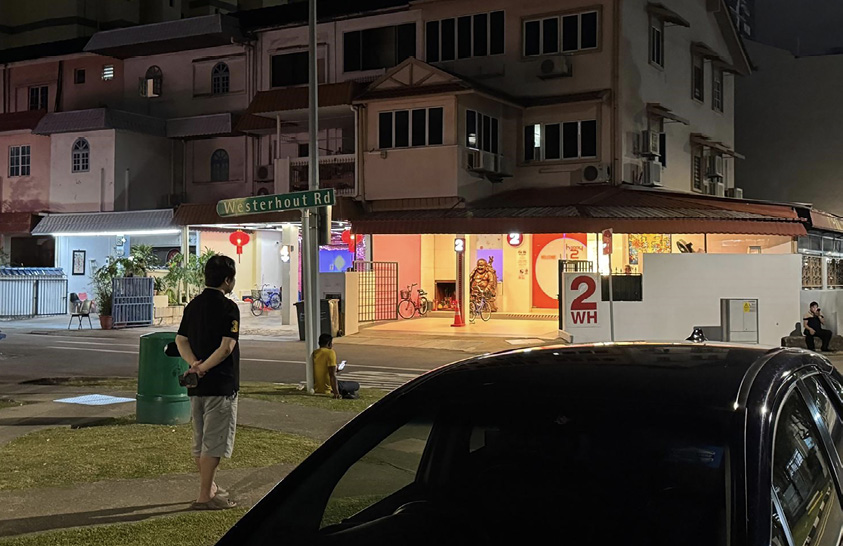
Westerhout Road in Geylang, 2026. Prominent house numbers are a subtle form of marketing in Geylang. Photo by Jimmy Yap.
By April 2008, these were installed in the backlanes of Lorongs 24, 24A, 34 and 36, with plans for more in the lanes between Lorongs 20 and 44. After two years and 96 new streetlamps, she noted that the situation had improved. “The streetwalkers and foreign workers who used to congregate in the backlanes are gone. Even littering has been reduced,” she said.40
An Ever-changing Urban Landscape
In the 1990s, Geylang’s urban environment and identity underwent significant changes when a wave of new private property developments swept through the area. Developers acquired affordable plots of land where old houses stood, demolished them and built new condominiums and budget hotels in their place.41
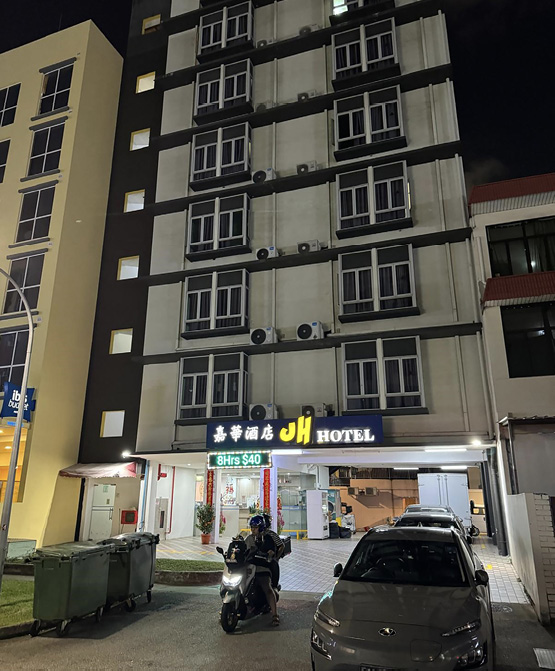
A hotel in Geylang, 2026. Some hotels in Geylang offer hourly room rates. Photo by Jimmy Yap.
Clan associations that had been affected by redevelopment and rising property prices at their original premises also began moving into Geylang after the URA rezoned a 50-hectare area as a “hub of growth for cultural activities by clans and other civic groups”. This space now contains the largest concentration of clan associations in Singapore, including the Huang Clan Association and the 168-year-old Char Yong (Dabu) Association.42
A similar phenomenon happened in 2009, but this time it was Chinese temples moving into the neighbourhood. “They’re popping up everywhere, like kopitiam. I have never seen so many temples here in my life,” longtime Geylang resident Khoo Hiang Lee told the Straits Times.43
It might have seemed odd that places of worship were moving into a red-light district, but many temple owners and devotees told reporters that they were not bothered about sharing the neighbourhood with sex workers since most temples closed in the evenings. “We don’t see them, they don’t see us. It works,” said Wu Ser Hock, a volunteer at the Gan Tian Da Di Temple on Lorong Bachok.44
In 2015, the URA rezoned the 14-hectare stretch from Lorongs 4 to 22 from residential/institution to commercial/institution use.45 This meant that no new residential projects could be developed along this stretch, in hopes of “better manag[ing] issues that had been arising from conflicting uses in the locale”.46 The new residential projects that were approved before the change were the last tranche of residential buildings developed in the area. As a result, Geylang saw a sharp decline in new private residential project launches in the ensuing years. According to a CNA report, an average of 2.9 projects were launched between 2017 and 2024 – an almost 70 percent drop from the average of 10.25 projects between 2008 and 2015.47
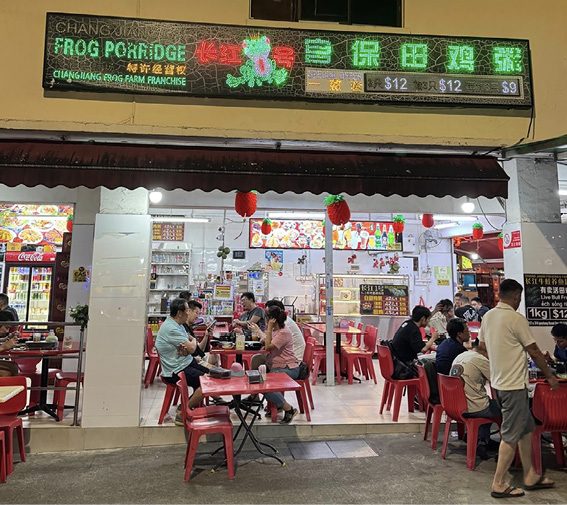
Frog porridge is a popular dish in Geylang, 2026. Photo by Jimmy Yap.
However, in recent years, change has been sweeping through Geylang yet again. The stigma of a red-light district still lingers, with complaints about noise and other disturbances, but residents and shop owners have noticed fewer sex workers in the streets. Instead, high-rise condominiums surround the few old houses that still remain, and owners of old shophouses must struggle with the decision of either investing in the maintenance of their ageing buildings or selling to a growing pool of eager buyers.48
Just as Geylang has transformed from a riverine village to a thriving residential suburb, its urban landscape continues to evolve till now, and one day, it might finally shed its reputation as a red-light district. But whether gentrification will completely change Geylang, as it did previously red-light areas of Keong Saik Road and Bugis Street, remains to be seen.
About the Author
Andrea Kee is a Librarian with the National Library Singapore, and works with the Singapore and Southeast Asia collections. Her responsibilities include collection management, content development as well as the provision of reference and research services.
Endnotes
1 Urban Redevelopment Authority, A Future with a Past: Saving Our Heritage (opens in new tab) (Singapore: Urban Redevelopment Authority, 1991), 22. (From National Library Singapore, call no. RSING 363.69095957 FUT); “Secondary Settlements,” Urban Redevelopment Authority, last updated 26 June 2026, https://www.ura.gov.sg/conservation/conservation-areas/secondary-settlements/ (opens in new tab).
2 Survey Department, Singapore Plan of the British Settlement of Singapore by Captain Franklin and Lieut. Jackson (opens in new tab), 1828, map. (From National Archives of Singapore, accession no. GM000014)
3 Victor R. Savage and Brenda S.A. Yeoh, Singapore Street Names: A Study of Toponymics (opens in new tab), 4th ed. (Singapore: Marshall Cavendish Editions, 2023), 348. (From National Library Singapore, call no. RSING 915.9570014 SAV-[TRA])
4 HOL Content Curators LLP, Stories from the Kallang River: Connecting People, Places and Memories (opens in new tab) (Singapore: Urban Redevelopment Authority, 2025), 9. (From PublicationSG)
5 Urban Redevelopment Authority, Secondary Settlements: Conservation Guidelines for Geylang Conservation Area (opens in new tab) (Singapore: URA, 1991), 6. (From National Library Singapore, call no. RSING 363.69095957 SEC); Savage and Yeoh, Singapore Street Names (opens in new tab), 348.
6 Lee Kip Lin, The Singapore House, 1819–1942 (opens in new tab), ed. Gretchen Liu (Singapore: Marshall Cavendish Editions; National Library Board, 2015), 27. (From National Library Singapore, call no. RSING 728.095957 LEE); Savage and Yeoh, Singapore Street Names (opens in new tab), 350.
7 Lisa Edmondson, Tatyana Kildisheva and Joanne Pasquale, Singapore Shophouse Walks: Joo Chiat, Katong, Geylang (opens in new tab) (Singapore: Kildi Photo, 2021), 147. (From National Library Singapore, call no. RSING 728.3 KIL); “Geylang.”
8 The electric tramway, which was first introduced in 1902, had extended to Geylang by 1905. The motor trolleybus service began plying Geylang Road in 1929. See Lee, The Singapore House, 1819–1942 (opens in new tab), 119; and Norman Edwards, , The Singapore House and Residential Life, 1819–1939 (opens in new tab) (Singapore: Talisman Publishing Pte Ltd, 2017), 77–78. (From National Library, call no. RSING 728.095957 EDW)
9 Edwards, The Singapore House and Residential Life, 1819–1939 (opens in new tab), 68, 78.
10 Bailyne Sung, “Geylang West (opens in new tab)”, Straits Times, 5 January 1971, 7. (From NewspaperSG); Survey on 100 Families in a Part of Geylang Area Singapore 14 (opens in new tab) (n.p.: n.p., 1959–1960), 1, 35–36. (From National Library Singapore, call no. RCLOS 306.85095957 SUR)
11 Peter Hill, “400 in Hunt for Gunmen (opens in new tab),” Singapore Free Press, 18 September 1950, 1; “'Shocking’ Geylang Slums Uncovered (opens in new tab), 19 September 1950, 5. (From NewspaperSG)
12 Lim Tin Seng, “Land From Sand: Singapore’s Reclamation Story (opens in new tab),” BiblioAsia 13, no. 1 (April–June 2017), 16–23.
13 R. Chandran and Abdul Fazil, “2,000 Homeless (opens in new tab),” Straits Budget, 20 November 1963, 17; “Relief And After (opens in new tab),” Straits Times, 8 April 1958, 6. (From NewspaperSG)
14 Steve Neoh, “The Village of Long Ago (opens in new tab),” Singapore Free Press, 22 July 1954, 5. (From NewspaperSG); Chandran and Fazil, “2,000 Homeless (opens in new tab).”
15 Chia Soon Ann, oral history interview by Ang Siew Ghim, 19 March 1985, transcript (opens in new tab) and MP3 audio, Reel/Disc 1 of 47, National Archives of Singapore (accession no. 000465 (opens in new tab)), 1–4.
16 Hong Yihan 洪毅瀚, Xiang qing ci yun: Shagang Cun he Wan shan fu de ci de liu bian yu chuan cheng 乡情祠韵: 沙冈村和万山福德祠的流变与传承 (opens in new tab) [A kampong and its temple: Change and tradition in Kampong Sar Kong and the Mun San Fook Tuck Chee] (Singapore: 万山福德祠, 2016), 42–43. (From National Library Singapore, call no. Chinese RSING 203.5095957 HYH)
17 Chia Soon Ann, oral history interview by Ang Siew Ghim, 24 December 1985, transcript (opens in new tab) and MP3 audio, Reel/Disc 28 of 47, National Archives of Singapore (accession no. 000465 (opens in new tab)), 352.
18 “Secret Society Raid (opens in new tab),” Singapore Free Press, 15 August 1923, 99. (From NewspaperSG); Chia Soon Ann, oral history interview by Ang Siew Ghim, 1 April 1985, transcript (opens in new tab) and MP3 audio, Reel/Disc 26 of 47, National Archives of Singapore (accession no. 000465 (opens in new tab)), 320.
19 Chia (opens in new tab), oral history interview, 24 December 1985, Reel/Disc 28 of 47, 354–55.
20 Cheong Yip Seng, “‘Smugglers' Haven Gives Way to Factories (opens in new tab),” Straits Times, 8 February 1970, 10. (From NewspaperSG)
21 Eric Charles Pemberton Paglar, oral history interview by Kelvin Kwek, 8 October 2003, MP3 audio, Reel/Disc 16 of 64, National Archives of Singapore (accession no. 002798 (opens in new tab)), 00:35–00:43, 01:19–01:24.
22 “Lorong’s ’Do It Yourself’ Firemen (opens in new tab),” Straits Times, 4 January 1960, 6. (From NewspaperSG)
23 Jospeh Yeo, “Fire! The Victims Tell Their Stories: Widow Saved Iron But Forgot $800 Hoard (opens in new tab),” Singapore Free Press, 17 July 1953, 3. (From NewspaperSG)
24 “Blaze Death Toll Up (opens in new tab),” Straits Times, 7 April 1958, 1; Alias Rahim, “Minister Yong Will Hand Over Keys of 203 New Houses to Fire Victims (opens in new tab),” Singapore Free Press, 30 December 1960, 7. (From NewspaperSG)
25 Loh Kah Seng, Squatters into Citizens: The 1961 Bukit Ho Swee Fire and the Making of Modern Singapore (opens in new tab) (Singapore: Asian Studies Association of Australia in association with NUS Press and NIAS Press, 2013), 115–16. (From National Library Singapore, call no. RSING 307.76095957 LOH)
26 “$1-Mil. Housing Project (opens in new tab),” Singapore Free Press, 21 October 1959, 7; “Fire Victims to Get $90 Each,” Straits Times, 20 March 1959, 6. (From NewspaperSG); Michelle Ng, “Geylang Landed Homes to Make Way for HDB Flats,” Straits Times, 16 November 2020, https://www.straitstimes.com/singapore/housing/residents-bid-goodbye-to-geylang-lorong-3-homes-the-first-leasehold-residential (opens in new tab).
27 Loh, Squatters into Citizens (opens in new tab), 3–4; “Kallang Basin Area to Be Developed (opens in new tab),” Straits Budget, 23 February 1966, 6. (From NewspaperSG)
28 Yalong cun min gong hui芽笼村民公会, Hu zhu hui qing zhu cheng li di ba, shi si zhou nian ji xin hui suo kai mu ji nian tei kan 互助会庆祝成立第八, 十四周年暨新会所开幕纪念特刊 (opens in new tab) [Geylang Villagers Association and Mutual Aid Society commemorative publication for the 8th and 14th anniversaries and the opening of the new clubhouse] (新加坡: 芽笼村民公会, 1976), 16. (From National Library Singapore, call no. Chinese RCLOS 307.095957 YLC); “Association Caters to Both Joy and Sorrow (opens in new tab),” Straits Times, 8 May 1987, 16; Elena Chong, “A Driver Was the Villain, and a Shop Girl Played a Heroine… (opens in new tab),” Straits Times, 9 January 1980, 13. (From NewspaperSG)
29 Hong, Xiang qing ci yun (opens in new tab), 52–54; HOL Content Curators LLP, Stories from the Kallang River (opens in new tab), 21.
30 Tan Chwee Thiam, oral history interview by Yun Lim Ying Ling, 10 January 2010, MP3 audio, Reel/Disc 1 of 3, National Archives of Singapore (accession no. 002650 (opens in new tab)), 06:44–07:12. [Note: The interview was conducted in Mandarin.]
31 Adeline Foo, “Beneath the Glitz and Glamour: The Untold Story of the ‘Lancing’ Girls (opens in new tab),” BiblioAsia 12, no. 4 (January–March 2017), 2–7.
32 Tan (opens in new tab), oral history interview, 10 January 2010, Reel/Disc 1 of 3, 08:10–08:28.
33 Nur Syahiidah Zainal, “School’s Out... Forever (opens in new tab),” Straits Times, 16 August 2021, 8–9. (From NewspaperSG); Wang Zhenchun王振春, Gen de xi lie zhi er 根的系列之二 (opens in new tab) [The Roots series part two] (新加坡: 胜友书局, 1990), 150. (From National Library Singapore, call no. Chinese RCLOS 959.57 WZC)
34 David Brazil, Street Smart: Singapore (opens in new tab) (Singapore: Times Books International, 1991), 174–76. (From National Library Singapore, call no. RSING 959.57 BRA-[HIS])
35 R.G. Pillai, “Govt. Blitz on Organised Vice (opens in new tab),” Straits Times, 23 August 1959, 11; “Callgirls Remove to Homes (opens in new tab),” Singapore Free Press, 16 November 1959, 5; Lawrence Basapa, “When Callgirls Hired the Butterfly (An All-Girl) Gang for Protection (opens in new tab),” Straits Times, 19 April 1970, 4. (From NewspaperSG)
36 “Three Fined for Letting House Be Used As Brothel (opens in new tab),” New Paper, 15 June 1990, 16; “Couple in Dock Over Brothel (opens in new tab),” Straits Times, 9 September 1990, 15; Roderick Chia and Jasbir Singh, “Geylang Hotels Report 50% Dip in Earnings (opens in new tab),” Straits Times, 11 January 1998, 28. (From NewspaperSG)
37 R. Tan, “Sounds of Vice Far Into the Night (opens in new tab),” Straits Times, 5 January 1971, 21. (From NewspaperSG)
38 “Call for More Raids on Geylang Brothels (opens in new tab),” Straits Times, 11 August 1971, 23; “Anti-vice Squad Raids After Complaints (opens in new tab),” Straits Times, 22 August 1971, 6. (From NewspaperSG)
39 Ronald Wong and Tham Kok Wing, “Vice Trade in Geylang Irks Residents and Public (opens in new tab),” Straits Times, 4 May 1987, 18. (From NewspaperSG)
40 Chong Chee Kin and Sujin Thomas, “Geylang Residents Act to Keep Vice Trade at Bay (opens in new tab),” Straits Times, 19 April 2008, 2; “Residents ‘Reclaim’ Geylang Streets (opens in new tab)” New Paper, 19 April 2008, 5; Nur Dianah Suhaimi, “Bright Idea Drives Out Sleaze From Geylang's Dark Alleys (opens in new tab),” Straits Times, 11 October 2009, 9. (From NewspaperSG)
41 Stephanie Yeo, “Geylang Getting Hot Among Developers and Buyers (opens in new tab),” Straits Times, 23 April 1995, 2; Lynn Seah, “Change Rolls Along the Lorongs (opens in new tab),” Straits Times, 8 November 1998, 8. (From NewspaperSG)
42 Rachel Tan, “Some Clan Groups Hesitant About Relocating to Geylang (opens in new tab),” Straits Times, 25 January 1993, 20. (From NewspaperSG); Ryan Tan, “Clans of Geylang: The Fight for Survival and Revival (opens in new tab),” Straits Times, 5 July 2025, https://www.straitstimes.com/singapore/clans-of-geylang-the-fight-for-survival-and-revival (opens in new tab).
43 Yen Feng and Feng Zengkun, “Religion Finds a Place in Red-light Area (opens in new tab),” Straits Times, 20 November 2009, 28. (From NewspaperSG)
44 Yen and Feng, “Religion Finds a Place in Red-light Area (opens in new tab).”
45 “No. 1811 - Planning Act – Notice under Rule 7(a),” Government Gazette, Electronic Edition, 23 July 2015, https://assets.egazette.gov.sg/2015/Government%20Gazette/Notices%20under%20other%20Acts/1811.pdf (opens in new tab).
46 Kalpana Rashiwala, “No More New Residential Projects in 14 Ha Area of Geylang (opens in new tab),” Business Times, 14 January 2015, 2. (From NewspaperSG)
47 Renald Loh, “The Big Read: Infamous as a Red-light District, Geylang Gets a Partial Makeover But Stigma Lingers,” CNA, 29 July 2024, https://www.channelnewsasia.com/today/big-read/big-read-geylang-red-light-district-makeover-stigma-4508571 (opens in new tab).
48 Loh, “The Big Read”; Ryan Tan, “From Temples to Towers: Old Memories Collide With New Money in Geylang,” Straits Times, 5 July 2025, https://www.straitstimes.com/singapore/from-temples-to-towers-old-memories-collide-with-new-money-in-geylang (opens in new tab).